 BambooForge Labs
PrestaShop Connector | PrestaShop Odoo Integration
Two-way PrestaShop 8.0 to 9.0 integration: products, customers, orders, refunds and stock, with signed webhooks and order totals that match.
Available for Odoo 16.0, Odoo 17.0, Odoo 18.0, Odoo 19.0, Odoo 20.0. Technical name bambooforge_prestashop_connector.
Transcript of the walkthrough (Odoo 20)
PrestaShop Connector / PrestaShop Odoo Integration. Two-way PrestaShop 8.0 to 9.0 integration: products, customers, orders, refunds and stock, with signed webhooks and order totals that match. The connector keeps Odoo and PrestaShop in sync over the official PrestaShop Webservice API. It covers: In the next few minutes: matching the storefront total, then tested against the real thing, then step 2 — create the connection in odoo, then step 3 — first sync (dry-run, then live), then order status mapping.
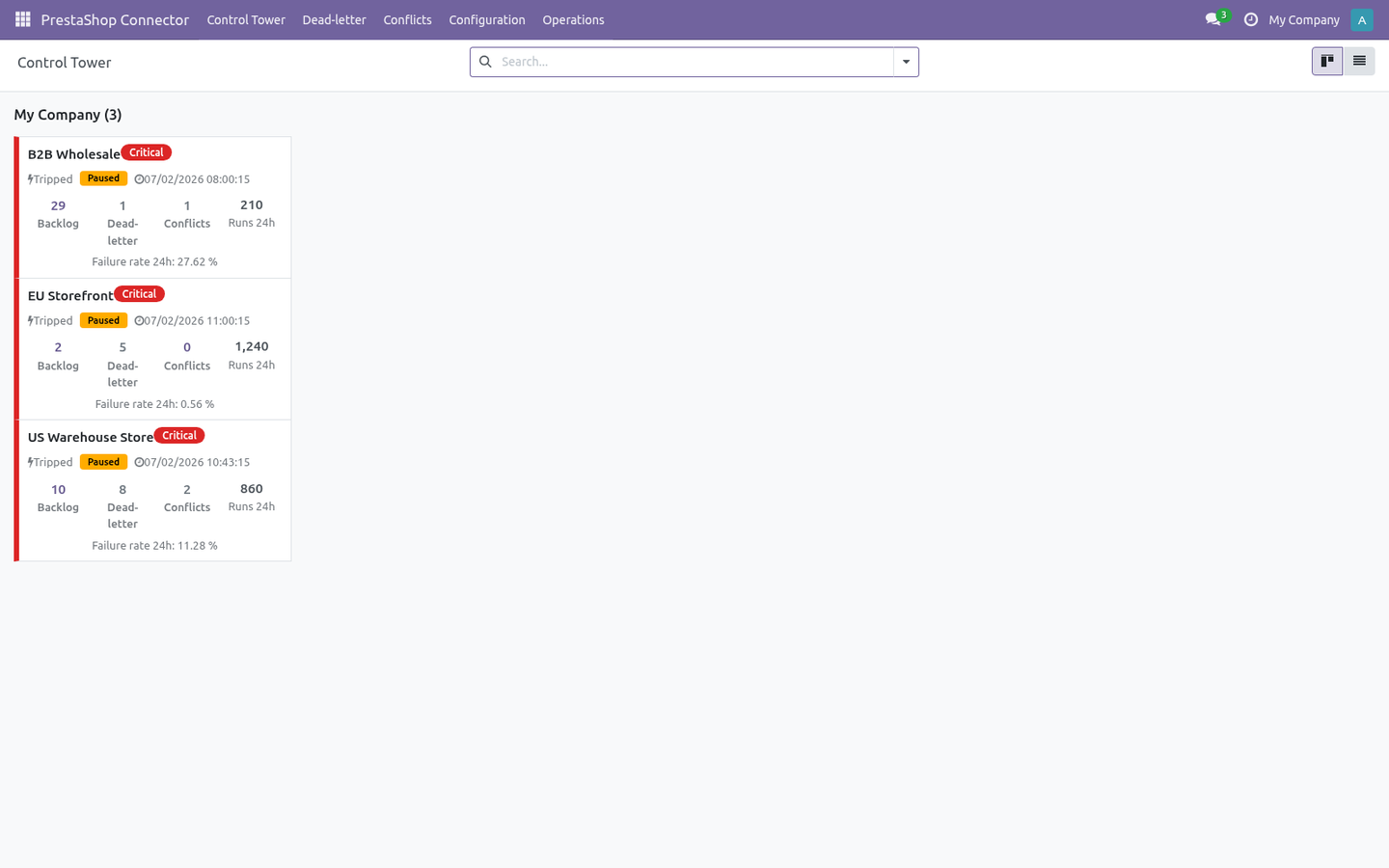
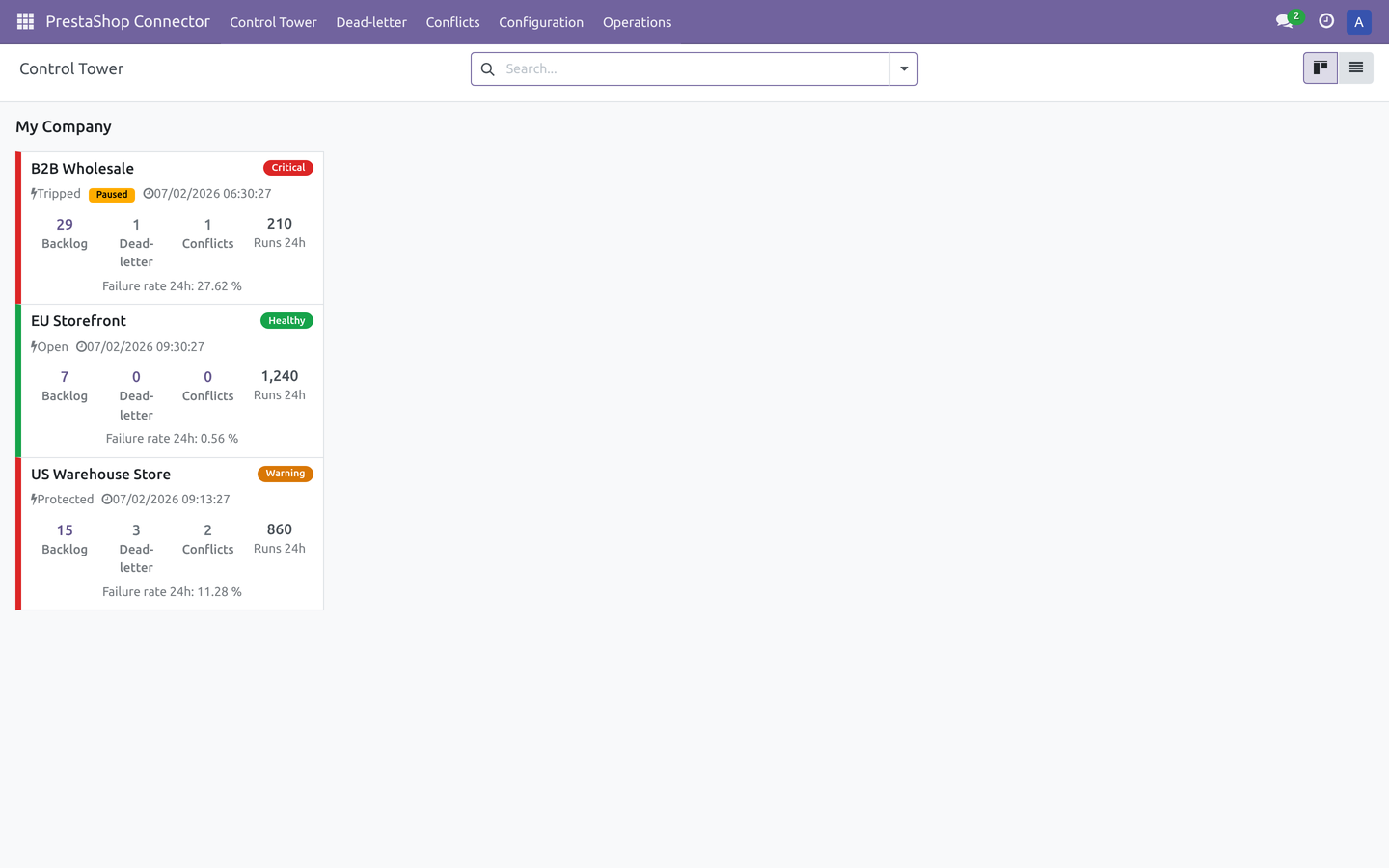
Then what this app deliberately does not do, so you can tell before you buy whether it fits. Everything lives under PrestaShop Connector then Control Tower then Dead-letter then Conflicts. Matching the storefront total. A storefront charges shipping and grants discounts outside the product lines, so an order rebuilt from those lines alone is worth less than the order the customer paid for: the sale looks smaller than it was and never reconciles against the platform payout.
the shipping charge is imported as its own order line, on a clearly named service product; whatever still separates Odoo from the platform total — platform discounts, fees, rounding — is posted as a single adjustment line rather than dropped; the platform total and the remaining difference are stored on the order and shown on its connector tab; an order that still does not match within Total Tolerance raises a validation warning, so the gap is visible instead of silent. With Match Storefront Totals on the instance (on by default): Tested against the real thing. Automated tests run against a bundled mock store on every release; the line below is the part no mock can give you - the connector pointed at the real platform, with real records and real order totals. Tested for real against PrestaShop 8 and PrestaShop 9.1.5: on 8, 19 products and 19 real orders came into Odoo in 24 sync jobs with 0 errors, and the two defects only a live store reveals - a missing unit of measure on imported order lines and a 7.00 shipping fee left off the total - were fixed; on a freshly installed 9.1.5 the same connector connected and brought in 19 products, 2 customers and 5 orders in 26 jobs with 0 errors, order totals and SKUs matching the store.
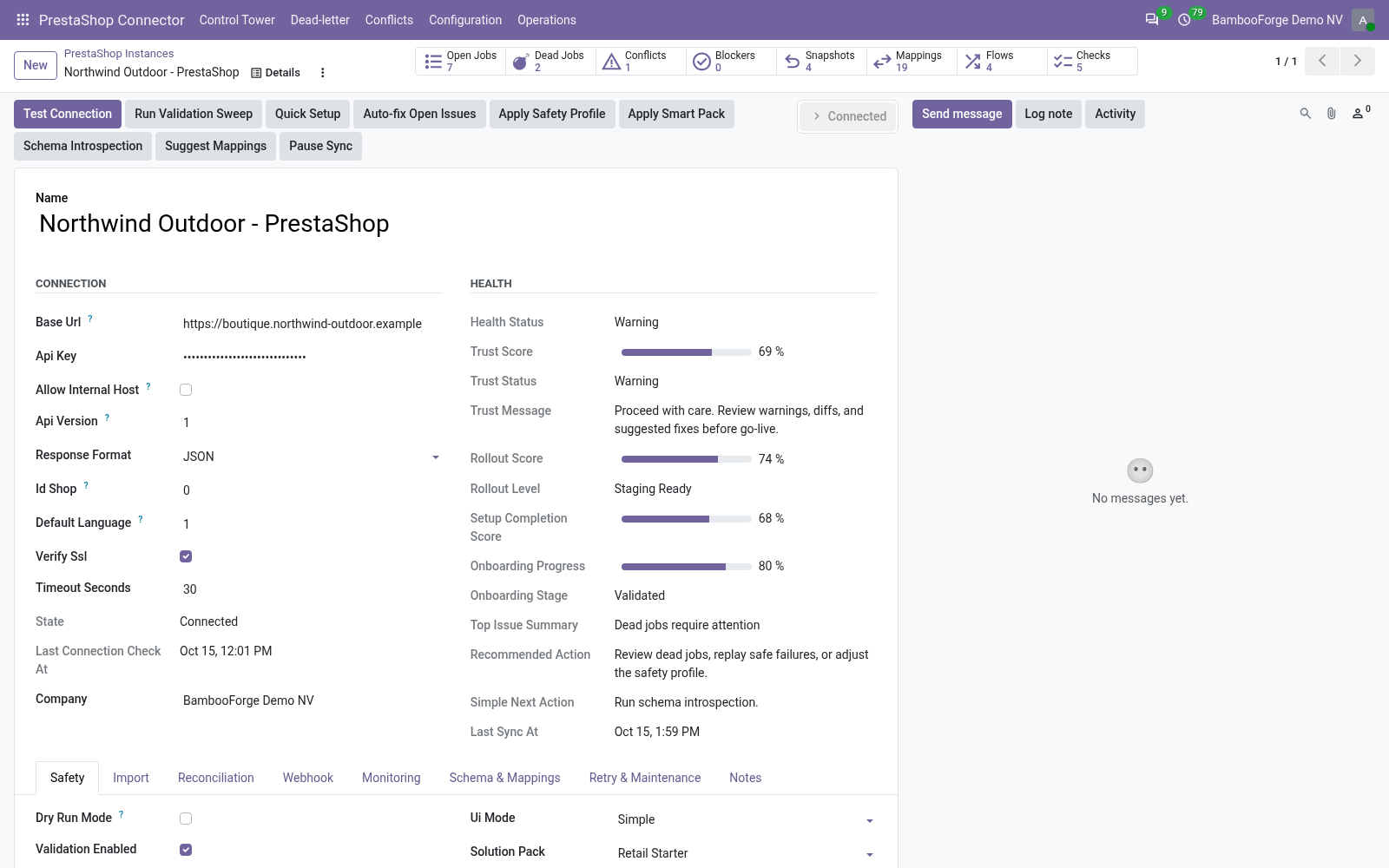
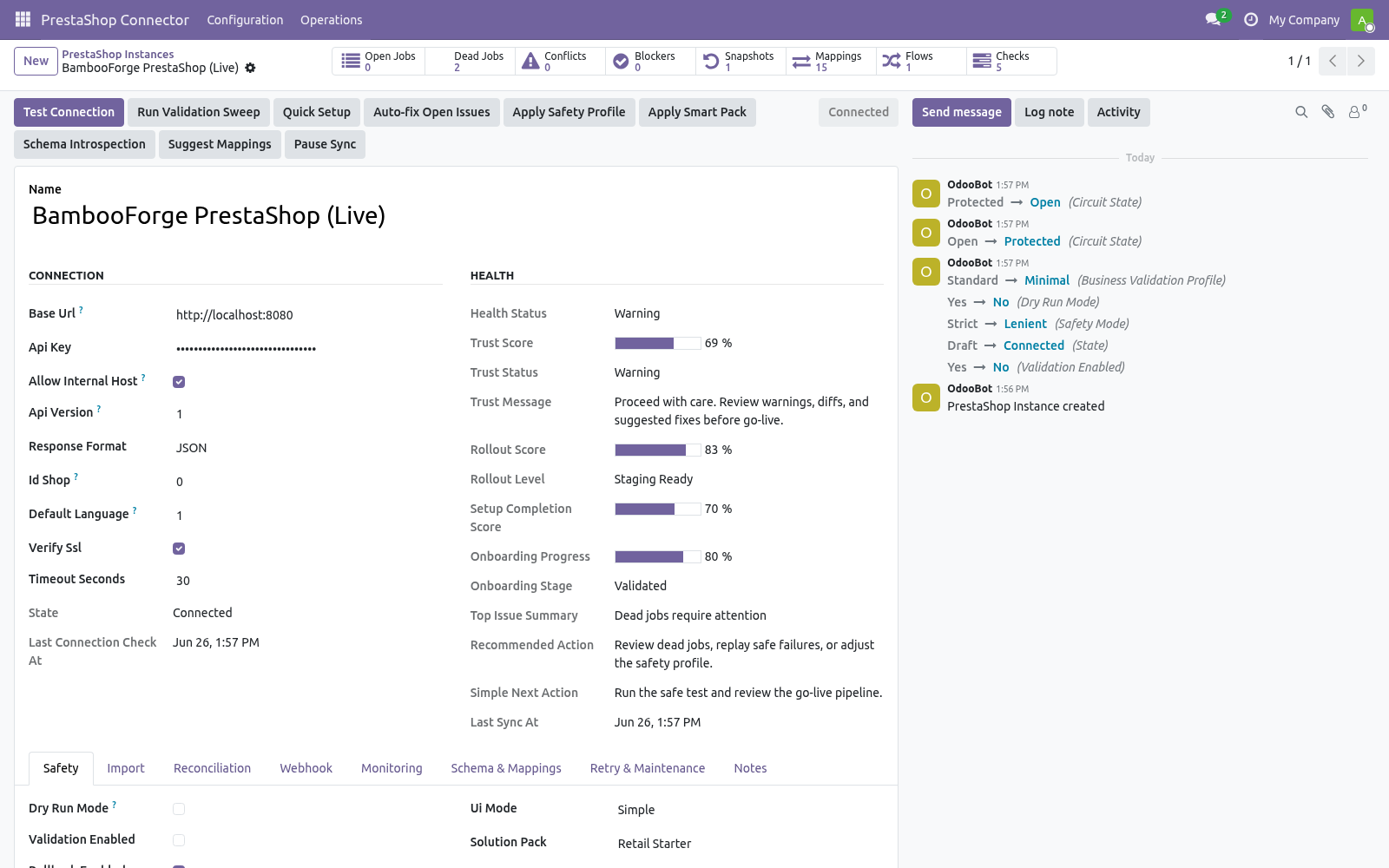
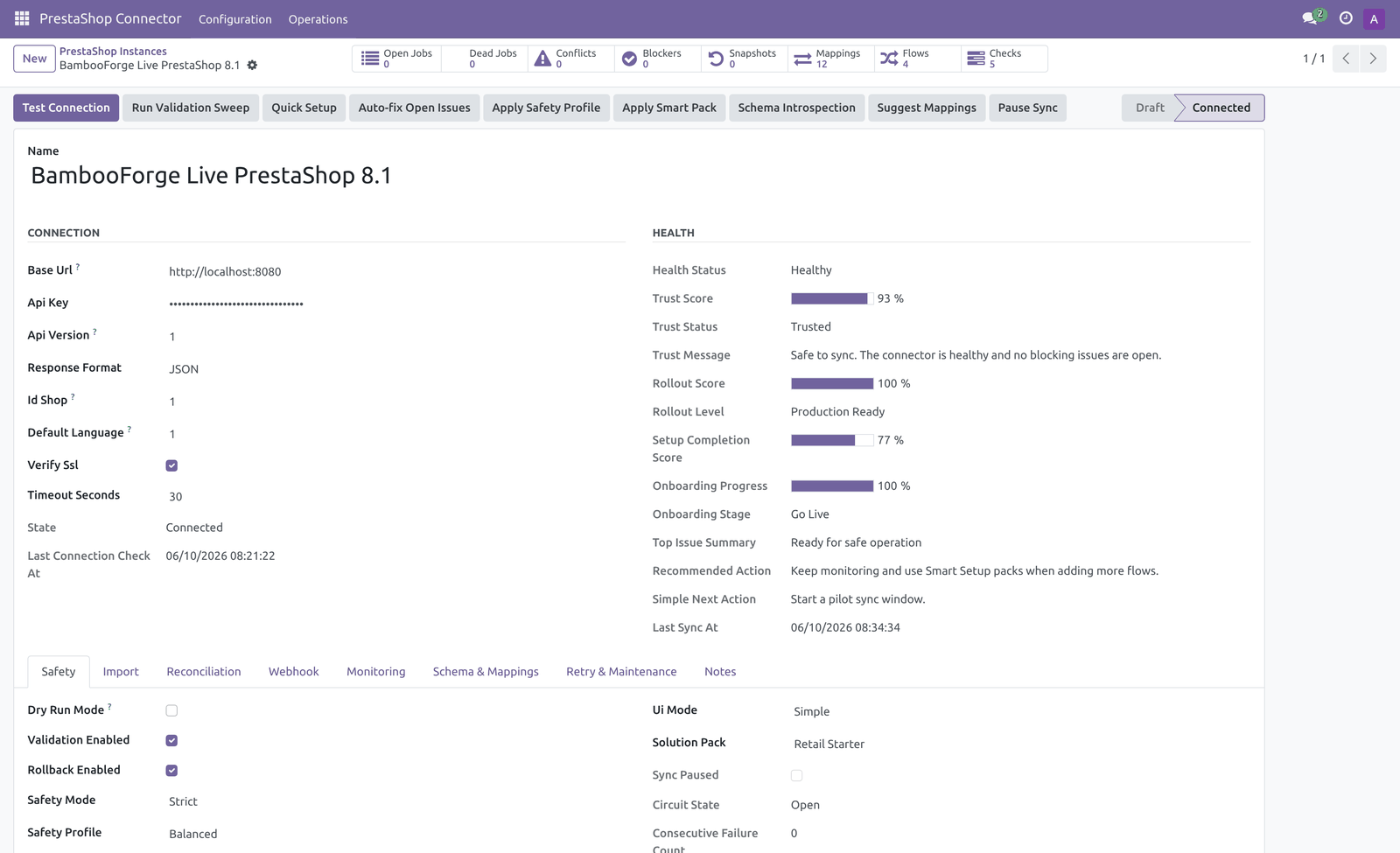
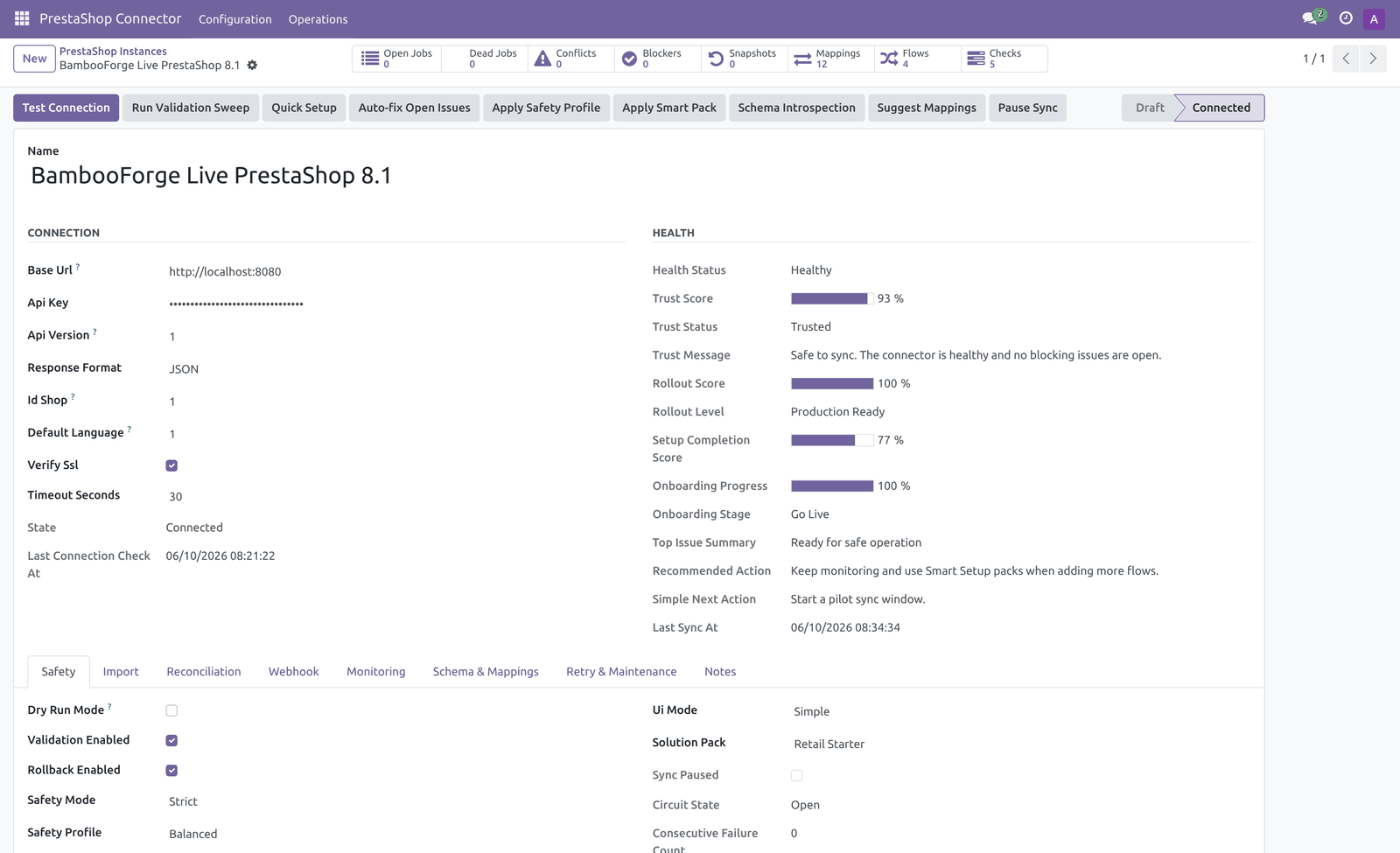
Step 2 — Create the connection in Odoo. Open PrestaShop ▸ Configuration ▸ Instances and create a record. Then click Test Connection. A green Connected state means the key and URL are correct, and the default order-state mapping is seeded automatically on first success.
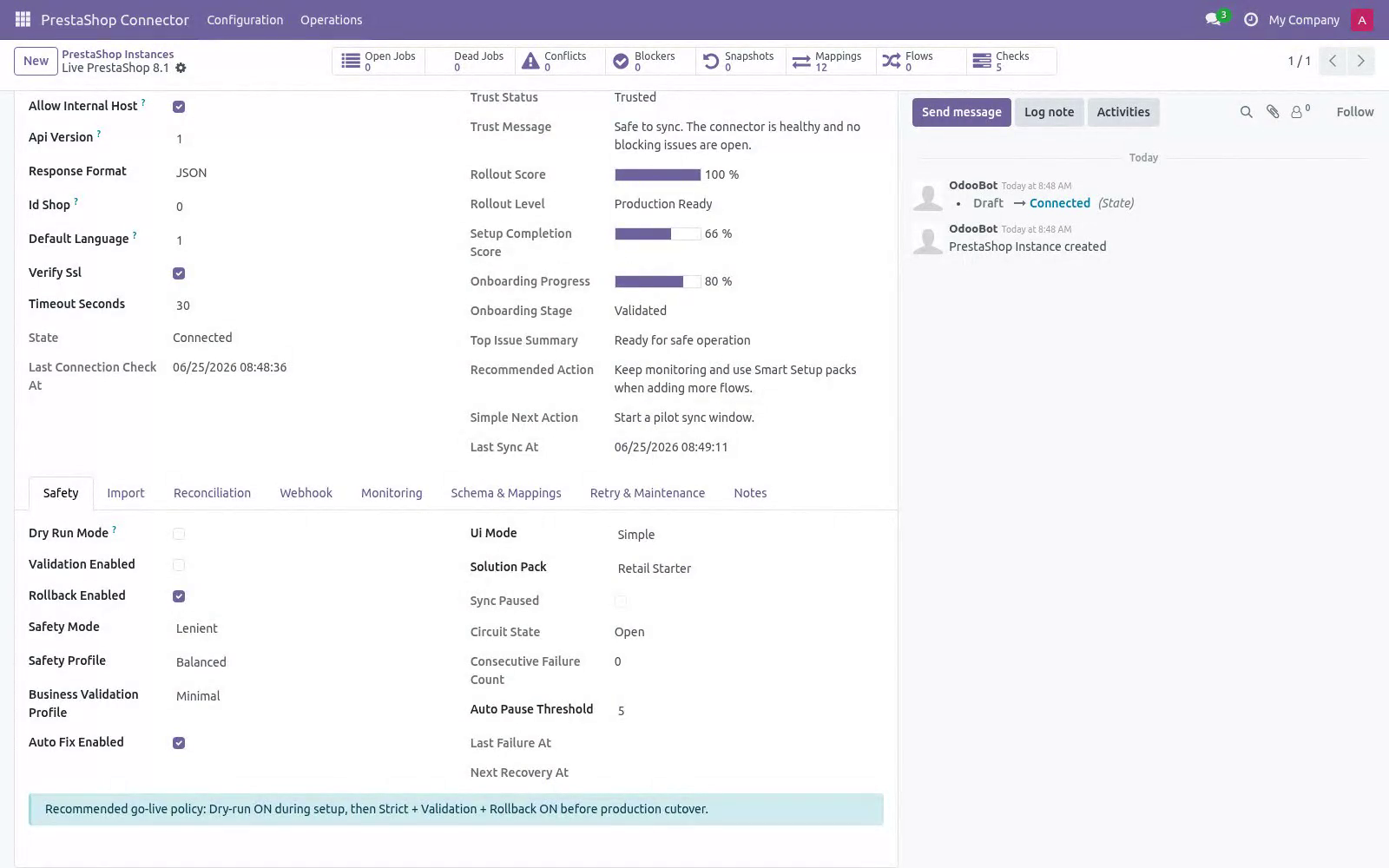
If it fails, the exact error is shown on the form and recorded in Logs (see Troubleshooting). Step 3 — First sync (dry-run, then live). New instances start with Dry-run ON. In dry-run, import and delete jobs simulate writes: instead of changing data they produce Validation Results you can review under PrestaShop ▸ Operations ▸ Validation Results.
This lets you confirm what would happen before anything is written. 1. On the instance, click Import Products (and/or Import Customers, Import Orders). This enqueues jobs; it does not block the UI.
2. Jobs are processed by the PrestaShop Queue Processor scheduled action (every minute), or immediately if you open Operations ▸ Queue Jobs and run them. 3. Review Validation Results while still in dry-run.
4. When satisfied, open the instance, turn Dry-run OFF, and run the imports again to write the records for real. Order status mapping. PrestaShop returns each order's state as a numeric id (its current_state), not a slug.
Under Configuration ▸ Order State Mappings each instance gets a default table (seeded on first successful Test Connection) that decides what happens to the Odoo sale order when an order arrives in a given PrestaShop state: Change any row to Ignore (do nothing), Keep draft, Confirm sale order or Cancel sale order. Unknown/custom state ids default to Ignore, so a state you have not mapped never triggers a destructive transition. Add a row for any custom state your shop introduces (use the exact PrestaShop numeric state id). Field mapping & customization Field Mappings (Configuration) map PrestaShop fields to Odoo fields per model.
Use Generate suggested mappings on the instance to seed the business-critical ones, then adjust. The mapping board flags fields that need attention. Schema Fields lists the discovered PrestaShop fields per resource. Run Schema Introspection on the instance to refresh it from your live store (or from the bundled mock when evaluating).
Stock / images / tax are opt-in toggles on the instance, all off by default; turn on only what you need: Automation (scheduled actions & webhooks). The module ships these scheduled actions (Settings ▸ Technical ▸ Scheduled Actions): Delivery URL: https://<your-odoo-domain>/prestashop/webhook Signature header: X-Prestashop-Signature — an HMAC-SHA256 hex digest of the raw request body, keyed with the instance Webhook Secret (admin-only field on the instance). Turn on Auto import / Auto reconcile per model on the instance to let the scheduled actions keep things in sync hands-free. Safety features Dry-run mode — simulate writes and review Validation Results before going live (field Dry-run, ON by default).
Business validation profiles — Minimal / Standard / Strict gate risky writes (field Business Validation Profile). Safety profiles — Conservative / Balanced / Aggressive set sensible defaults for dry-run, delete strategy and batch size in one click. Resilient queue — every remote action is a job with retry and exponential back-off, and a dead-letter queue for exhausted jobs. Circuit breaker — after repeated failures (or an auth/config error) an instance auto-pauses (Tripped); the Auto Recover action reopens it once the store responds again, or click Resume.
Rollback snapshots — when enabled, imports capture a snapshot so you can undo a batch from Operations ▸ Rollback Snapshots. SSRF guard — the connector refuses internal/loopback/private/reserved hosts; Base URL must be a public http(s) address. Signed webhooks with replay protection — deliveries must carry a valid HMAC-SHA256 signature and a fresh emitted_at; duplicates are rejected. Where PrestaShop shows up in Odoo.
The connector stays out of the way on records that have nothing to do with PrestaShop: Sales orders - the PrestaShop tab, Queue PrestaShop Export and PrestaShop Binding appear only on orders that came from PrestaShop, are bound to PrestaShop, or belong to a customer bound to PrestaShop. Products and contacts - the PrestaShop tab appears once an active PrestaShop connection exists; the PrestaShop Binding button inside it appears once the record is bound. List views, the sync queue and the control tower are unchanged. Troubleshooting.
For anything else, Operations ▸ Logs records every API call, payload and error with a timestamp. Now the part most videos leave out: what this does not do. The connector reads products, customers, orders and order slips from your store and writes the corresponding Odoo records. The API key and webhook secret are stored in admin-only fields.
In scope today: product/customer/order import, product export, numeric order-state mapping, refund (order slip) discovery, multistore/multilang flattening, scheduled sync, signed webhooks. Out of scope / best-effort: tax auto-matching (off by default, name-based, never auto-creates taxes); multi-warehouse stock routing; subscription/booking order types. The complete manual is at docs dot bambooforge dot dev, the demo database is linked from the store page, and support answers within twenty-four hours. Links are in the description.
Transcript of the walkthrough (Odoo 19)
PrestaShop Connector / PrestaShop Odoo Integration. Two-way PrestaShop 8.0 to 9.0 integration: products, customers, orders, refunds and stock, with signed webhooks and order totals that match. The connector keeps Odoo and PrestaShop in sync over the official PrestaShop Webservice API. It covers: In the next few minutes: matching the storefront total, then step 2 — create the connection in odoo, then step 3 — first sync (dry-run, then live), then order status mapping, then field mapping & customization.
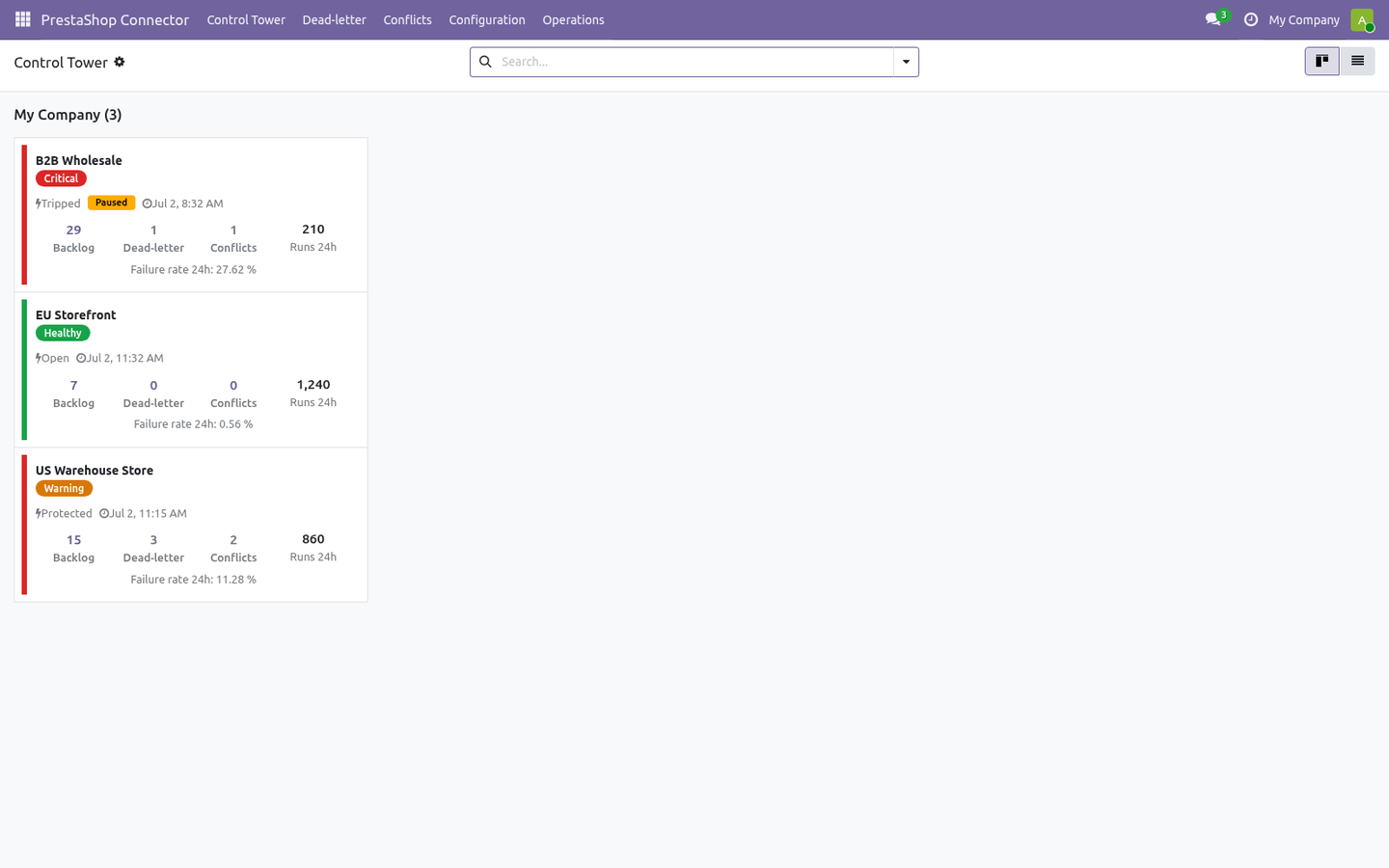
Then what this app deliberately does not do, so you can tell before you buy whether it fits. Everything lives under PrestaShop Connector then Control Tower then Dead-letter then Conflicts. Matching the storefront total. A storefront charges shipping and grants discounts outside the product lines, so an order rebuilt from those lines alone is worth less than the order the customer paid for: the sale looks smaller than it was and never reconciles against the platform payout.
the shipping charge is imported as its own order line, on a clearly named service product; whatever still separates Odoo from the platform total — platform discounts, fees, rounding — is posted as a single adjustment line rather than dropped; the platform total and the remaining difference are stored on the order and shown on its connector tab; an order that still does not match within Total Tolerance raises a validation warning, so the gap is visible instead of silent. With Match Storefront Totals on the instance (on by default): Step 2 — Create the connection in Odoo. Open PrestaShop ▸ Configuration ▸ Instances and create a record. A label for this store, e.g.
My Live Store (unique per company). The Odoo company that owns this instance. Your shop root, e.g. https://shop.example.com.
Must be a public http:// or https:// URL. The Webservice key from Step 1 (visible to administrators only). - Response Format JSON (default) or XML. Leave on JSON unless you have a reason to change it.
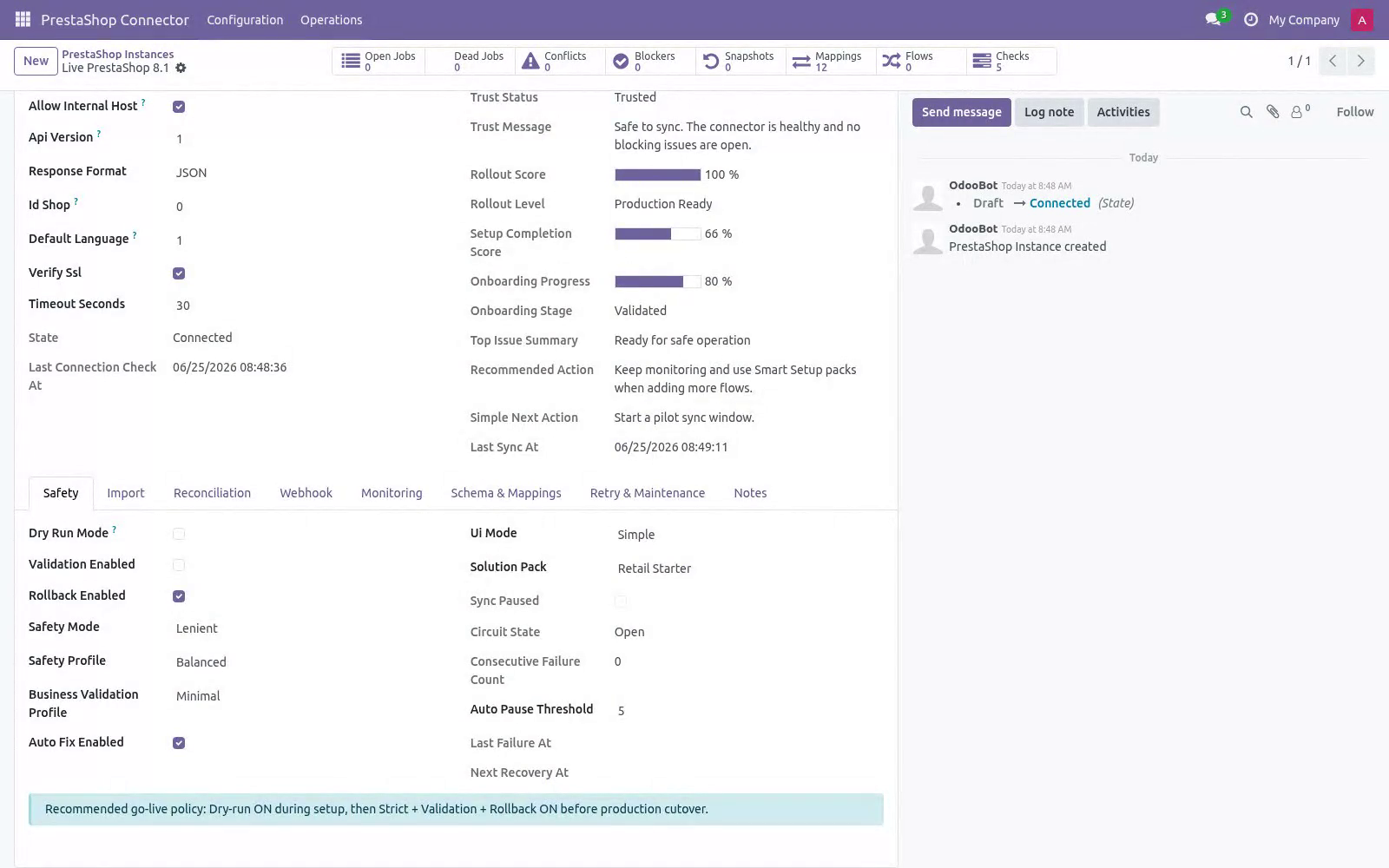
0 (default) targets all shops. Set a non-zero PrestaShop shop id to scope a single store on a multistore install. - Default Language ID Then click Test Connection. A green Connected state means the key and URL are correct, and the default order-state mapping is seeded automatically on first success.
If it fails, the exact error is shown on the form and recorded in Logs (see Troubleshooting). Step 3 — First sync (dry-run, then live). New instances start with Dry-run ON. In dry-run, import and delete jobs simulate writes: instead of changing data they produce Validation Results you can review under PrestaShop ▸ Operations ▸ Validation Results.
This lets you confirm what would happen before anything is written. 1. On the instance, click Import Products (and/or Import Customers, Import Orders). This enqueues jobs; it does not block the UI.
2. Jobs are processed by the PrestaShop Queue Processor scheduled action (every minute), or immediately if you open Operations ▸ Queue Jobs and run them. 3. Review Validation Results while still in dry-run.
4. When satisfied, open the instance, turn Dry-run OFF, and run the imports again to write the records for real. Order status mapping. PrestaShop returns each order's state as a numeric id (its current_state), not a slug.
Under Configuration ▸ Order State Mappings each instance gets a default table (seeded on first successful Test Connection) that decides what happens to the Odoo sale order when an order arrives in a given PrestaShop state: PrestaShop state Default Odoo action Awaiting check payment Payment accepted Confirm sale order Preparation in progress Confirm sale order Change any row to Ignore (do nothing), Keep draft, Confirm sale order or Cancel sale order. Unknown/custom state ids default to Ignore, so a state you have not mapped never triggers a destructive transition. Add a row for any custom state your shop introduces (use the exact PrestaShop numeric state id). Field mapping & customization Field Mappings (Configuration) map PrestaShop fields to Odoo fields per model.
Use Generate suggested mappings on the instance to seed the business-critical ones, then adjust. The mapping board flags fields that need attention. Schema Fields lists the discovered PrestaShop fields per resource. Run Schema Introspection on the instance to refresh it from your live store (or from the bundled mock when evaluating).
Stock / images / tax are opt-in toggles on the instance, all off by default; turn on only what you need: Reads stock_available and writes the PrestaShop quantity on the product template. Resolves the PrestaShop tax_rules_group and stores it on the product (best effort). - Auto-match Taxes on Import With Sync Taxes, matches the PrestaShop tax group name to an existing Odoo sales tax in the same company. Never auto-creates taxes.
Downloads the first PrestaShop image as the Odoo product cover image. Automation (scheduled actions & webhooks). The module ships these scheduled actions (Settings ▸ Technical ▸ Scheduled Actions): - Scheduled action - PrestaShop Queue Processor Processes queued import/export/delete jobs. - PrestaShop Reconciliation Pulls recent remote changes for enabled models.
- PrestaShop Maintenance Recovers stale/locked jobs and trims old logs. - PrestaShop Flow Scheduler Turn on Auto import / Auto reconcile per model on the instance to let the scheduled actions keep things in sync hands-free. Safety features Dry-run mode — simulate writes and review Validation Results before going live (field Dry-run, ON by default). Business validation profiles — Minimal / Standard / Strict gate risky writes (field Business Validation Profile).
Safety profiles — Conservative / Balanced / Aggressive set sensible defaults for dry-run, delete strategy and batch size in one click. Resilient queue — every remote action is a job with retry and exponential back-off, and a dead-letter queue for exhausted jobs. Circuit breaker — after repeated failures (or an auth/config error) an instance auto-pauses (Tripped); the Auto Recover action reopens it once the store responds again, or click Resume. Rollback snapshots — when enabled, imports capture a snapshot so you can undo a batch from Operations ▸ Rollback Snapshots.
SSRF guard — the connector refuses internal/loopback/private/reserved hosts; Base URL must be a public http(s) address. Signed webhooks with replay protection — deliveries must carry a valid HMAC-SHA256 signature and a fresh emitted_at; duplicates are rejected. Troubleshooting. For anything else, Operations ▸ Logs records every API call, payload and error with a timestamp.
- Test Connection fails with 401 Wrong API key, or the key is disabled. Re-check Step 1: the key must be Enabled and have at least View (GET) permission on the resources you sync. - Test Connection fails with 403 / "webservice disabled" The PrestaShop Webservice is off. Set Advanced Parameters ▸ Webservice ▸ Enable PrestaShop's webservice to Yes.
- 401 even with a correct key (behind a proxy) Your front proxy strips the HTTP Authorization header. Enable HTTP method override in the Webservice settings, or configure the proxy to pass the header. - "is not allowed because it resolves to a non-public address" Base URL points at localhost/a private IP/cloud metadata. Point the connector at a public shop URL; the SSRF guard blocks internal hosts by design.
Frequently asked questions. Which versions are supported? Odoo 19.0 on the Odoo side. On the store side the connector was live-tested on PrestaShop 8.0, 8.1, 8.2 and 9.0 over the PrestaShop Webservice.
Validate your exact build with the bundled mock first. Do I need PrestaShop installed to evaluate it? No. A mock PrestaShop Webservice ships inside (served at /prestashop/mock_api/api), so you can install, explore and demo the full import flow before connecting a real store.
Support & updates. .. BAMBOOFORGE-DOC-APPENDIX (auto-generated: Upgrade/Uninstall/Changelog + bespoke) Support: support@bambooforge.dev — answered within 24 hours, setup help included. Refund: report a bug within 2 months of purchase; if unresolved within 15 days, full refund.
Full source is included. Updates track the supported Odoo 19 / PrestaShop 8.0–9.0 line. Now the part most videos leave out: what this does not do. The connector reads products, customers, orders and order slips from your store and writes the corresponding Odoo records.
The API key and webhook secret are stored in admin-only fields. In scope today: product/customer/order import, product export, numeric order-state mapping, refund (order slip) discovery, multistore/multilang flattening, scheduled sync, signed webhooks. Out of scope / best-effort: tax auto-matching (off by default, name-based, never auto-creates taxes); multi-warehouse stock routing; subscription/booking order types. The complete manual is at docs dot bambooforge dot dev, the demo database is linked from the store page, and support answers within twenty-four hours.
Links are in the description.
Transcript of the walkthrough (Odoo 18)
PrestaShop Connector / PrestaShop Odoo Integration. Two-way PrestaShop 8.0 to 9.0 integration: products, customers, orders, refunds and stock, with signed webhooks and order totals that match. The connector keeps Odoo and PrestaShop in sync over the official PrestaShop Webservice API. It covers: In the next few minutes: matching the storefront total, then step 2 — create the connection in odoo, then step 3 — first sync (dry-run, then live), then order status mapping, then field mapping & customization.
Then what this app deliberately does not do, so you can tell before you buy whether it fits. Everything lives under PrestaShop Connector then Control Tower then Dead-letter then Conflicts. Matching the storefront total. A storefront charges shipping and grants discounts outside the product lines, so an order rebuilt from those lines alone is worth less than the order the customer paid for: the sale looks smaller than it was and never reconciles against the platform payout.
the shipping charge is imported as its own order line, on a clearly named service product; whatever still separates Odoo from the platform total — platform discounts, fees, rounding — is posted as a single adjustment line rather than dropped; the platform total and the remaining difference are stored on the order and shown on its connector tab; an order that still does not match within Total Tolerance raises a validation warning, so the gap is visible instead of silent. With Match Storefront Totals on the instance (on by default): Step 2 — Create the connection in Odoo. Open PrestaShop ▸ Configuration ▸ Instances and create a record. A label for this store, e.g.
My Live Store (unique per company). The Odoo company that owns this instance. Your shop root, e.g. https://shop.example.com.
Must be a public http:// or https:// URL. The Webservice key from Step 1 (visible to administrators only). - Response Format JSON (default) or XML. Leave on JSON unless you have a reason to change it.
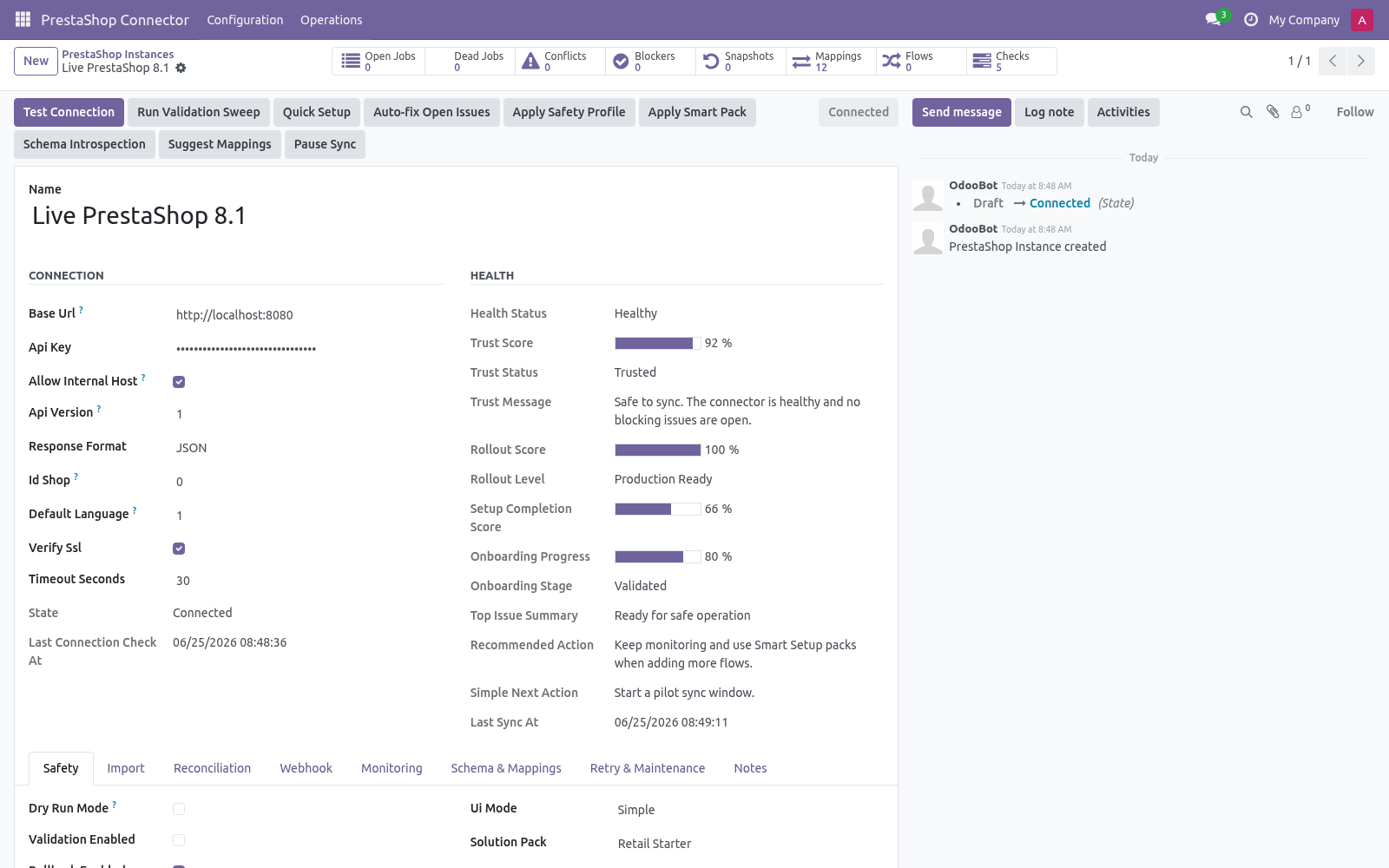
0 (default) targets all shops. Set a non-zero PrestaShop shop id to scope a single store on a multistore install. - Default Language ID Then click Test Connection. A green Connected state means the key and URL are correct, and the default order-state mapping is seeded automatically on first success.
If it fails, the exact error is shown on the form and recorded in Logs (see Troubleshooting). Step 3 — First sync (dry-run, then live). New instances start with Dry-run ON. In dry-run, import and delete jobs simulate writes: instead of changing data they produce Validation Results you can review under PrestaShop ▸ Operations ▸ Validation Results.
This lets you confirm what would happen before anything is written. 1. On the instance, click Import Products (and/or Import Customers, Import Orders). This enqueues jobs; it does not block the UI.
2. Jobs are processed by the PrestaShop Queue Processor scheduled action (every minute), or immediately if you open Operations ▸ Queue Jobs and run them. 3. Review Validation Results while still in dry-run.
4. When satisfied, open the instance, turn Dry-run OFF, and run the imports again to write the records for real. Order status mapping. PrestaShop returns each order's state as a numeric id (its current_state), not a slug.
Under Configuration ▸ Order State Mappings each instance gets a default table (seeded on first successful Test Connection) that decides what happens to the Odoo sale order when an order arrives in a given PrestaShop state: PrestaShop state Default Odoo action Awaiting check payment Payment accepted Confirm sale order Preparation in progress Confirm sale order Change any row to Ignore (do nothing), Keep draft, Confirm sale order or Cancel sale order. Unknown/custom state ids default to Ignore, so a state you have not mapped never triggers a destructive transition. Add a row for any custom state your shop introduces (use the exact PrestaShop numeric state id). Field mapping & customization Field Mappings (Configuration) map PrestaShop fields to Odoo fields per model.
Use Generate suggested mappings on the instance to seed the business-critical ones, then adjust. The mapping board flags fields that need attention. Schema Fields lists the discovered PrestaShop fields per resource. Run Schema Introspection on the instance to refresh it from your live store (or from the bundled mock when evaluating).
Stock / images / tax are opt-in toggles on the instance, all off by default; turn on only what you need: Reads stock_available and writes the PrestaShop quantity on the product template. Resolves the PrestaShop tax_rules_group and stores it on the product (best effort). - Auto-match Taxes on Import With Sync Taxes, matches the PrestaShop tax group name to an existing Odoo sales tax in the same company. Never auto-creates taxes.
Downloads the first PrestaShop image as the Odoo product cover image. Automation (scheduled actions & webhooks). The module ships these scheduled actions (Settings ▸ Technical ▸ Scheduled Actions): - Scheduled action - PrestaShop Queue Processor Processes queued import/export/delete jobs. - PrestaShop Reconciliation Pulls recent remote changes for enabled models.
- PrestaShop Maintenance Recovers stale/locked jobs and trims old logs. - PrestaShop Flow Scheduler Turn on Auto import / Auto reconcile per model on the instance to let the scheduled actions keep things in sync hands-free. Safety features Dry-run mode — simulate writes and review Validation Results before going live (field Dry-run, ON by default). Business validation profiles — Minimal / Standard / Strict gate risky writes (field Business Validation Profile).
Safety profiles — Conservative / Balanced / Aggressive set sensible defaults for dry-run, delete strategy and batch size in one click. Resilient queue — every remote action is a job with retry and exponential back-off, and a dead-letter queue for exhausted jobs. Circuit breaker — after repeated failures (or an auth/config error) an instance auto-pauses (Tripped); the Auto Recover action reopens it once the store responds again, or click Resume. Rollback snapshots — when enabled, imports capture a snapshot so you can undo a batch from Operations ▸ Rollback Snapshots.
SSRF guard — the connector refuses internal/loopback/private/reserved hosts; Base URL must be a public http(s) address. Signed webhooks with replay protection — deliveries must carry a valid HMAC-SHA256 signature and a fresh emitted_at; duplicates are rejected. Troubleshooting. For anything else, Operations ▸ Logs records every API call, payload and error with a timestamp.
- Test Connection fails with 401 Wrong API key, or the key is disabled. Re-check Step 1: the key must be Enabled and have at least View (GET) permission on the resources you sync. - Test Connection fails with 403 / "webservice disabled" The PrestaShop Webservice is off. Set Advanced Parameters ▸ Webservice ▸ Enable PrestaShop's webservice to Yes.
- 401 even with a correct key (behind a proxy) Your front proxy strips the HTTP Authorization header. Enable HTTP method override in the Webservice settings, or configure the proxy to pass the header. - "is not allowed because it resolves to a non-public address" Base URL points at localhost/a private IP/cloud metadata. Point the connector at a public shop URL; the SSRF guard blocks internal hosts by design.
Frequently asked questions. Which versions are supported? Odoo 18.0 on the Odoo side. On the store side the connector was live-tested on PrestaShop 8.0, 8.1, 8.2 and 9.0 over the PrestaShop Webservice.
Validate your exact build with the bundled mock first. Do I need PrestaShop installed to evaluate it? No. A mock PrestaShop Webservice ships inside (served at /prestashop/mock_api/api), so you can install, explore and demo the full import flow before connecting a real store.
Support & updates. .. BAMBOOFORGE-DOC-APPENDIX (auto-generated: Upgrade/Uninstall/Changelog + bespoke) Support: support@bambooforge.dev — answered within 24 hours, setup help included. Refund: report a bug within 2 months of purchase; if unresolved within 15 days, full refund.
Full source is included. Updates track the supported Odoo 18 / PrestaShop 8.0–9.0 line. Now the part most videos leave out: what this does not do. The connector reads products, customers, orders and order slips from your store and writes the corresponding Odoo records.
The API key and webhook secret are stored in admin-only fields. In scope today: product/customer/order import, product export, numeric order-state mapping, refund (order slip) discovery, multistore/multilang flattening, scheduled sync, signed webhooks. Out of scope / best-effort: tax auto-matching (off by default, name-based, never auto-creates taxes); multi-warehouse stock routing; subscription/booking order types. The complete manual is at docs dot bambooforge dot dev, the demo database is linked from the store page, and support answers within twenty-four hours.
Links are in the description.
Transcript of the walkthrough (Odoo 17)
PrestaShop Connector / PrestaShop Odoo Integration. Two-way PrestaShop 8.0 to 9.0 integration: products, customers, orders, refunds and stock, with signed webhooks and order totals that match. The connector keeps Odoo and PrestaShop in sync over the official PrestaShop Webservice API. It covers: In the next few minutes: matching the storefront total, then step 2 — create the connection in odoo, then step 3 — first sync (dry-run, then live), then order status mapping, then field mapping & customization.
Then what this app deliberately does not do, so you can tell before you buy whether it fits. Everything lives under PrestaShop Connector then Control Tower then Dead-letter then Conflicts. Matching the storefront total. A storefront charges shipping and grants discounts outside the product lines, so an order rebuilt from those lines alone is worth less than the order the customer paid for: the sale looks smaller than it was and never reconciles against the platform payout.
the shipping charge is imported as its own order line, on a clearly named service product; whatever still separates Odoo from the platform total — platform discounts, fees, rounding — is posted as a single adjustment line rather than dropped; the platform total and the remaining difference are stored on the order and shown on its connector tab; an order that still does not match within Total Tolerance raises a validation warning, so the gap is visible instead of silent. With Match Storefront Totals on the instance (on by default): Step 2 — Create the connection in Odoo. Open PrestaShop ▸ Configuration ▸ Instances and create a record. A label for this store, e.g.
My Live Store (unique per company). The Odoo company that owns this instance. Your shop root, e.g. https://shop.example.com.
Must be a public http:// or https:// URL. The Webservice key from Step 1 (visible to administrators only). - Response Format JSON (default) or XML. Leave on JSON unless you have a reason to change it.
0 (default) targets all shops. Set a non-zero PrestaShop shop id to scope a single store on a multistore install. - Default Language ID Then click Test Connection. A green Connected state means the key and URL are correct, and the default order-state mapping is seeded automatically on first success.
If it fails, the exact error is shown on the form and recorded in Logs (see Troubleshooting). Step 3 — First sync (dry-run, then live). New instances start with Dry-run ON. In dry-run, import and delete jobs simulate writes: instead of changing data they produce Validation Results you can review under PrestaShop ▸ Operations ▸ Validation Results.
This lets you confirm what would happen before anything is written. 1. On the instance, click Import Products (and/or Import Customers, Import Orders). This enqueues jobs; it does not block the UI.
2. Jobs are processed by the PrestaShop Queue Processor scheduled action (every minute), or immediately if you open Operations ▸ Queue Jobs and run them. 3. Review Validation Results while still in dry-run.
4. When satisfied, open the instance, turn Dry-run OFF, and run the imports again to write the records for real. Order status mapping. PrestaShop returns each order's state as a numeric id (its current_state), not a slug.
Under Configuration ▸ Order State Mappings each instance gets a default table (seeded on first successful Test Connection) that decides what happens to the Odoo sale order when an order arrives in a given PrestaShop state: PrestaShop state Default Odoo action Awaiting check payment Payment accepted Confirm sale order Preparation in progress Confirm sale order Change any row to Ignore (do nothing), Keep draft, Confirm sale order or Cancel sale order. Unknown/custom state ids default to Ignore, so a state you have not mapped never triggers a destructive transition. Add a row for any custom state your shop introduces (use the exact PrestaShop numeric state id). Field mapping & customization Field Mappings (Configuration) map PrestaShop fields to Odoo fields per model.
Use Generate suggested mappings on the instance to seed the business-critical ones, then adjust. The mapping board flags fields that need attention. Schema Fields lists the discovered PrestaShop fields per resource. Run Schema Introspection on the instance to refresh it from your live store (or from the bundled mock when evaluating).
Stock / images / tax are opt-in toggles on the instance, all off by default; turn on only what you need: Reads stock_available and writes the PrestaShop quantity on the product template. Resolves the PrestaShop tax_rules_group and stores it on the product (best effort). - Auto-match Taxes on Import With Sync Taxes, matches the PrestaShop tax group name to an existing Odoo sales tax in the same company. Never auto-creates taxes.
Downloads the first PrestaShop image as the Odoo product cover image. Automation (scheduled actions & webhooks). The module ships these scheduled actions (Settings ▸ Technical ▸ Scheduled Actions): - Scheduled action - PrestaShop Queue Processor Processes queued import/export/delete jobs. - PrestaShop Reconciliation Pulls recent remote changes for enabled models.
- PrestaShop Maintenance Recovers stale/locked jobs and trims old logs. - PrestaShop Flow Scheduler Turn on Auto import / Auto reconcile per model on the instance to let the scheduled actions keep things in sync hands-free. Safety features Dry-run mode — simulate writes and review Validation Results before going live (field Dry-run, ON by default). Business validation profiles — Minimal / Standard / Strict gate risky writes (field Business Validation Profile).
Safety profiles — Conservative / Balanced / Aggressive set sensible defaults for dry-run, delete strategy and batch size in one click. Resilient queue — every remote action is a job with retry and exponential back-off, and a dead-letter queue for exhausted jobs. Circuit breaker — after repeated failures (or an auth/config error) an instance auto-pauses (Tripped); the Auto Recover action reopens it once the store responds again, or click Resume. Rollback snapshots — when enabled, imports capture a snapshot so you can undo a batch from Operations ▸ Rollback Snapshots.
SSRF guard — the connector refuses internal/loopback/private/reserved hosts; Base URL must be a public http(s) address. Signed webhooks with replay protection — deliveries must carry a valid HMAC-SHA256 signature and a fresh emitted_at; duplicates are rejected. Troubleshooting. For anything else, Operations ▸ Logs records every API call, payload and error with a timestamp.
- Test Connection fails with 401 Wrong API key, or the key is disabled. Re-check Step 1: the key must be Enabled and have at least View (GET) permission on the resources you sync. - Test Connection fails with 403 / "webservice disabled" The PrestaShop Webservice is off. Set Advanced Parameters ▸ Webservice ▸ Enable PrestaShop's webservice to Yes.
- 401 even with a correct key (behind a proxy) Your front proxy strips the HTTP Authorization header. Enable HTTP method override in the Webservice settings, or configure the proxy to pass the header. - "is not allowed because it resolves to a non-public address" Base URL points at localhost/a private IP/cloud metadata. Point the connector at a public shop URL; the SSRF guard blocks internal hosts by design.
Frequently asked questions. Which versions are supported? Odoo 17.0 on the Odoo side. On the store side the connector was live-tested on PrestaShop 8.0, 8.1, 8.2 and 9.0 over the PrestaShop Webservice.
Validate your exact build with the bundled mock first. Do I need PrestaShop installed to evaluate it? No. A mock PrestaShop Webservice ships inside (served at /prestashop/mock_api/api), so you can install, explore and demo the full import flow before connecting a real store.
Support & updates. .. BAMBOOFORGE-DOC-APPENDIX (auto-generated: Upgrade/Uninstall/Changelog + bespoke) Support: support@bambooforge.dev — answered within 24 hours, setup help included. Refund: report a bug within 2 months of purchase; if unresolved within 15 days, full refund.
Full source is included. Updates track the supported Odoo 17 / PrestaShop 8.0–9.0 line. Now the part most videos leave out: what this does not do. The connector reads products, customers, orders and order slips from your store and writes the corresponding Odoo records.
The API key and webhook secret are stored in admin-only fields. In scope today: product/customer/order import, product export, numeric order-state mapping, refund (order slip) discovery, multistore/multilang flattening, scheduled sync, signed webhooks. Out of scope / best-effort: tax auto-matching (off by default, name-based, never auto-creates taxes); multi-warehouse stock routing; subscription/booking order types. The complete manual is at docs dot bambooforge dot dev, the demo database is linked from the store page, and support answers within twenty-four hours.
Links are in the description.
Transcript of the walkthrough (Odoo 16)
PrestaShop Connector / PrestaShop Odoo Integration. Two-way PrestaShop 8.0 to 9.0 integration: products, customers, orders, refunds and stock, with signed webhooks and order totals that match. The connector keeps Odoo and PrestaShop in sync over the official PrestaShop Webservice API. It covers: In the next few minutes: matching the storefront total, then step 2 — create the connection in odoo, then step 3 — first sync (dry-run, then live), then order status mapping, then field mapping & customization.
Then what this app deliberately does not do, so you can tell before you buy whether it fits. Everything lives under PrestaShop Connector then Control Tower then Dead-letter then Conflicts. Matching the storefront total. A storefront charges shipping and grants discounts outside the product lines, so an order rebuilt from those lines alone is worth less than the order the customer paid for: the sale looks smaller than it was and never reconciles against the platform payout.
the shipping charge is imported as its own order line, on a clearly named service product; whatever still separates Odoo from the platform total — platform discounts, fees, rounding — is posted as a single adjustment line rather than dropped; the platform total and the remaining difference are stored on the order and shown on its connector tab; an order that still does not match within Total Tolerance raises a validation warning, so the gap is visible instead of silent. With Match Storefront Totals on the instance (on by default): Step 2 — Create the connection in Odoo. Open PrestaShop ▸ Configuration ▸ Instances and create a record. A label for this store, e.g.
My Live Store (unique per company). The Odoo company that owns this instance. Your shop root, e.g. https://shop.example.com.
Must be a public http:// or https:// URL. The Webservice key from Step 1 (visible to administrators only). - Response Format JSON (default) or XML. Leave on JSON unless you have a reason to change it.
0 (default) targets all shops. Set a non-zero PrestaShop shop id to scope a single store on a multistore install. - Default Language ID Then click Test Connection. A green Connected state means the key and URL are correct, and the default order-state mapping is seeded automatically on first success.
If it fails, the exact error is shown on the form and recorded in Logs (see Troubleshooting). Step 3 — First sync (dry-run, then live). New instances start with Dry-run ON. In dry-run, import and delete jobs simulate writes: instead of changing data they produce Validation Results you can review under PrestaShop ▸ Operations ▸ Validation Results.
This lets you confirm what would happen before anything is written. 1. On the instance, click Import Products (and/or Import Customers, Import Orders). This enqueues jobs; it does not block the UI.
2. Jobs are processed by the PrestaShop Queue Processor scheduled action (every minute), or immediately if you open Operations ▸ Queue Jobs and run them. 3. Review Validation Results while still in dry-run.
4. When satisfied, open the instance, turn Dry-run OFF, and run the imports again to write the records for real. Order status mapping. PrestaShop returns each order's state as a numeric id (its current_state), not a slug.
Under Configuration ▸ Order State Mappings each instance gets a default table (seeded on first successful Test Connection) that decides what happens to the Odoo sale order when an order arrives in a given PrestaShop state: PrestaShop state Default Odoo action Awaiting check payment Payment accepted Confirm sale order Preparation in progress Confirm sale order Change any row to Ignore (do nothing), Keep draft, Confirm sale order or Cancel sale order. Unknown/custom state ids default to Ignore, so a state you have not mapped never triggers a destructive transition. Add a row for any custom state your shop introduces (use the exact PrestaShop numeric state id). Field mapping & customization Field Mappings (Configuration) map PrestaShop fields to Odoo fields per model.
Use Generate suggested mappings on the instance to seed the business-critical ones, then adjust. The mapping board flags fields that need attention. Schema Fields lists the discovered PrestaShop fields per resource. Run Schema Introspection on the instance to refresh it from your live store (or from the bundled mock when evaluating).
Stock / images / tax are opt-in toggles on the instance, all off by default; turn on only what you need: Reads stock_available and writes the PrestaShop quantity on the product template. Resolves the PrestaShop tax_rules_group and stores it on the product (best effort). - Auto-match Taxes on Import With Sync Taxes, matches the PrestaShop tax group name to an existing Odoo sales tax in the same company. Never auto-creates taxes.
Downloads the first PrestaShop image as the Odoo product cover image. Automation (scheduled actions & webhooks). The module ships these scheduled actions (Settings ▸ Technical ▸ Scheduled Actions): - Scheduled action - PrestaShop Queue Processor Processes queued import/export/delete jobs. - PrestaShop Reconciliation Pulls recent remote changes for enabled models.
- PrestaShop Maintenance Recovers stale/locked jobs and trims old logs. - PrestaShop Flow Scheduler Turn on Auto import / Auto reconcile per model on the instance to let the scheduled actions keep things in sync hands-free. Safety features Dry-run mode — simulate writes and review Validation Results before going live (field Dry-run, ON by default). Business validation profiles — Minimal / Standard / Strict gate risky writes (field Business Validation Profile).
Safety profiles — Conservative / Balanced / Aggressive set sensible defaults for dry-run, delete strategy and batch size in one click. Resilient queue — every remote action is a job with retry and exponential back-off, and a dead-letter queue for exhausted jobs. Circuit breaker — after repeated failures (or an auth/config error) an instance auto-pauses (Tripped); the Auto Recover action reopens it once the store responds again, or click Resume. Rollback snapshots — when enabled, imports capture a snapshot so you can undo a batch from Operations ▸ Rollback Snapshots.
SSRF guard — the connector refuses internal/loopback/private/reserved hosts; Base URL must be a public http(s) address. Signed webhooks with replay protection — deliveries must carry a valid HMAC-SHA256 signature and a fresh emitted_at; duplicates are rejected. Troubleshooting. For anything else, Operations ▸ Logs records every API call, payload and error with a timestamp.
- Test Connection fails with 401 Wrong API key, or the key is disabled. Re-check Step 1: the key must be Enabled and have at least View (GET) permission on the resources you sync. - Test Connection fails with 403 / "webservice disabled" The PrestaShop Webservice is off. Set Advanced Parameters ▸ Webservice ▸ Enable PrestaShop's webservice to Yes.
- 401 even with a correct key (behind a proxy) Your front proxy strips the HTTP Authorization header. Enable HTTP method override in the Webservice settings, or configure the proxy to pass the header. - "is not allowed because it resolves to a non-public address" Base URL points at localhost/a private IP/cloud metadata. Point the connector at a public shop URL; the SSRF guard blocks internal hosts by design.
Frequently asked questions. Which versions are supported? Odoo 17.0 on the Odoo side. On the store side the connector was live-tested on PrestaShop 8.0, 8.1, 8.2 and 9.0 over the PrestaShop Webservice.
Validate your exact build with the bundled mock first. Do I need PrestaShop installed to evaluate it? No. A mock PrestaShop Webservice ships inside (served at /prestashop/mock_api/api), so you can install, explore and demo the full import flow before connecting a real store.
Support & updates. .. BAMBOOFORGE-DOC-APPENDIX (auto-generated: Upgrade/Uninstall/Changelog + bespoke) Support: support@bambooforge.dev — answered within 24 hours, setup help included. Refund: report a bug within 2 months of purchase; if unresolved within 15 days, full refund.
Full source is included. Updates track the supported Odoo 17 / PrestaShop 8.0–9.0 line. Now the part most videos leave out: what this does not do. The connector reads products, customers, orders and order slips from your store and writes the corresponding Odoo records.
The API key and webhook secret are stored in admin-only fields. In scope today: product/customer/order import, product export, numeric order-state mapping, refund (order slip) discovery, multistore/multilang flattening, scheduled sync, signed webhooks. Out of scope / best-effort: tax auto-matching (off by default, name-based, never auto-creates taxes); multi-warehouse stock routing; subscription/booking order types. The complete manual is at docs dot bambooforge dot dev, the demo database is linked from the store page, and support answers within twenty-four hours.
Links are in the description.
Key facts
- What it is
- Two-way PrestaShop 8.0 to 9.0 integration: products, customers, orders, refunds and stock, with signed webhooks and order totals that match.
- For
- eCommerce
- Odoo versions
- 16.0, 17.0, 18.0, 19.0, 20.0 - Community and Enterprise
- Runs on
- Odoo.sh or Odoo you host yourself - not Odoo Online, which accepts no third-party apps
- Price
- 249 EUR, one-time, on the Odoo Apps Store
- Technical name
- bambooforge_prestashop_connector
- Run for real
- Tested for real against PrestaShop 8 and PrestaShop 9.1.5: on 8, 19 products and 19 real orders came into Odoo in 24 sync jobs with 0 errors, and the two defects only a live store reveals - a missing unit of measure on imported order lines and a 7.00 shipping fee left off the total - were fixed; on a freshly installed 9.1.5 the same connector connected and brought in 19 products, 2 customers and 5 orders in 26 jobs with 0 errors, order totals and SKUs matching the store.
- Not for
- The connector reads products, customers, orders and order slips from your store and writes the corresponding Odoo records. The API key and webhook secret are stored in admin-only fields.; In scope today: product/customer/order import, product export, numeric order-state mapping, refund (order slip) discovery, multistore/multilang flattening, scheduled sync, signed webhooks.; Out of scope / best-effort: tax auto-matching (off by default, name-based, never auto-creates taxes); multi-warehouse stock routing; subscription/booking order types.
- Compared with the alternatives
- https://docs.bambooforge.dev/bambooforge_prestashop_connector/compare/
- Manual last updated
- 2026-10-15
PrestaShop Connector | PrestaShop Odoo Integration
A two-way bridge between Odoo 20 and your PrestaShop store: import products, customers and orders, push product changes back, and reconcile refunds — with a resilient job queue, dry-run safety, validation and rollback so you stay in control.
This page is the complete manual. If you follow it top to bottom you can install, connect, run your first sync, automate it, and fix the common issues without contacting support.
Matching the storefront total
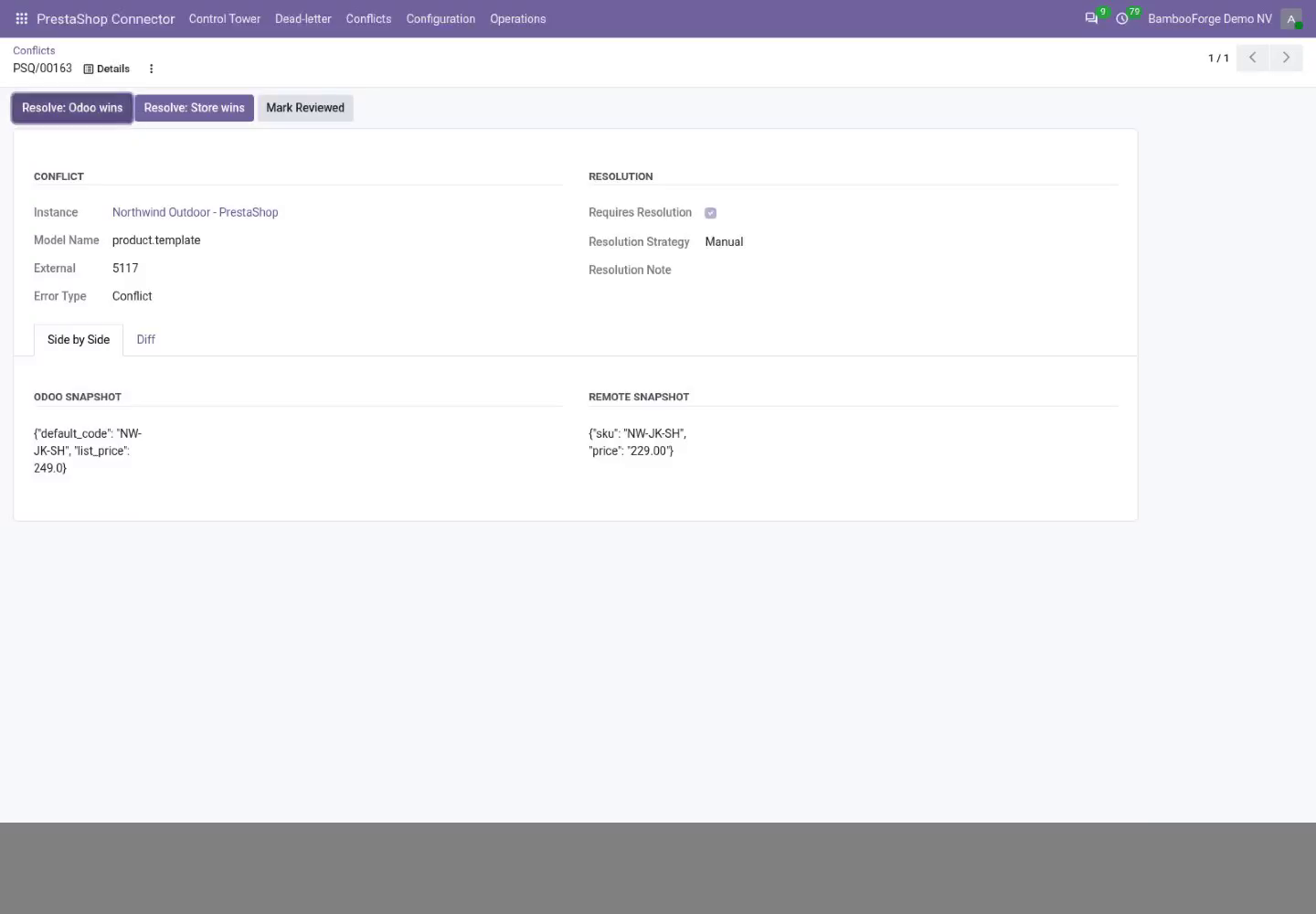
A storefront charges shipping and grants discounts outside the product lines, so an order rebuilt from those lines alone is worth less than the order the customer paid for: the sale looks smaller than it was and never reconciles against the platform payout.
With Match Storefront Totals on the instance (on by default):
the shipping charge is imported as its own order line, on a clearly named service product;
whatever still separates Odoo from the platform total — platform discounts, fees, rounding — is posted as a single adjustment line rather than dropped;
the platform total and the remaining difference are stored on the order and shown on its connector tab;
an order that still does not match within Total Tolerance raises a validation warning, so the gap is visible instead of silent.
Imported lines deliberately carry no Odoo tax: the storefront has already computed tax and it is kept on the order's own tax amount field. Switch the option off if you would rather Odoo recompute everything from your own price lists and tax rules.
Overview
The connector keeps Odoo and PrestaShop in sync over the official PrestaShop Webservice API. It covers:
Products — import PrestaShop products (with variants and images) into Odoo product templates, optionally with stock and tax group, and export Odoo product changes back to the store.
Customers — import PrestaShop customers (and their addresses) into Odoo contacts.
Orders — import PrestaShop orders into Odoo sale orders, mapping each order's PrestaShop state id to a sale-order action (keep draft, confirm, cancel, or ignore).
Refunds — optionally discover PrestaShop order slips (credit notes) attached to an order and create matching draft customer credit notes in Odoo.
Direction of sync: Odoo ↔ PrestaShop (import is the primary flow; product export and webhook-driven updates are supported). Multistore and multilanguage shops are supported via a shop id and a default language id on the instance.
Every remote call goes through a queue: nothing is written to Odoo until a job runs, jobs retry with back-off on transient failures, and a circuit breaker pauses an instance that keeps failing.
Tested against the real thing
Automated tests run against a bundled mock store on every release; the line below is the part no mock can give you - the connector pointed at the real platform, with real records and real order totals.
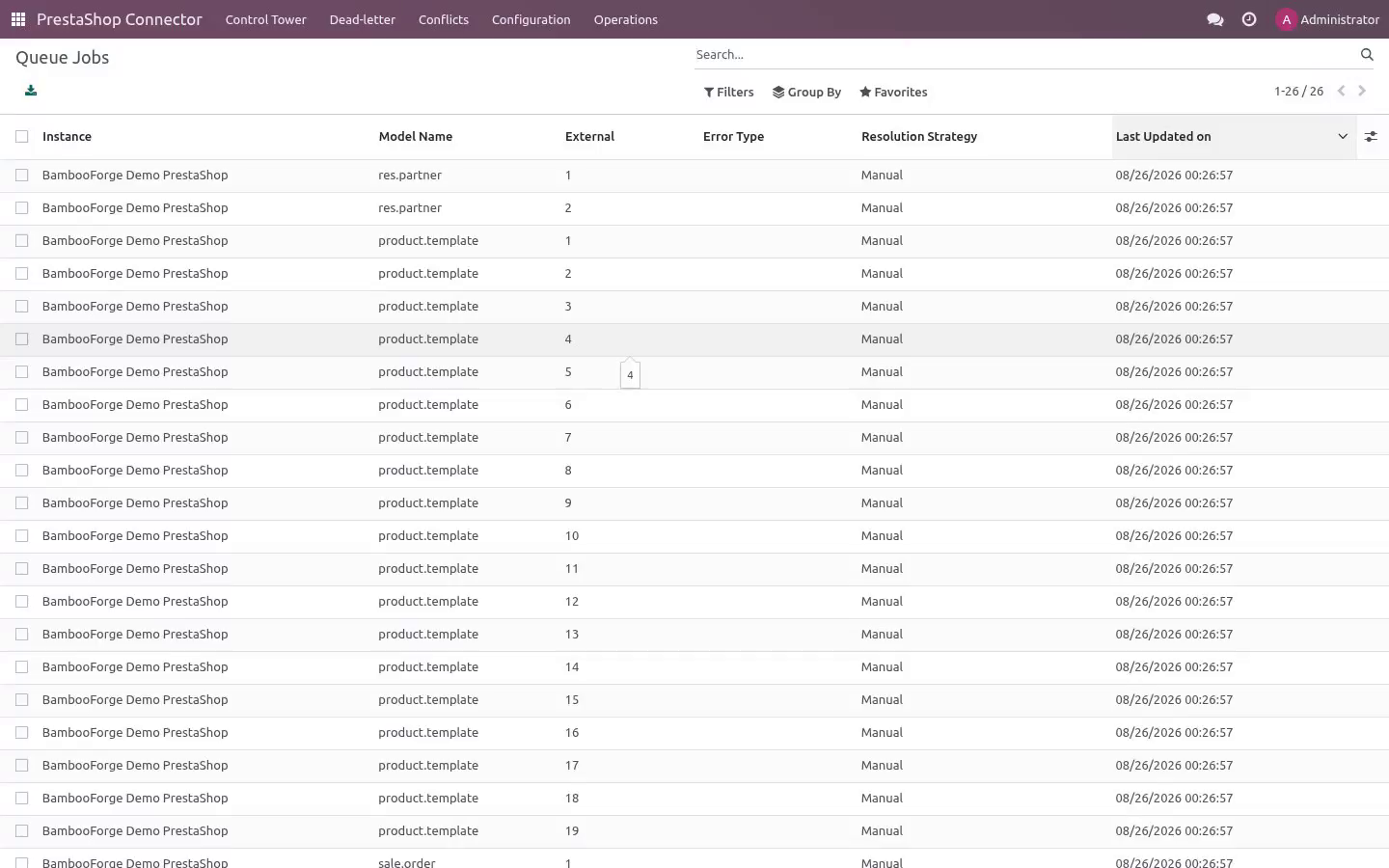
Tested for real against PrestaShop 8 and PrestaShop 9.1.5: on 8, 19 products and 19 real orders came into Odoo in 24 sync jobs with 0 errors, and the two defects only a live store reveals - a missing unit of measure on imported order lines and a 7.00 shipping fee left off the total - were fixed; on a freshly installed 9.1.5 the same connector connected and brought in 19 products, 2 customers and 5 orders in 26 jobs with 0 errors, order totals and SKUs matching the store.
Requirements
Odoo: 20.0, Community or Enterprise.
PrestaShop: live-tested against PrestaShop 8.0, 8.1, 8.2, 9.0 and 9.1 (9.1.5 on a fresh install). The shop must be reachable from the Odoo server and have the Webservice feature enabled.
Python: no extra libraries beyond a standard Odoo 20 install.
Odoo access: any internal user can use the connector screens. PrestaShop credentials are stored in system-only fields, so only the Settings / Administration user can read or change the API key and the webhook secret.
Network: outbound HTTPS from Odoo to your shop. By default the connector refuses internal/loopback/private hosts as an SSRF safeguard (see Safety features).
Installation
Copy bambooforge_prestashop_connector into your Odoo addons path.
Restart the Odoo service.
Open Apps, click Update Apps List, search for PrestaShop, and press Activate / Install. Dependencies (Sales, Contacts, Invoicing) install automatically.
No PrestaShop store is required to evaluate the connector: a mock PrestaShop Webservice ships inside the module (served under /prestashop/mock_api/api), so you can install, explore and run the full import flow against sample data before pointing it at a real store.
Step 1 — Enable the PrestaShop Webservice & create an API key
PrestaShop talks over its built-in Webservice (a REST-style API). You enable it and mint a key in the PrestaShop back office.
Log in to the PrestaShop back office as an administrator.
Go to Advanced Parameters ▸ Webservice.
Set Enable PrestaShop's webservice to Yes and save. (If your store is behind a proxy that strips the HTTP Authorization header, also set Enable HTTP method override to Yes.)
Click Add new webservice key.
Leave Key to be generated automatically (or click Generate), and set a clear Key description, e.g. Odoo connector.
Set Status to Enabled.
Under Permissions, grant the resources the connector uses. For a full two-way sync, give View (GET), Add (POST), Modify (PUT) and (optionally) Delete on at least: products, combinations, images, stock_availables, customers, addresses, orders, order_states, order_details and order_slips. View (GET) alone is enough if you only import.
Save, then copy the generated Key — this long alphanumeric string is your API key.
The key is used as the HTTP Basic username with an empty password — exactly how the PrestaShop Webservice expects it. The connector handles that for you; you only paste the key.
Optional, for real-time updates, you will also configure a webhook later (see Automation).
Step 2 — Create the connection in Odoo
Open PrestaShop ▸ Configuration ▸ Instances and create a record.
Key fields:
Field |
What to enter |
|---|---|
Name |
A label for this store, e.g. My Live Store (unique per company). |
Company |
The Odoo company that owns this instance. |
Base URL |
Your shop root, e.g. https://shop.example.com. Must be a public http:// or https:// URL. |
API Key |
The Webservice key from Step 1 (visible to administrators only). |
Response Format |
JSON (default) or XML. Leave on JSON unless you have a reason to change it. |
Shop ID |
0 (default) targets all shops. Set a non-zero PrestaShop shop id to scope a single store on a multistore install. |
Default Language ID |
The PrestaShop language id (default 1) used to flatten multilanguage fields into Odoo's single-language columns. |
Verify SSL |
Keep on for production. Turn off only for self-signed test certificates. |
Timeout (seconds) |
HTTP request timeout (default 30). |
Webhook Enabled |
On by default; controls whether the public webhook route accepts deliveries for this instance (see Automation). |
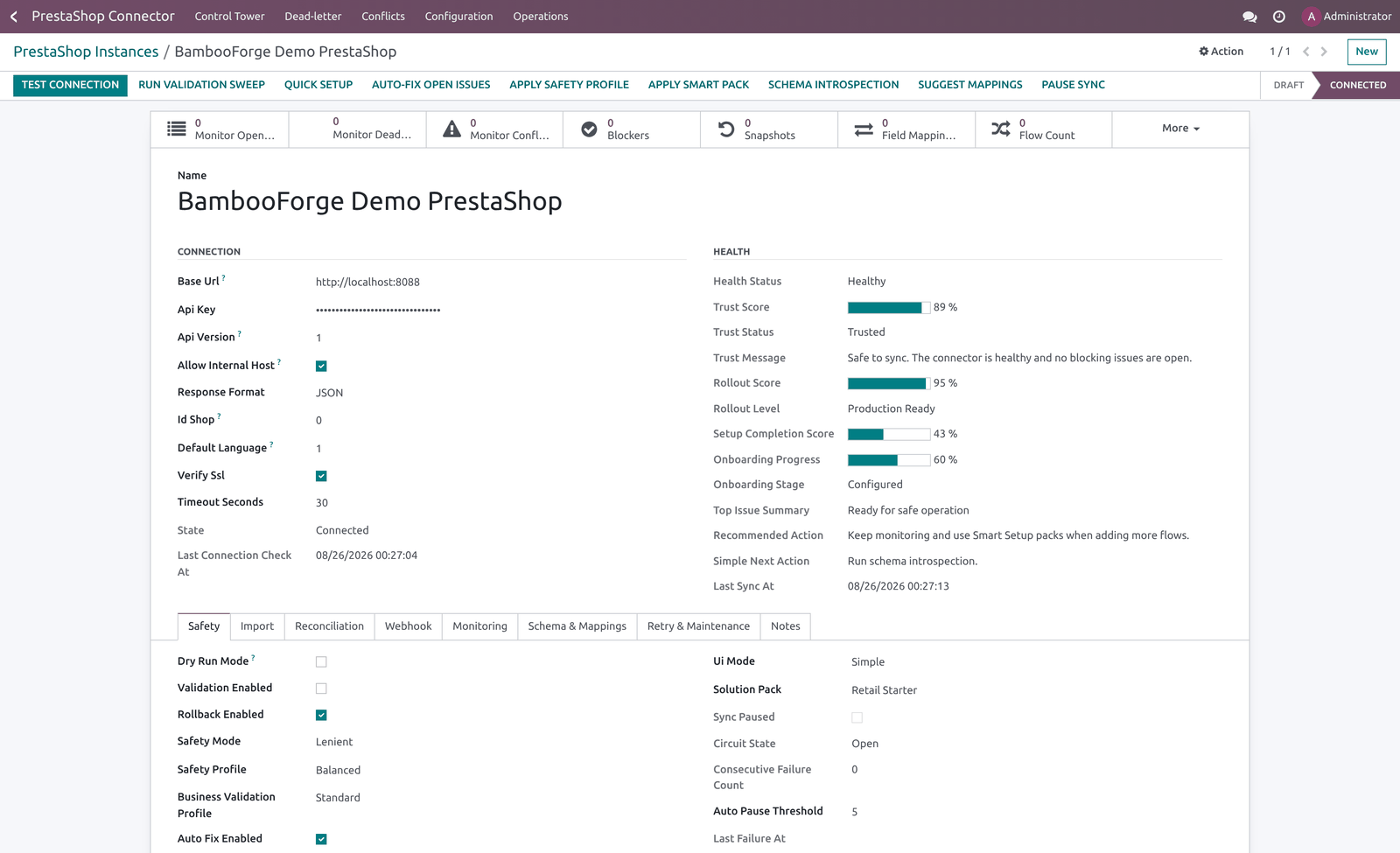
Then click Test Connection. A green Connected state means the key and URL are correct, and the default order-state mapping is seeded automatically on first success. If it fails, the exact error is shown on the form and recorded in Logs (see Troubleshooting).
Tip: use Quick Setup (button on the instance) to pick a solution pack (Catalog Only, B2C Full Sync, B2B Order-First, Retail Starter), seed default field mappings and starter flows, and apply a recommended safety profile in one step.
Step 3 — First sync (dry-run, then live)
New instances start with Dry-run ON. In dry-run, import and delete jobs simulate writes: instead of changing data they produce Validation Results you can review under PrestaShop ▸ Operations ▸ Validation Results. This lets you confirm what would happen before anything is written.
To run a first import:
On the instance, click Import Products (and/or Import Customers, Import Orders). This enqueues jobs; it does not block the UI.
Jobs are processed by the PrestaShop Queue Processor scheduled action (every minute), or immediately if you open Operations ▸ Queue Jobs and run them.
Review Validation Results while still in dry-run.
When satisfied, open the instance, turn Dry-run OFF, and run the imports again to write the records for real.
Imported records land in the standard Odoo apps: Sales ▸ Products, Contacts, and Sales ▸ Orders (refunds appear as draft credit notes in Invoicing). Each carries its PrestaShop reference so re-imports update the same record instead of duplicating it.
Order status mapping
PrestaShop returns each order's state as a numeric id (its current_state), not a slug. Under Configuration ▸ Order State Mappings each instance gets a default table (seeded on first successful Test Connection) that decides what happens to the Odoo sale order when an order arrives in a given PrestaShop state:
State id |
PrestaShop state |
Default Odoo action |
|---|---|---|
1 |
Awaiting check payment |
Keep draft |
2 |
Payment accepted |
Confirm sale order |
3 |
Preparation in progress |
Confirm sale order |
4 |
Shipped |
Confirm sale order |
5 |
Delivered |
Confirm sale order |
6 |
Canceled |
Cancel sale order |
7 |
Refunded |
Cancel sale order |
8 |
Payment error |
Keep draft |
9 |
On backorder |
Keep draft |
10 |
Awaiting bank wire payment |
Keep draft |
11 |
Awaiting PayPal payment |
Keep draft |
12 |
Payment remotely accepted |
Confirm sale order |
Change any row to Ignore (do nothing), Keep draft, Confirm sale order or Cancel sale order. Unknown/custom state ids default to Ignore, so a state you have not mapped never triggers a destructive transition. Add a row for any custom state your shop introduces (use the exact PrestaShop numeric state id).
Field mapping & customization
Field Mappings (Configuration) map PrestaShop fields to Odoo fields per model. Use Generate suggested mappings on the instance to seed the business-critical ones, then adjust. The mapping board flags fields that need attention.
Schema Fields lists the discovered PrestaShop fields per resource. Run Schema Introspection on the instance to refresh it from your live store (or from the bundled mock when evaluating).
Stock / images / tax are opt-in toggles on the instance, all off by default; turn on only what you need:
Toggle
What it does
Sync Stock
Reads stock_available and writes the PrestaShop quantity on the product template.
Sync Taxes
Resolves the PrestaShop tax_rules_group and stores it on the product (best effort).
Auto-match Taxes on Import
With Sync Taxes, matches the PrestaShop tax group name to an existing Odoo sales tax in the same company. Never auto-creates taxes.
Sync Images
Downloads the first PrestaShop image as the Odoo product cover image.
Max Images
How many images to download per product (default 1; only the first becomes the cover, the rest go to product images).
Upload Images on Export
When exporting a product, also uploads its images to PrestaShop.
Sync Refunds
On order import, discovers attached order slips and creates a draft customer credit note.
Auto-post Refund
Auto-validates the refund credit note instead of leaving it draft (off by default so accountants review first).
Automation (scheduled actions & webhooks)
The module ships these scheduled actions (Settings ▸ Technical ▸ Scheduled Actions):
Scheduled action |
Default |
Purpose |
|---|---|---|
PrestaShop Queue Processor |
every 1 min |
Processes queued import/export/delete jobs. |
PrestaShop Reconciliation |
every 15 min |
Pulls recent remote changes for enabled models. |
PrestaShop Maintenance |
every 1 hr |
Recovers stale/locked jobs and trims old logs. |
PrestaShop Flow Scheduler |
every 5 min |
Runs scheduled sync flows. |
PrestaShop Flow Metrics |
every 1 hr |
Aggregates flow-run metrics. |
PrestaShop Auto Recover |
every 15 min |
Reopens a tripped circuit breaker once the store is healthy. |
Turn on Auto import / Auto reconcile per model on the instance to let the scheduled actions keep things in sync hands-free.
Real-time webhooks (optional): the connector exposes a single public route that accepts signed deliveries:
Delivery URL: https://<your-odoo-domain>/prestashop/webhook
Signature header: X-Prestashop-Signature — an HMAC-SHA256 hex digest of the raw request body, keyed with the instance Webhook Secret (admin-only field on the instance).
The shipped PHP companion module posts to this route with the correct signature. Odoo verifies the signature on every delivery, rejects stale or replayed requests, and enqueues a safe import. The route accepts product, customer, order and order_slip events, and you can target a specific instance with an instance_id (or base_url) query parameter. Without webhooks, the scheduled reconciliation still keeps data current.
Safety features
Dry-run mode — simulate writes and review Validation Results before going live (field Dry-run, ON by default).
Business validation profiles — Minimal / Standard / Strict gate risky writes (field Business Validation Profile).
Safety profiles — Conservative / Balanced / Aggressive set sensible defaults for dry-run, delete strategy and batch size in one click.
Resilient queue — every remote action is a job with retry and exponential back-off, and a dead-letter queue for exhausted jobs.
Circuit breaker — after repeated failures (or an auth/config error) an instance auto-pauses (Tripped); the Auto Recover action reopens it once the store responds again, or click Resume.
Rollback snapshots — when enabled, imports capture a snapshot so you can undo a batch from Operations ▸ Rollback Snapshots.
SSRF guard — the connector refuses internal/loopback/private/reserved hosts; Base URL must be a public http(s) address.
Signed webhooks with replay protection — deliveries must carry a valid HMAC-SHA256 signature and a fresh emitted_at; duplicates are rejected.
Where PrestaShop shows up in Odoo
The connector stays out of the way on records that have nothing to do with PrestaShop:
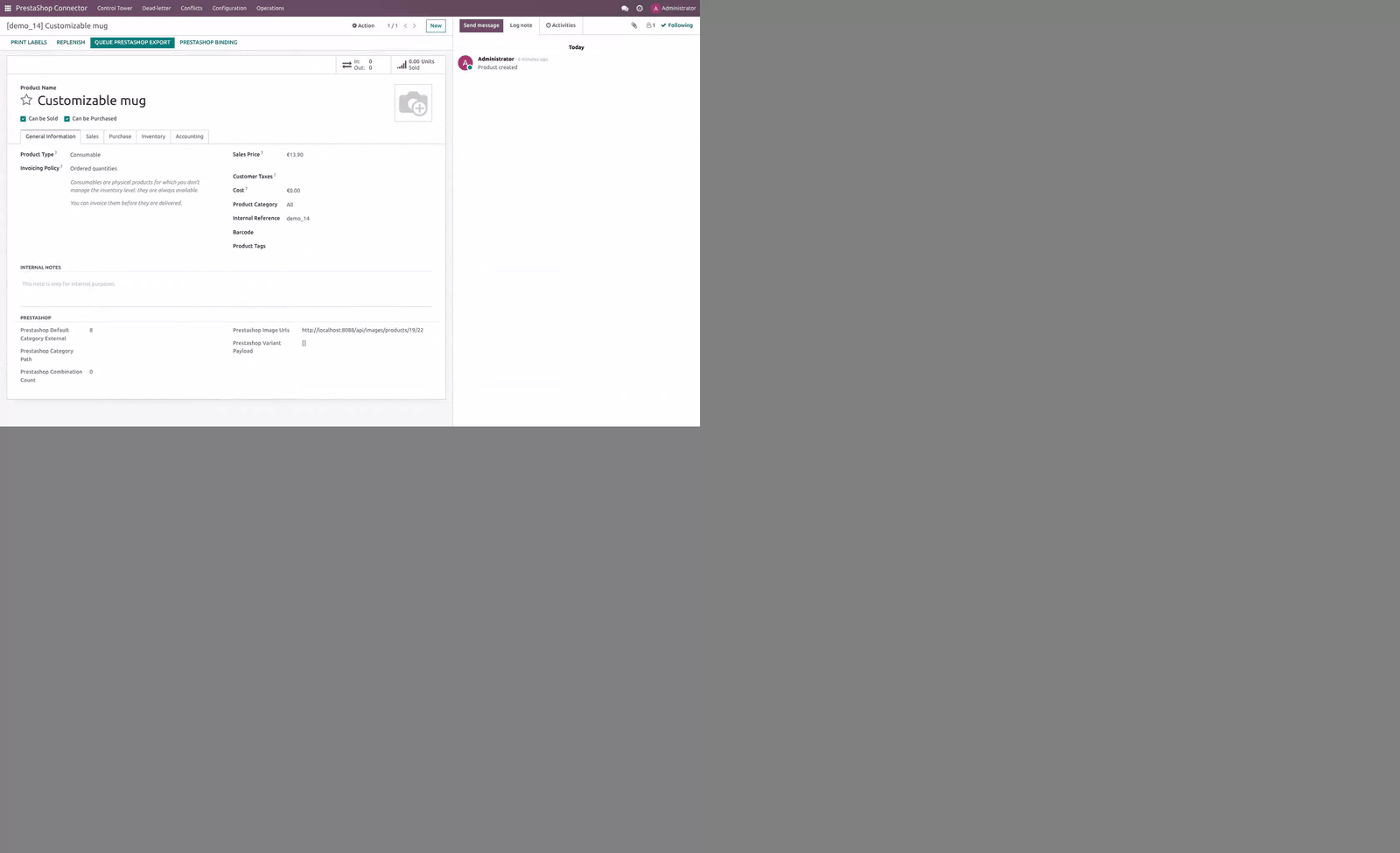
Sales orders - the PrestaShop tab, Queue PrestaShop Export and PrestaShop Binding appear only on orders that came from PrestaShop, are bound to PrestaShop, or belong to a customer bound to PrestaShop.
Products and contacts - the PrestaShop tab appears once an active PrestaShop connection exists; the PrestaShop Binding button inside it appears once the record is bound.
List views, the sync queue and the control tower are unchanged.
Troubleshooting
Symptom |
Cause and fix |
|---|---|
Test Connection fails with 401 |
Wrong API key, or the key is disabled. Re-check Step 1: the key must be Enabled and have at least View (GET) permission on the resources you sync. |
Test Connection fails with 403 / "webservice disabled" |
The PrestaShop Webservice is off. Set Advanced Parameters ▸ Webservice ▸ Enable PrestaShop's webservice to Yes. |
401 even with a correct key (behind a proxy) |
Your front proxy strips the HTTP Authorization header. Enable HTTP method override in the Webservice settings, or configure the proxy to pass the header. |
"is not allowed because it resolves to a non-public address" |
Base URL points at localhost/a private IP/cloud metadata. Point the connector at a public shop URL; the SSRF guard blocks internal hosts by design. |
SSL errors on Test Connection |
Self-signed or invalid certificate. Use a valid cert, or turn off Verify SSL for testing only. |
Orders import but never confirm |
The order's PrestaShop state id is mapped to Keep draft or Ignore. Adjust Order State Mappings (match the exact numeric state id). |
Jobs stay in Pending |
The Queue Processor is off or the instance is paused. Check Scheduled Actions is active and the instance is not Paused. |
Instance shows Tripped |
Circuit breaker tripped after repeated failures (or an auth/config error). Fix the store/credentials; Auto Recover reopens it after cooldown, or click Resume. |
Webhook returns 401 "Invalid signature" |
The X-Prestashop-Signature HMAC does not match. Confirm the companion module's secret equals the instance Webhook Secret. |
Webhook returns 400 "Stale" / "in the future" |
The two servers' clocks differ by more than the freshness window. Sync the clocks (NTP) on both the PrestaShop and Odoo hosts. |
Records imported twice |
Imports are keyed by the PrestaShop reference, so this should not happen. If it does, check that two instances do not point at the same store. |
Nothing happens after Import |
You are in Dry-run. Review Validation Results, then turn dry-run off and re-run. |
For anything else, Operations ▸ Logs records every API call, payload and error with a timestamp.
Frequently asked questions
Which versions are supported? Odoo 20.0 on the Odoo side. On the store side the connector was live-tested on PrestaShop 8.0, 8.1, 8.2, 9.0 and 9.1 over the PrestaShop Webservice. Validate your exact build with the bundled mock first.
Do I need PrestaShop installed to evaluate it? No. A mock PrestaShop Webservice ships inside (served at /prestashop/mock_api/api), so you can install, explore and demo the full import flow before connecting a real store.
How does authentication work? You enable the Webservice and create a key under Advanced Parameters ▸ Webservice in the PrestaShop back office. Paste that key into the instance's API Key field. The connector sends it as the HTTP Basic username with an empty password — the standard PrestaShop scheme.
How does real-time sync work? The shipped PHP companion posts signed events to /prestashop/webhook with an HMAC-SHA256 X-Prestashop-Signature over the raw body, keyed with the instance webhook secret. Odoo verifies the signature, rejects stale/replayed requests, and enqueues a safe import. Without it, scheduled reconciliation keeps things in sync.
How are multistore and multiple languages handled? Set Shop ID to scope requests to one store (0 = all), and Default Language ID to choose which PrestaShop language is flattened into Odoo's single-language fields.
Is it safe to run against production data? Dry-run is ON by default, validation blocks risky writes, and rollback snapshots let you undo. You decide when to go live.
What support and refund policy do I get? Every request is answered within 24 hours, setup help included. If you report a bug within 2 months of purchase and it is not resolved within 15 days, you are entitled to a full money-back refund.
Data, privacy & limits
The connector reads products, customers, orders and order slips from your store and writes the corresponding Odoo records. The API key and webhook secret are stored in admin-only fields.
In scope today: product/customer/order import, product export, numeric order-state mapping, refund (order slip) discovery, multistore/multilang flattening, scheduled sync, signed webhooks.
Out of scope / best-effort: tax auto-matching (off by default, name-based, never auto-creates taxes); multi-warehouse stock routing; subscription/booking order types.
Support & updates
Support: support@bambooforge.dev — answered within 24 hours, setup help included.
Refund: report a bug within 2 months of purchase; if unresolved within 15 days, full refund.
Full source is included. Updates track the supported Odoo 20 / PrestaShop 8.0–9.1 line.
Upgrading & version compatibility
This build targets Odoo 20.0. Each Odoo major series (16.0, 17.0, 18.0, 19.0, 20.0) has its own dedicated build of this module — always install the build that matches your Odoo version. Mixing a build with a different Odoo series is not supported.
Patch upgrades (same series, e.g. 20.0.1.0.0 → later)
Back up your database and filestore first.
Replace the module folder with the newer build.
Restart Odoo with the module updated:
./odoo-bin -c your.conf -u bambooforge_prestashop_connector -d your_db
Odoo applies any schema/data changes automatically. Your existing records and configuration are preserved.
Cross-version migration (moving to a newer Odoo)
Upgrading Odoo itself is a database migration handled by Odoo's standard upgrade tooling. When you migrate the database to the next Odoo series, install the matching build of this module for that series. Data created by this module carries over with the database migration.
After any upgrade the module's scheduled actions resume on their normal cadence — no manual re-activation is required.
Uninstallation
You can remove this module at any time from Apps → (this module) → Uninstall, or from the command line. Uninstalling is clean and reversible by reinstalling — but note what is and is not deleted.
What is removed
The module's own tables and every record in them (20 models, prefixed prestashop.*) — this is the data this module created.
The menus, actions, views and reports this module installed.
Its scheduled actions (cron jobs) — they stop immediately on uninstall.
Connection records, credentials, field mappings, queue jobs and sync logs stored in Odoo.
What is preserved
Your remote platform is never touched. Uninstalling only removes the Odoo-side connector; products, customers and orders on the external store/service are untouched.
Records already imported into standard Odoo models (e.g. contacts, products, sales orders) remain — they are ordinary Odoo records once created.
Attachments and chatter messages on standard records are kept.
As always, take a database backup before uninstalling in production.
Changelog
20.0.1.36.5
Built for Odoo 20: record rules and access rights rewritten onto Odoo 20's single ir.access model, the screens rebuilt on Owl 3, and every icon moved to the icon set Odoo 20 ships.
20.0.1.35.0
Current release for Odoo 20.0. This build includes:
Two-way Odoo 20 <-> PrestaShop 8.0 / 8.1 / 8.2 / 9.0 connector: products, customers, orders, refunds and stock, signed webhooks.
Two-way stock sync, live Sync Control Tower, resilient queue and dry-run safety.
Feature additions and fixes ship as new builds on the Odoo Apps store; this page and the module's version reflect the current published release. Always keep the build matched to your Odoo series (see Upgrading & version compatibility).
How we make sure it works
Before every release, 133 automated checks run against this app on Odoo 16, 17, 18, 19 and 20. Among them:
A domain that does not parse is refused.
Plain user cannot create.
Plain user cannot unlink.
Plain user cannot write.
Nothing at all is an empty row not a crash.
Tested for real against PrestaShop 8 and PrestaShop 9.1.5: on 8, 19 products and 19 real orders came into Odoo in 24 sync jobs with 0 errors, and the two defects only a live store reveals - a missing unit of measure on imported order lines and a 7.00 shipping fee left off the total - were fixed; on a freshly installed 9.1.5 the same connector connected and brought in 19 products, 2 customers and 5 orders in 26 jobs with 0 errors, order totals and SKUs matching the store.
The complete list is in the source you receive.