 BambooForge Labs
nopCommerce Connector
Read-only nopCommerce import: products, customers and orders read straight from the nopCommerce database on a schedule - no REST API needed.
Available for Odoo 16.0, Odoo 17.0, Odoo 18.0, Odoo 19.0, Odoo 20.0. Technical name bambooforge_nopcommerce_connector.
Transcript of the walkthrough (Odoo 20)
nopCommerce Connector. Read-only nopCommerce import: products, customers and orders read straight from the nopCommerce database on a schedule - no REST API needed. The connector imports data from nopCommerce into Odoo by reading the nopCommerce MySQL database directly (via the pymysql library) with the credentials you supply. nopCommerce has no built-in REST API, so there is no API key to generate and no plugin to install on the store side — only read access to the database.
It covers: In the next few minutes: nopcommerce connector, then matching the storefront total, then tested against the real thing, then step 2 — create the connection in odoo, then step 3 — first sync (dry-run, then live). Then what this app deliberately does not do, so you can tell before you buy whether it fits. Everything lives under nopCommerce Connector then Control Tower then Dead-letter then Conflicts. nopCommerce Connector.
A read-only bridge from your nopCommerce store into Odoo 20: import products, customers and orders on a schedule by reading the nopCommerce MySQL database directly — with a resilient job queue, dry-run safety, validation and rollback so you stay in control. nopCommerce ships no REST API by default, so the connector never depends on one: it connects to the database with read-only credentials and never writes back. This page is the complete manual. If you follow it top to bottom you can install, connect, run your first sync, automate it, and fix the common issues without contacting support.
Matching the storefront total. A storefront charges shipping and grants discounts outside the product lines, so an order rebuilt from those lines alone is worth less than the order the customer paid for: the sale looks smaller than it was and never reconciles against the platform payout. the shipping charge is imported as its own order line, on a clearly named service product; whatever still separates Odoo from the platform total — platform discounts, fees, rounding — is posted as a single adjustment line rather than dropped; the platform total and the remaining difference are stored on the order and shown on its connector tab; an order that still does not match within Total Tolerance raises a validation warning, so the gap is visible instead of silent. With Match Storefront Totals on the instance (on by default): Tested against the real thing.
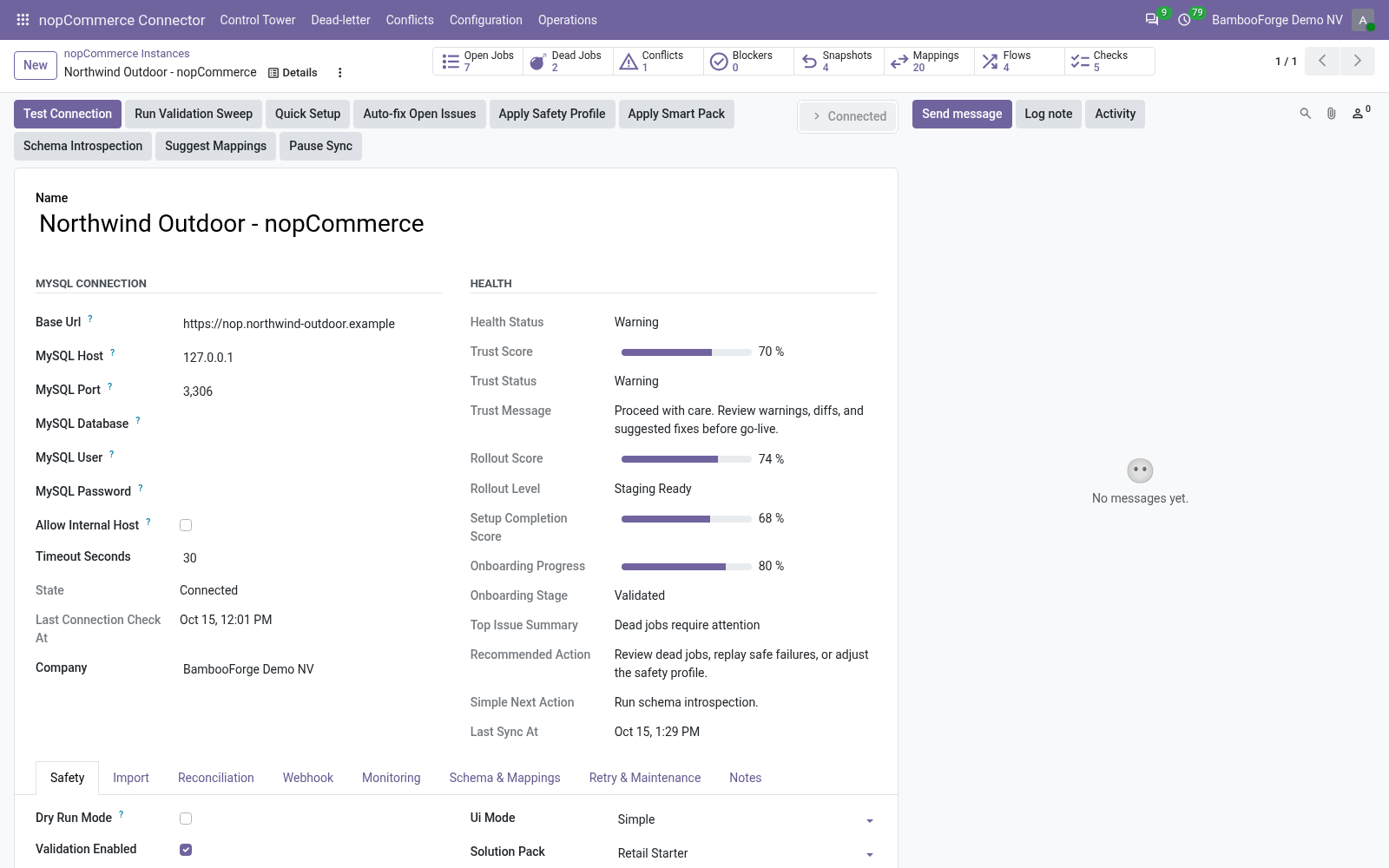
Automated tests run against a bundled mock store on every release; the line below is the part no mock can give you - the connector pointed at the real platform, with real records and real order totals. Tested for real against nopCommerce 4.80 and the current release: 47 products, 6 customers and 5 orders read straight from the store's MySQL database with 0 errors, every order total matching the source exactly. Step 2 — Create the connection in Odoo. Open nopCommerce Connector ▸ Configuration ▸ Instances and create a record.
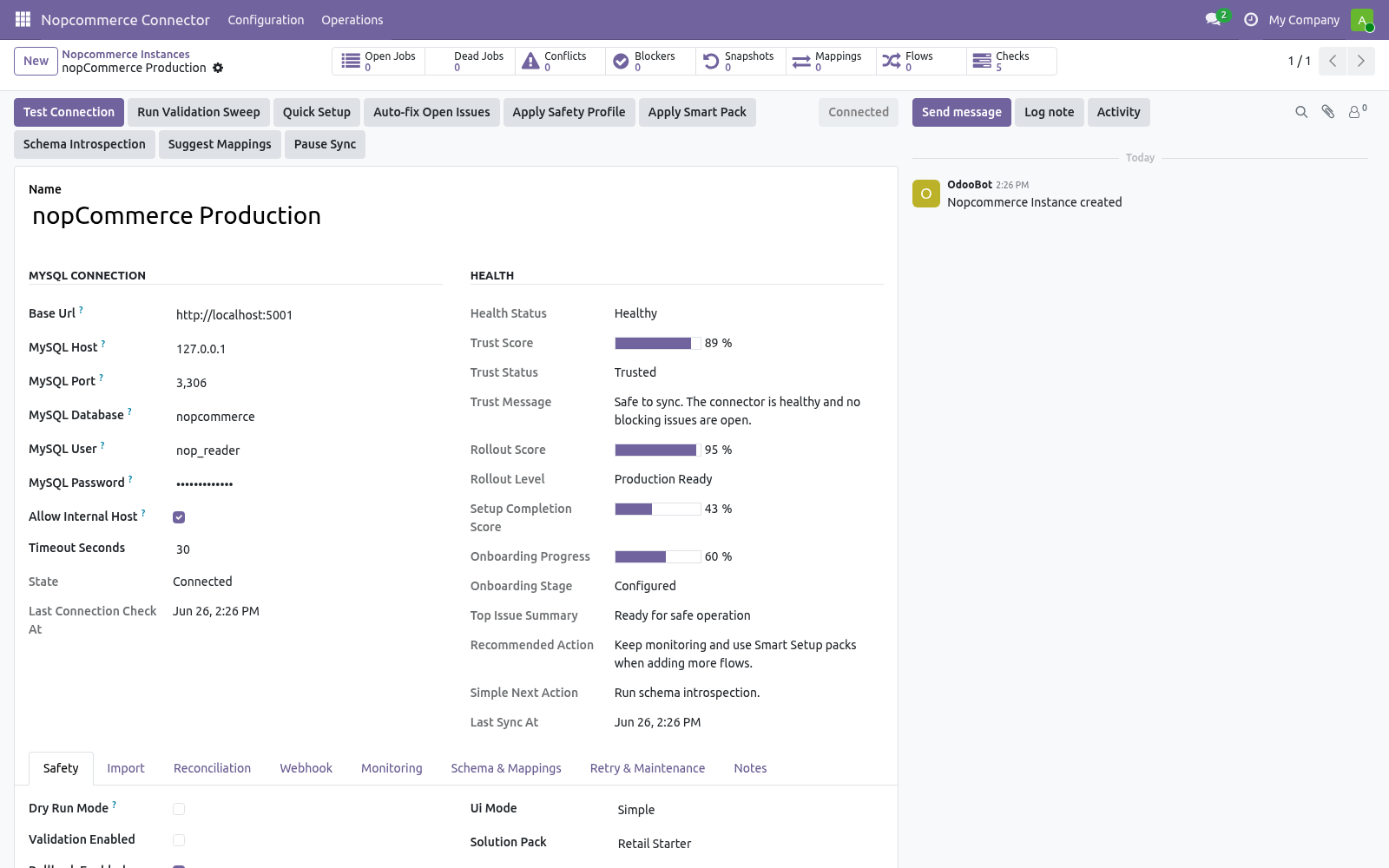
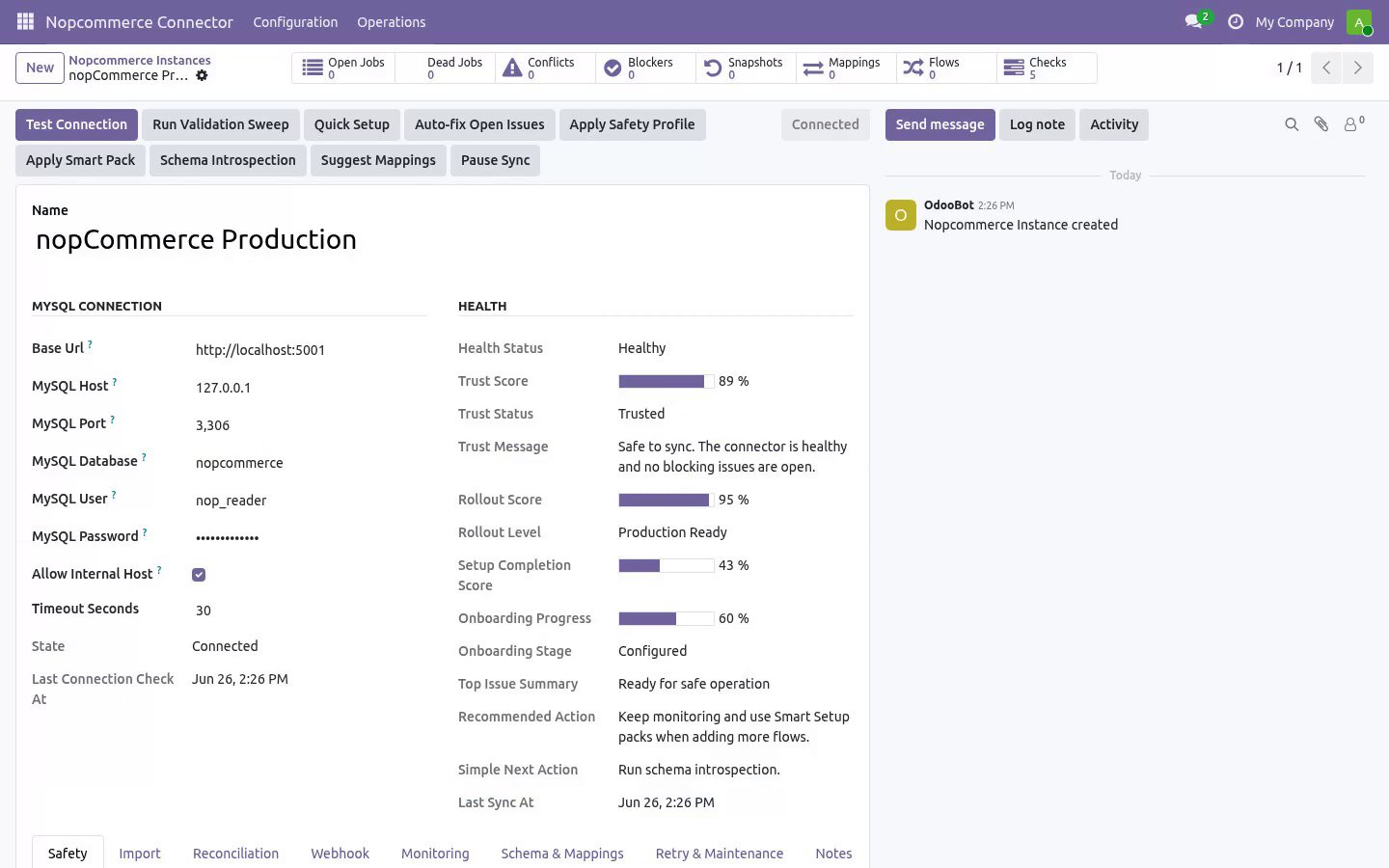
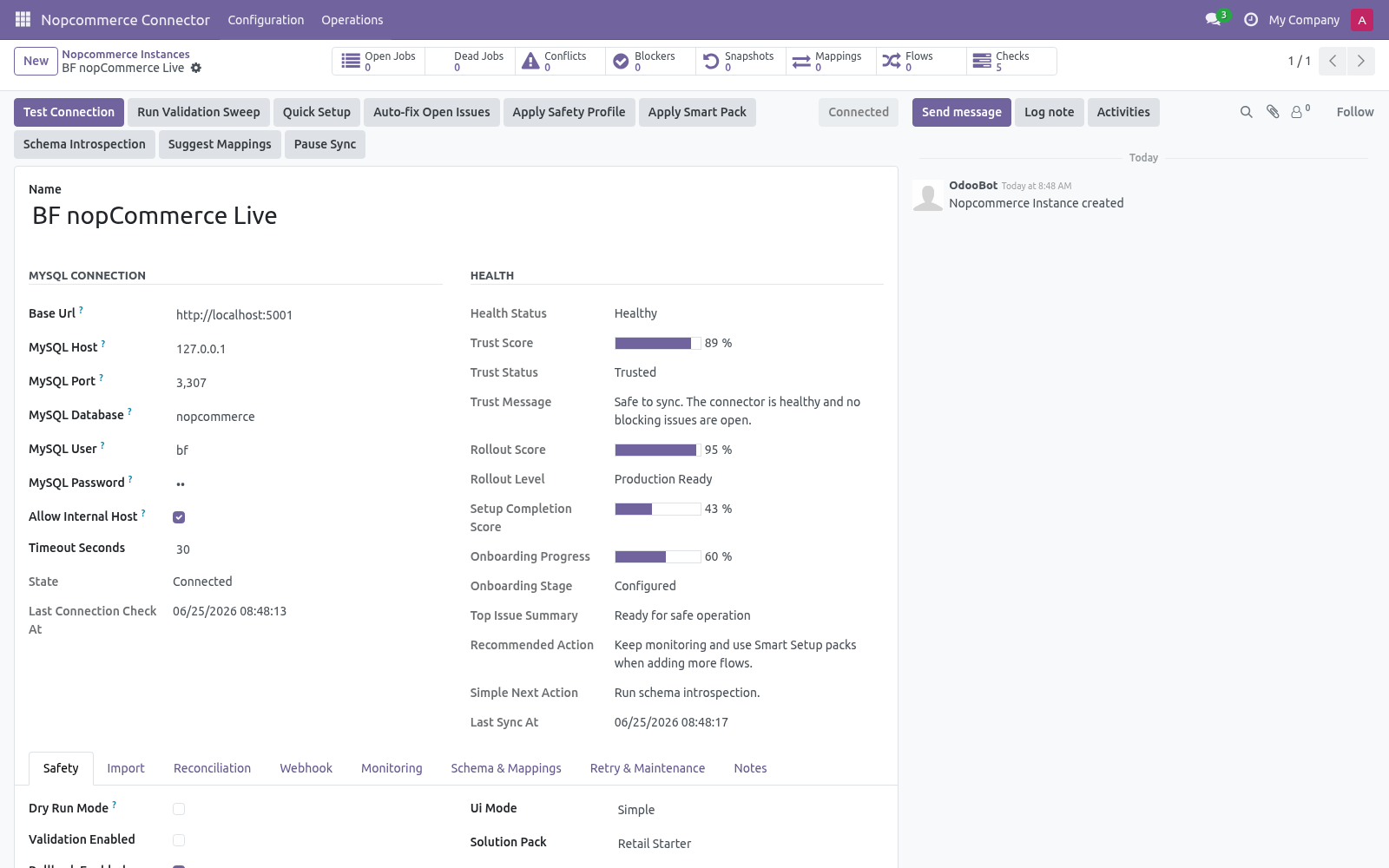
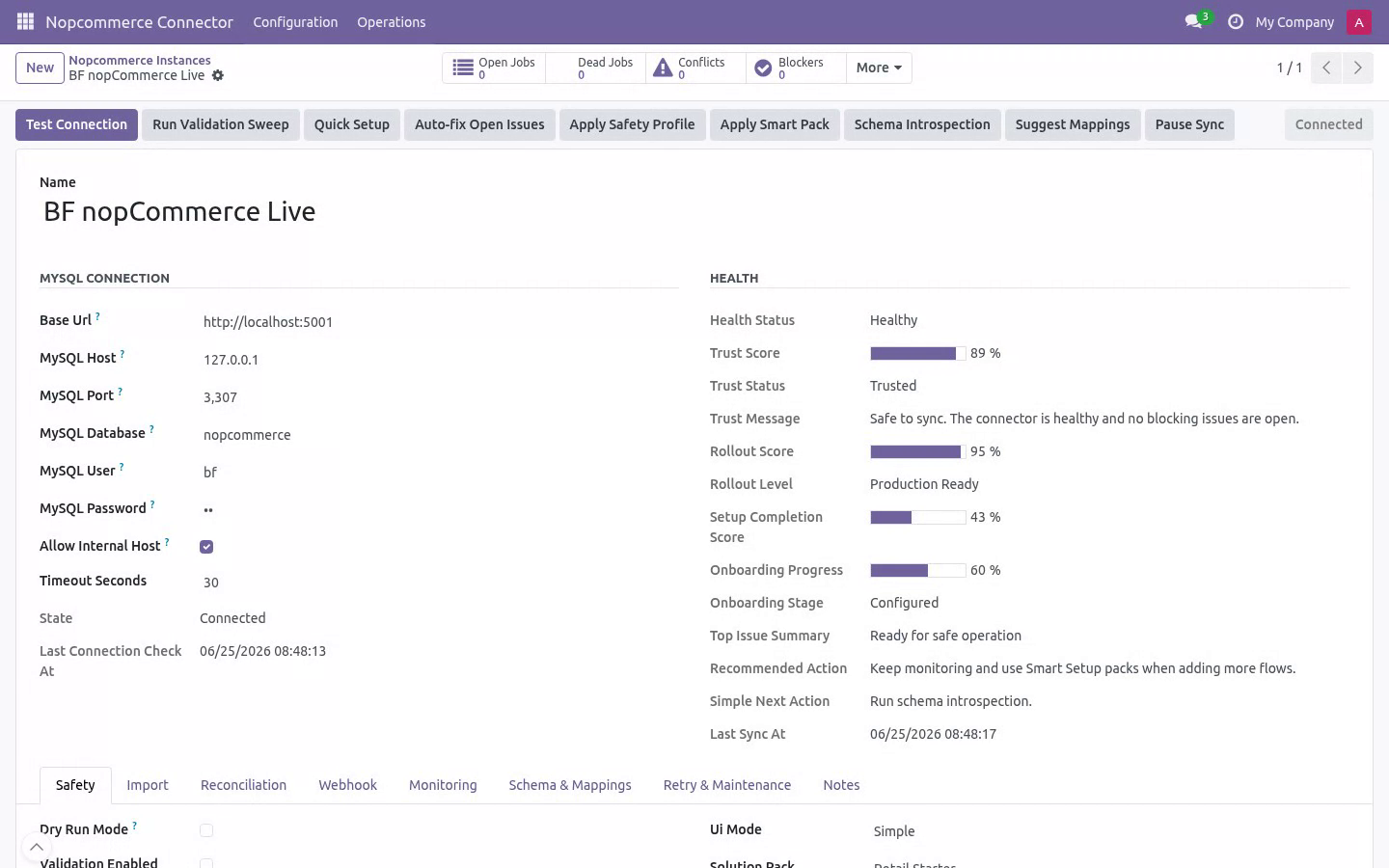
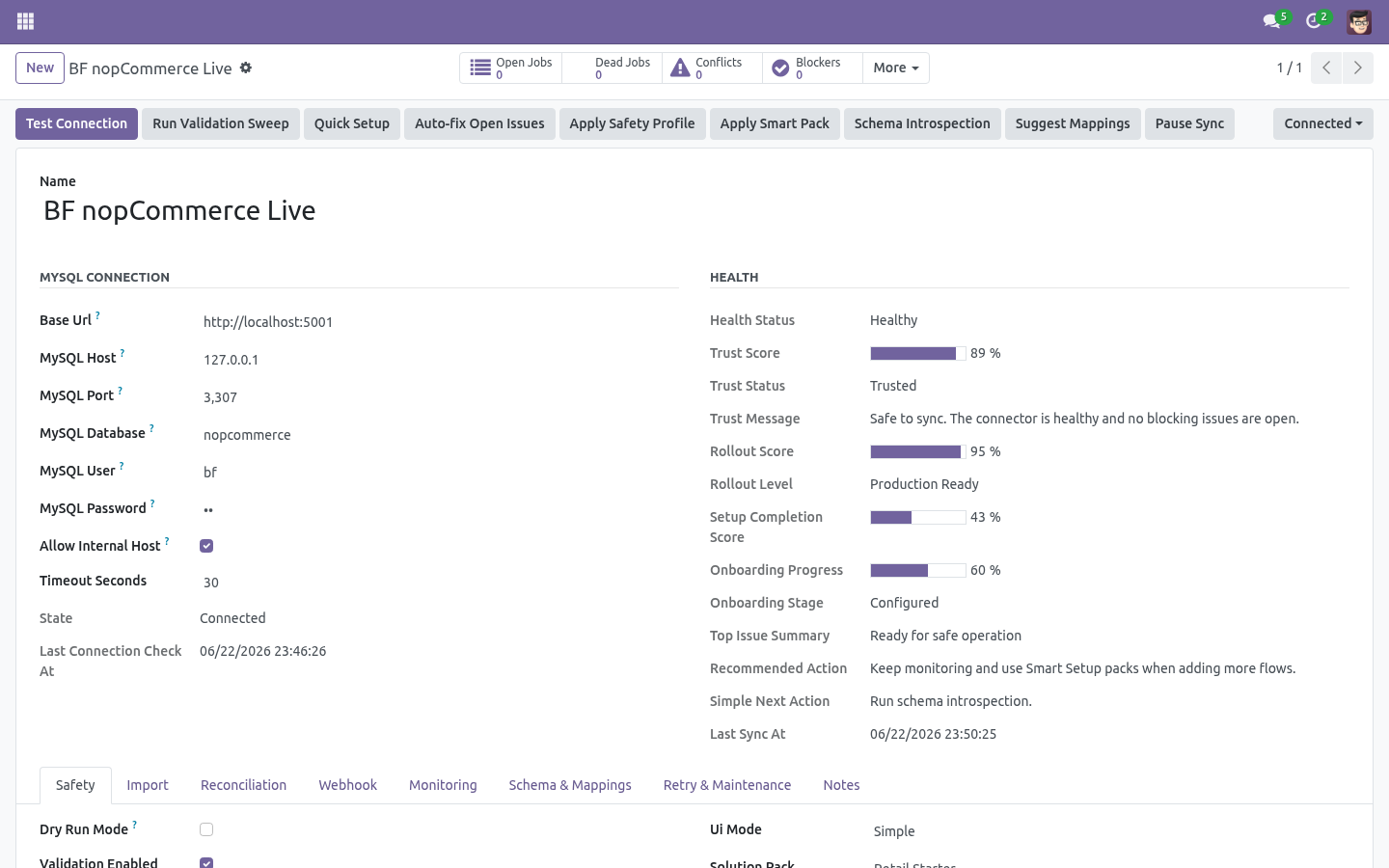
Then click Test Connection. The connector opens a database connection and runs SELECT 1. A green Connected state means the host, port, database name and credentials are correct. On the first successful connect, the default order-status mapping table is seeded automatically.
If it fails, the exact error is shown on the form and recorded in Logs (see Troubleshooting). Step 3 — First sync (dry-run, then live). New instances start with Dry-run ON. In dry-run, import jobs simulate writes: instead of changing data they produce Validation Results you can review under nopCommerce Connector ▸ Operations ▸ Validation Results.
This lets you confirm what would happen before anything is written. 1. On the instance, click Import Products (and/or Import Customers, Import Orders). This enqueues jobs; it does not block the UI.
2. Jobs are processed by the nopCommerce Queue Processor scheduled action (every minute), or immediately if you run it manually from Operations ▸ Queue Jobs. 3. Review Validation Results while still in dry-run.
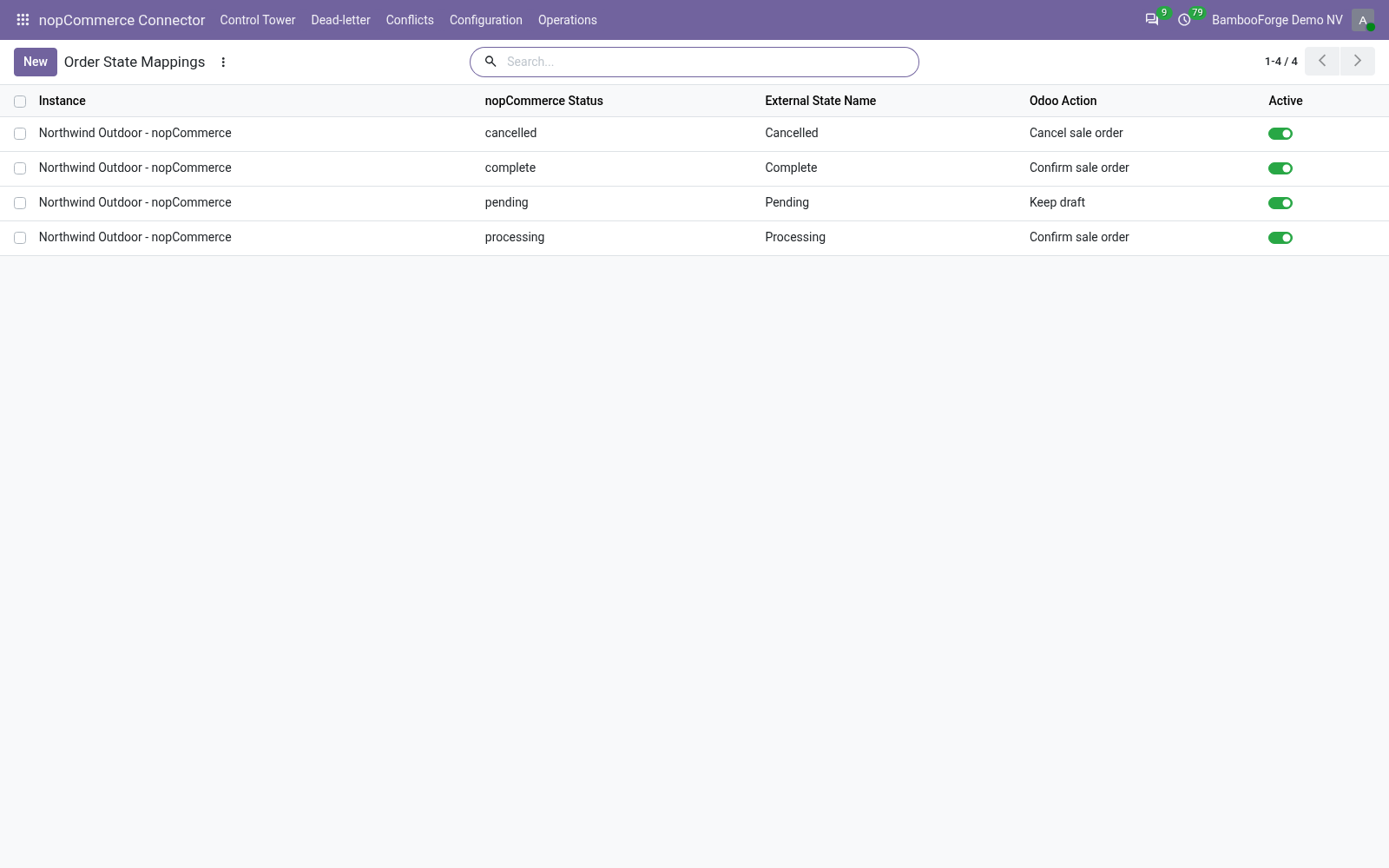
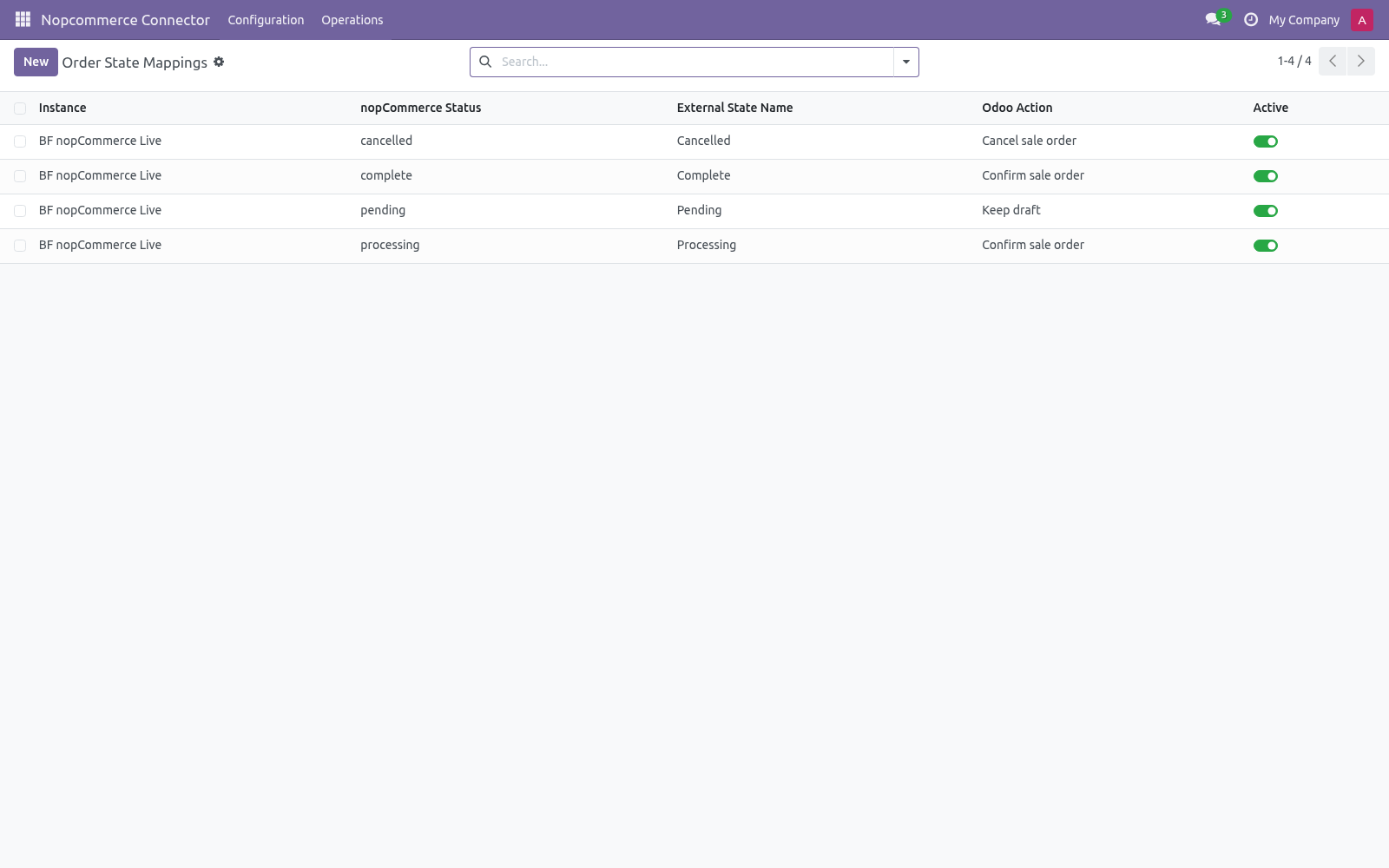
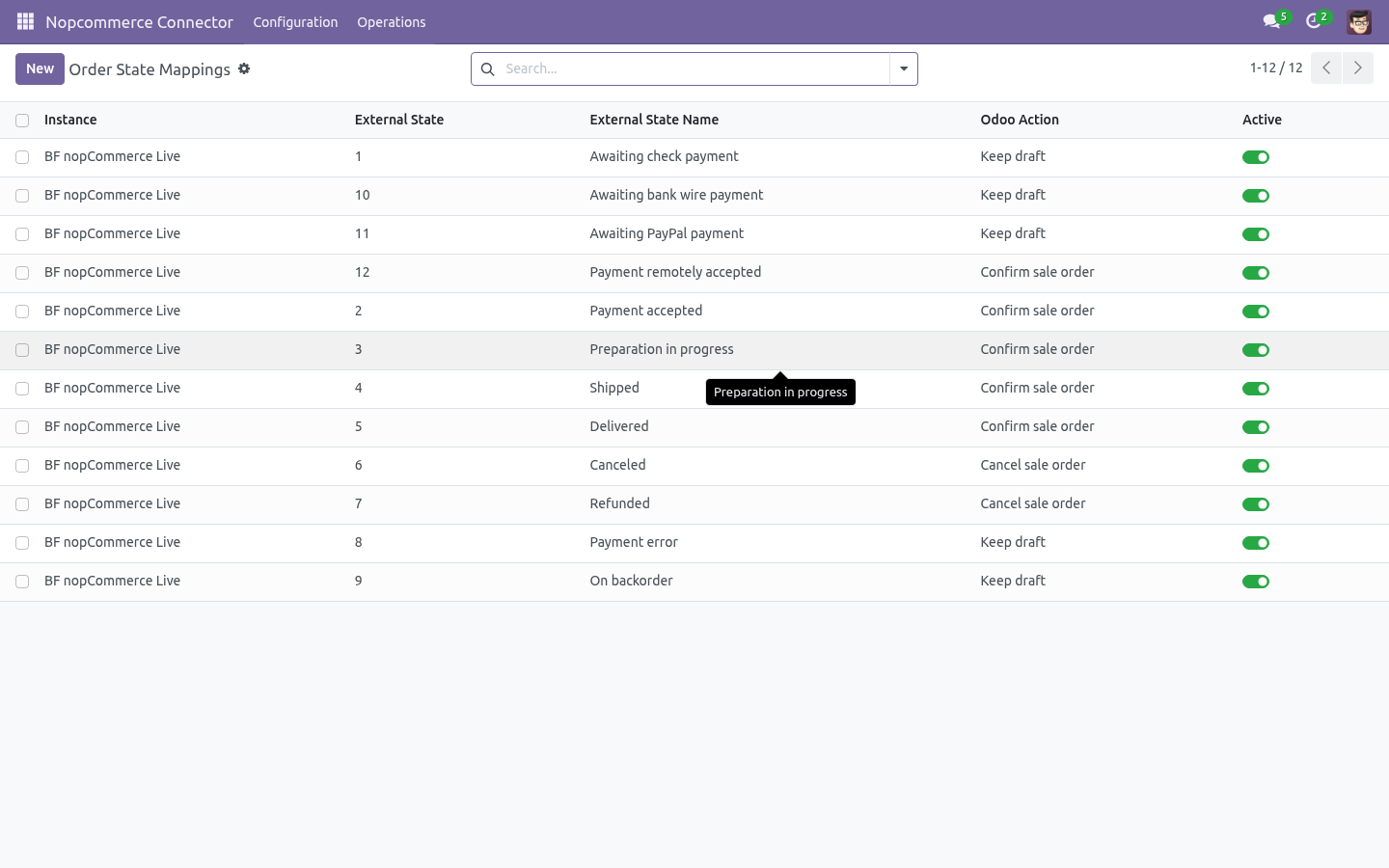
4. When satisfied, open the instance, turn Dry-run OFF, and run the imports again to write the records for real. Order status mapping. nopCommerce stores each order's status as a numeric OrderStatusId, which the connector normalizes to a status slug (pending, processing, complete, cancelled).
Under Configuration ▸ Order State Mappings each instance gets a default table that decides what happens to the Odoo sale order when an order arrives in a given status: Change any row to Ignore (do nothing), Keep draft, Confirm sale order or Cancel sale order. Unknown/unmapped statuses default to Ignore, so a status you have not mapped never triggers a destructive transition. Field mapping & customization Field Mappings (Configuration) map nopCommerce columns to Odoo fields per model. Use Generate suggested mappings on the instance to seed the business-critical ones, then adjust.
The mapping board flags fields that need attention. Schema Fields lists the discovered nopCommerce columns per resource. Run Schema Introspection on the instance to refresh it (it samples live rows; if the database is unreachable it falls back to the bundled sample row so you can still review the mapping). Stock / images / tax are opt-in toggles on the instance: Sync stock (reads StockQuantity), Sync images (and max images), Sync taxes / Auto-match taxes (best effort, name-based, never auto-creates taxes).
They are off by default; turn on only what you need. Automation (scheduled actions). Sync is schedule-driven only. nopCommerce has no REST API and emits no events, so there are no real-time webhooks — the connector polls the database on a cron, like a database mirror.
The module ships these scheduled actions (Settings ▸ Technical ▸ Scheduled Actions): Turn on Auto import / Auto reconcile per model on the instance to let the scheduled actions keep things in sync hands-free. Safety features Read-only by design — the connector only ever runs SELECT queries against nopCommerce; it never writes, updates or deletes there. Use a read-only MySQL grant (Step 1) to enforce this at the database level. Dry-run mode — simulate writes and review Validation Results before going live.
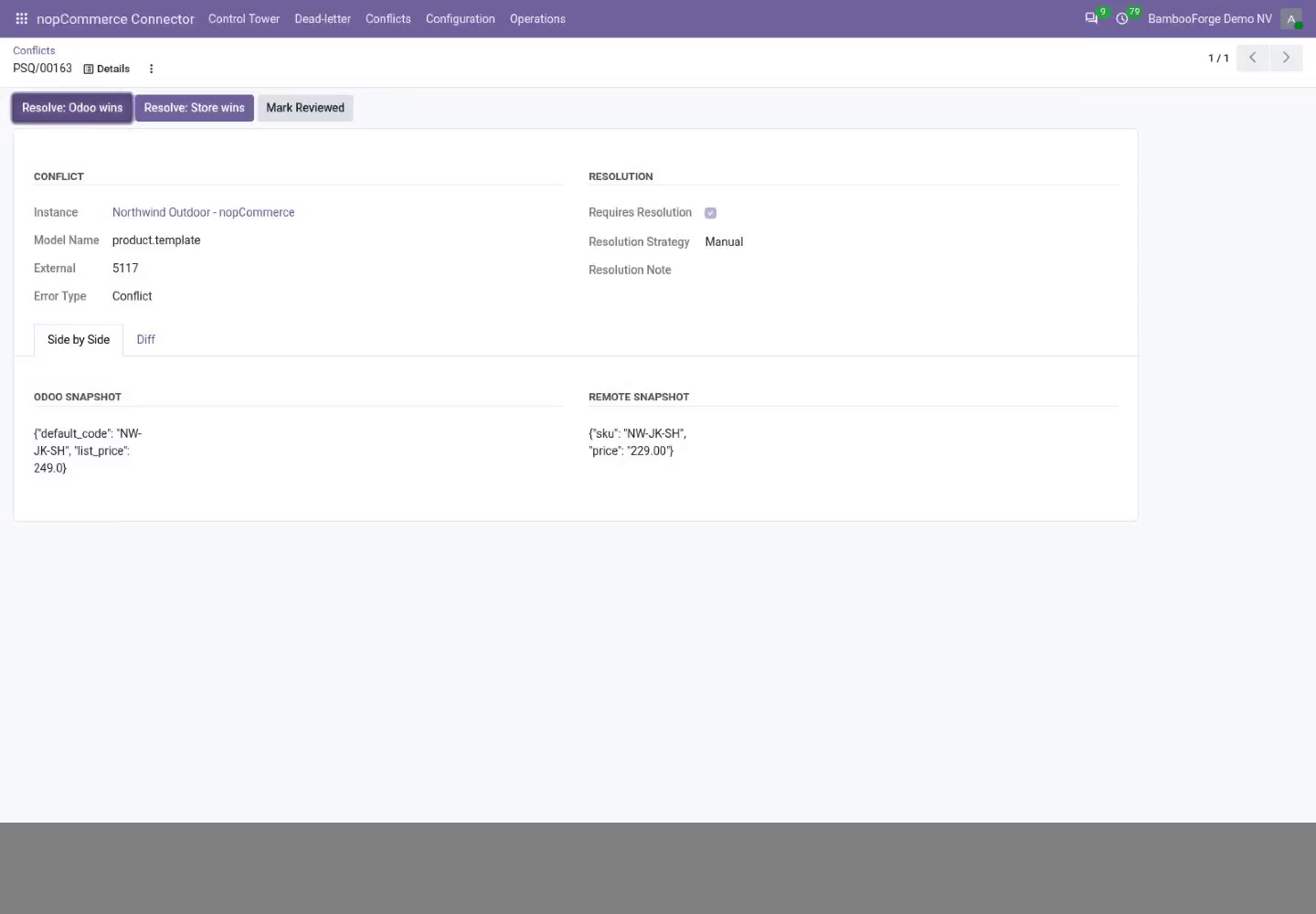
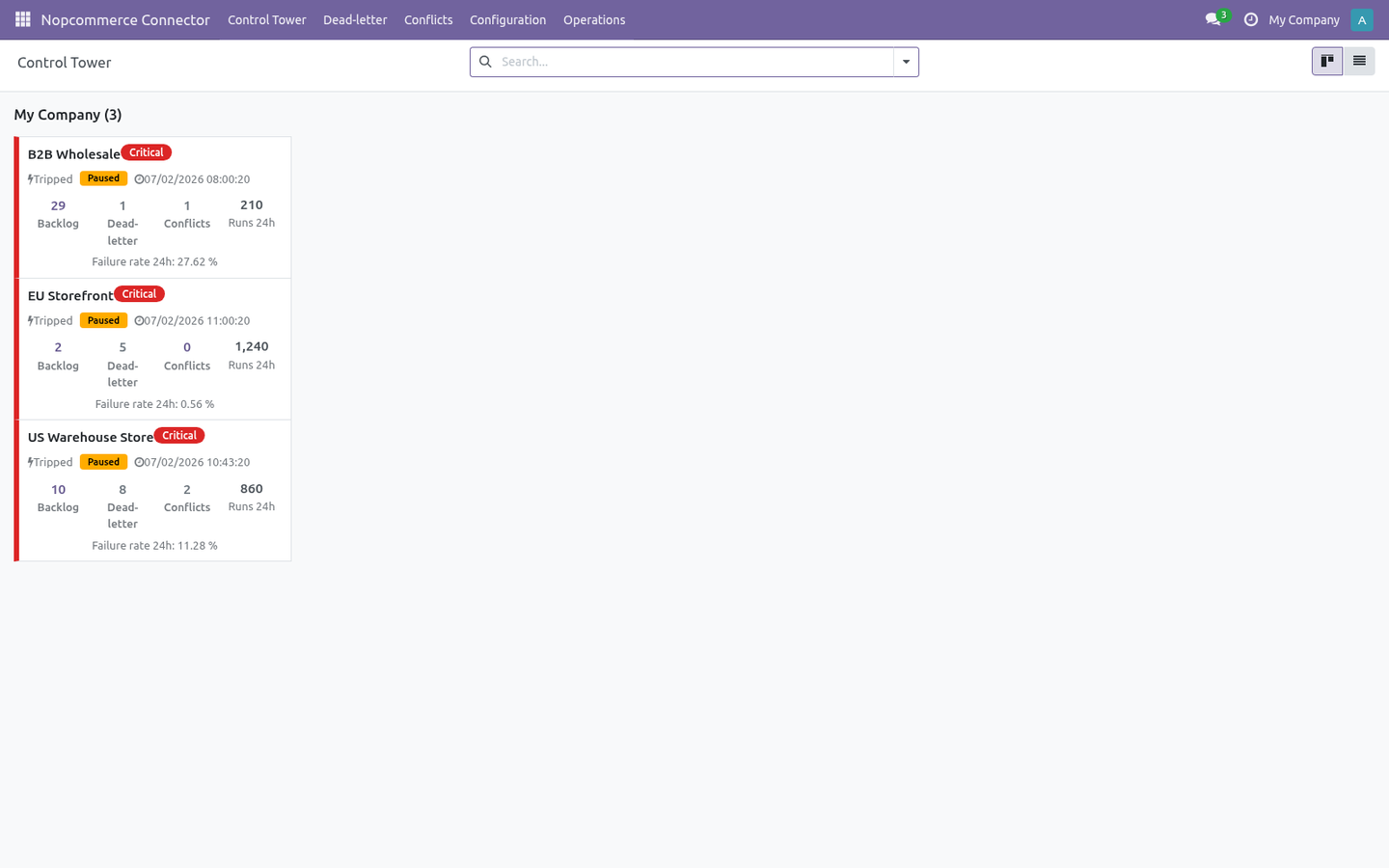
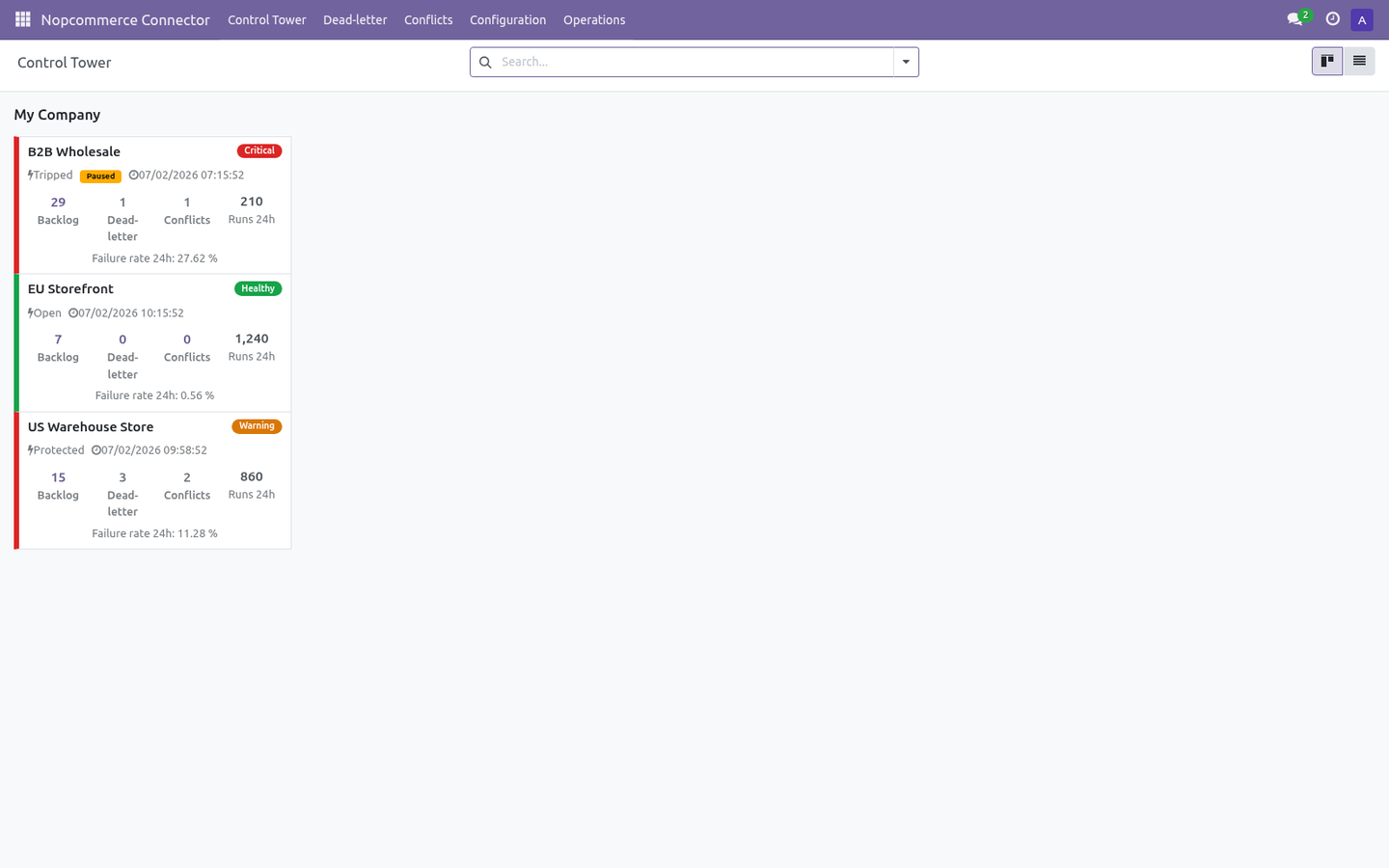
Business validation profiles — Minimal / Standard / Strict gate risky writes into Odoo. Resilient queue — every read/import action is a job with retry and exponential back-off. Circuit breaker — after repeated failures an instance auto-pauses (Tripped); the Auto Recover action reopens it once the database responds again. Rollback snapshots — when enabled, imports capture a snapshot so you can undo a batch from Operations ▸ Rollback Snapshots.
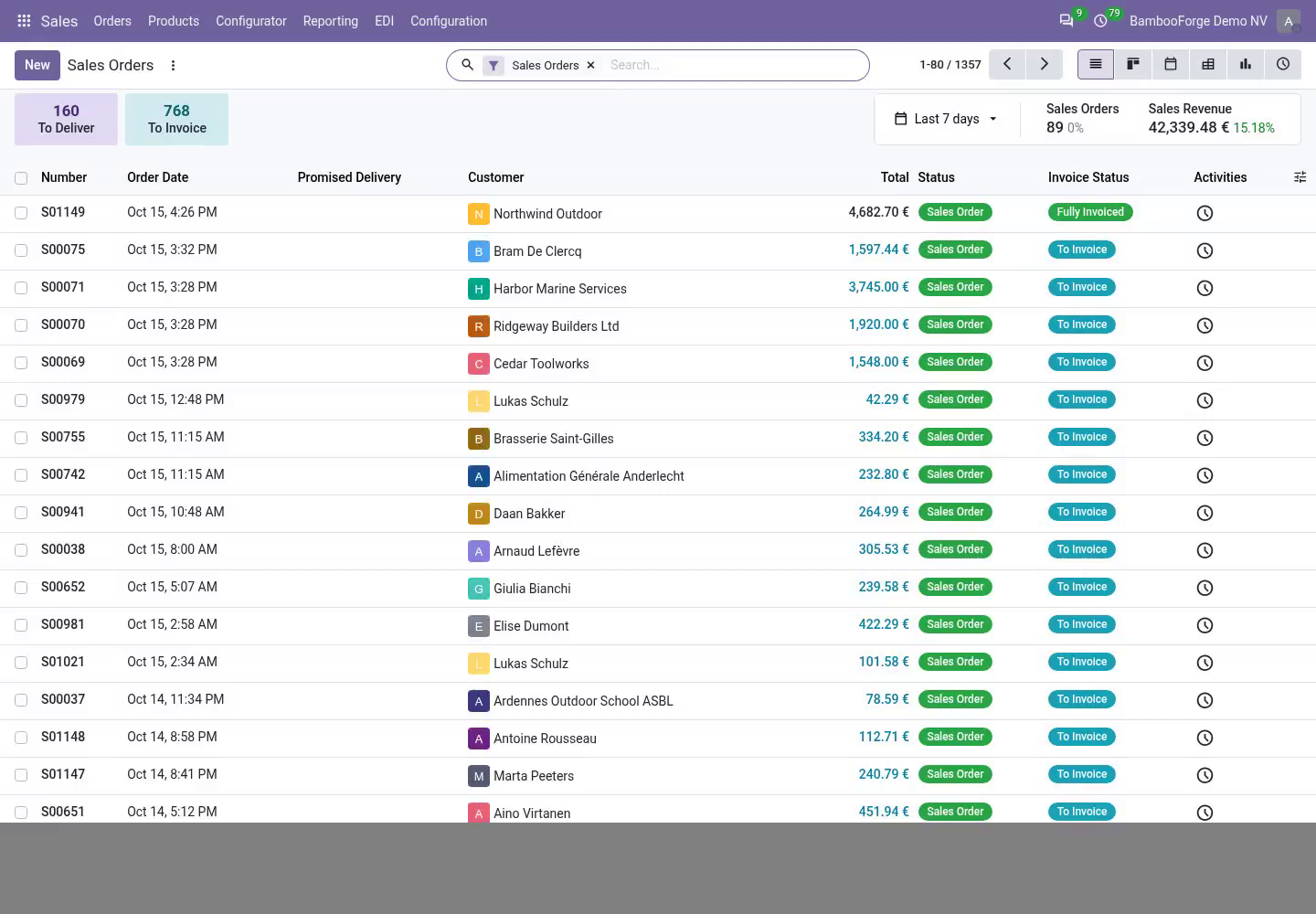
SSRF guard — the connector refuses an internal/loopback/private storefront Base URL unless Allow internal host is explicitly enabled. Where nopCommerce shows up in Odoo. The connector stays out of the way on records that have nothing to do with nopCommerce: Sales orders - the nopCommerce tab, Queue nopCommerce Export and nopCommerce Binding appear only on orders that came from nopCommerce, are bound to nopCommerce, or belong to a customer bound to nopCommerce. Products and contacts - the nopCommerce tab appears once an active nopCommerce connection exists; the nopCommerce Binding button inside it appears once the record is bound.
List views, the sync queue and the control tower are unchanged. Now the part most videos leave out: what this does not do. The connector reads products, customers and orders from the nopCommerce MySQL database and writes the corresponding Odoo records. The MySQL credentials are stored in admin-only fields.
Read-only: the connector never writes to, updates or deletes anything in nopCommerce. It opens the database connection only to run SELECT queries. In scope today: product/customer/order import, order-status mapping, scheduled sync, dry-run, validation and rollback. Out of scope / roadmap: refund/credit-note import and inbound webhooks are not yet supported.
Export back to nopCommerce is not supported (read-only by design). Tax auto-matching is best-effort, name-based and never auto-creates taxes; multi-warehouse stock routing is not handled. The complete manual is at docs dot bambooforge dot dev, the demo database is linked from the store page, and support answers within twenty-four hours. Links are in the description.
Transcript of the walkthrough (Odoo 19)
nopCommerce Connector. Read-only nopCommerce import: products, customers and orders read straight from the nopCommerce database on a schedule - no REST API needed. The connector imports data from nopCommerce into Odoo by reading the nopCommerce MySQL database directly (via the pymysql library) with the credentials you supply. nopCommerce has no built-in REST API, so there is no API key to generate and no plugin to install on the store side — only read access to the database.
It covers: In the next few minutes: nopcommerce connector, then matching the storefront total, then step 2 — create the connection in odoo, then step 3 — first sync (dry-run, then live), then order status mapping. Then what this app deliberately does not do, so you can tell before you buy whether it fits. Everything lives under Nopcommerce Connector then Control Tower then Dead-letter then Conflicts. nopCommerce Connector.
A read-only bridge from your nopCommerce store into Odoo 19: import products, customers and orders on a schedule by reading the nopCommerce MySQL database directly — with a resilient job queue, dry-run safety, validation and rollback so you stay in control. nopCommerce ships no REST API by default, so the connector never depends on one: it connects to the database with read-only credentials and never writes back. This page is the complete manual. If you follow it top to bottom you can install, connect, run your first sync, automate it, and fix the common issues without contacting support.
Matching the storefront total. A storefront charges shipping and grants discounts outside the product lines, so an order rebuilt from those lines alone is worth less than the order the customer paid for: the sale looks smaller than it was and never reconciles against the platform payout. the shipping charge is imported as its own order line, on a clearly named service product; whatever still separates Odoo from the platform total — platform discounts, fees, rounding — is posted as a single adjustment line rather than dropped; the platform total and the remaining difference are stored on the order and shown on its connector tab; an order that still does not match within Total Tolerance raises a validation warning, so the gap is visible instead of silent. With Match Storefront Totals on the instance (on by default): Step 2 — Create the connection in Odoo.
Open nopCommerce Connector ▸ Configuration ▸ Instances and create a record. A label for this store, e.g. My Live Store. Hostname or IP of the nopCommerce MySQL server.
Default 127.0.0.1. TCP port of the MySQL server. Default 3306. - MySQL Database Name of the nopCommerce database/schema, e.g.
nopcommerce. The read-only user from Step 1, e.g. odoo_ro (administrators only). - MySQL Password The password for that user (administrators only).
Then click Test Connection. The connector opens a database connection and runs SELECT 1. A green Connected state means the host, port, database name and credentials are correct. On the first successful connect, the default order-status mapping table is seeded automatically.
If it fails, the exact error is shown on the form and recorded in Logs (see Troubleshooting). Step 3 — First sync (dry-run, then live). New instances start with Dry-run ON. In dry-run, import jobs simulate writes: instead of changing data they produce Validation Results you can review under nopCommerce Connector ▸ Operations ▸ Validation Results.
This lets you confirm what would happen before anything is written. 1. On the instance, click Import Products (and/or Import Customers, Import Orders). This enqueues jobs; it does not block the UI.
2. Jobs are processed by the Nopcommerce Queue Processor scheduled action (every minute), or immediately if you run it manually from Operations ▸ Queue Jobs. 3. Review Validation Results while still in dry-run.
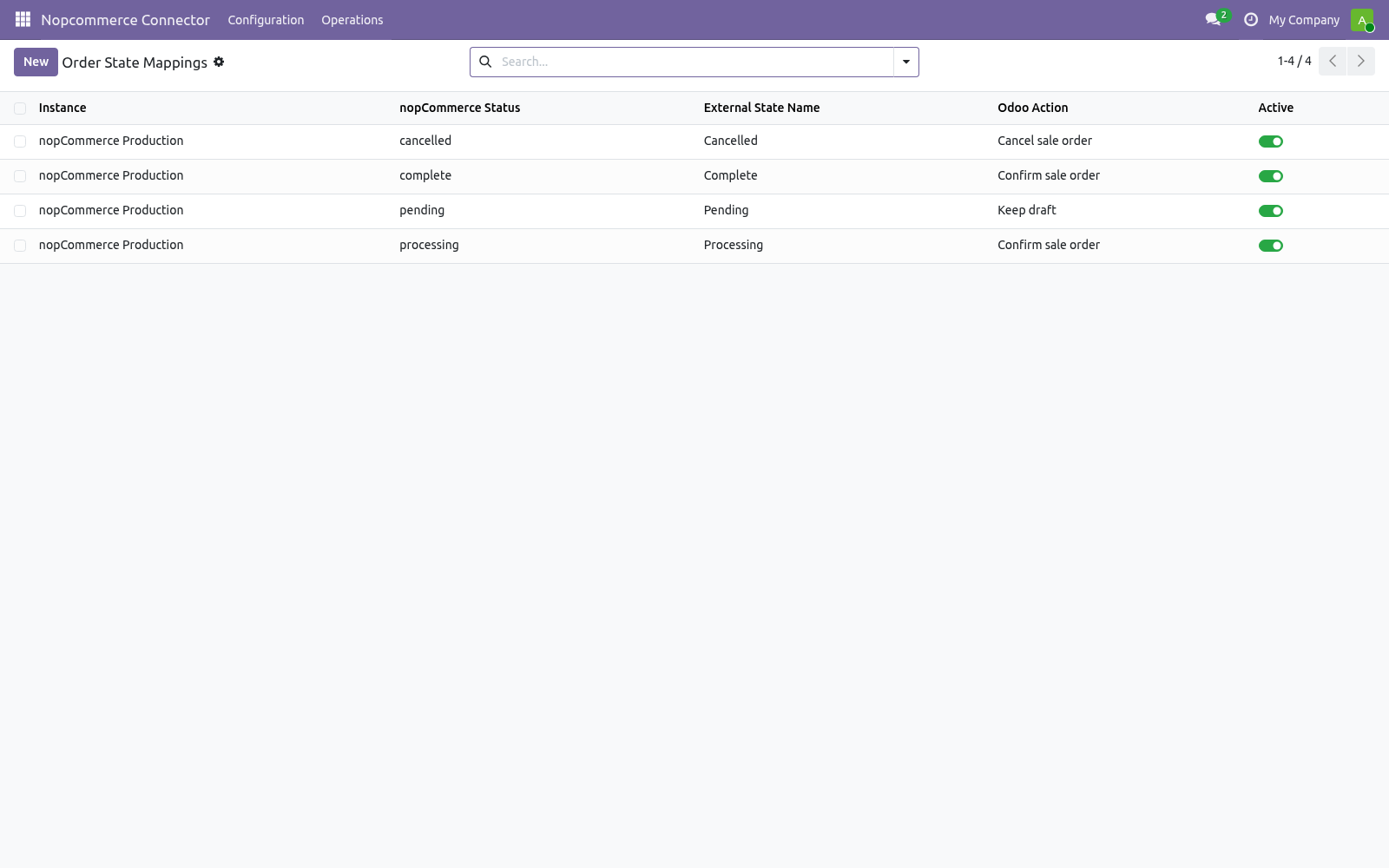
4. When satisfied, open the instance, turn Dry-run OFF, and run the imports again to write the records for real. Order status mapping. nopCommerce stores each order's status as a numeric OrderStatusId, which the connector normalizes to a status slug (pending, processing, complete, cancelled).
Under Configuration ▸ Order State Mappings each instance gets a default table that decides what happens to the Odoo sale order when an order arrives in a given status: - nopCommerce status Default Odoo action Confirm sale order Cancel sale order Change any row to Ignore (do nothing), Keep draft, Confirm sale order or Cancel sale order. Unknown/unmapped statuses default to Ignore, so a status you have not mapped never triggers a destructive transition. Field mapping & customization Field Mappings (Configuration) map nopCommerce columns to Odoo fields per model. Use Generate suggested mappings on the instance to seed the business-critical ones, then adjust.
The mapping board flags fields that need attention. Schema Fields lists the discovered nopCommerce columns per resource. Run Schema Introspection on the instance to refresh it (it samples live rows; if the database is unreachable it falls back to the bundled sample row so you can still review the mapping). Stock / images / tax are opt-in toggles on the instance: Sync stock (reads StockQuantity), Sync images (and max images), Sync taxes / Auto-match taxes (best effort, name-based, never auto-creates taxes).
They are off by default; turn on only what you need. Automation (scheduled actions). Sync is schedule-driven only. nopCommerce has no REST API and emits no events, so there are no real-time webhooks — the connector polls the database on a cron, like a database mirror.
The module ships these scheduled actions (Settings ▸ Technical ▸ Scheduled Actions): - Scheduled action - Nopcommerce Queue Processor Processes queued import jobs. - Nopcommerce Reconciliation Re-reads recent rows for enabled models and re-queues anything missing. - Nopcommerce Maintenance Recovers stale/locked jobs and trims old logs. - Nopcommerce Flow Scheduler Turn on Auto import / Auto reconcile per model on the instance to let the scheduled actions keep things in sync hands-free.
Safety features Read-only by design — the connector only ever runs SELECT queries against nopCommerce; it never writes, updates or deletes there. Use a read-only MySQL grant (Step 1) to enforce this at the database level. Dry-run mode — simulate writes and review Validation Results before going live. Business validation profiles — Minimal / Standard / Strict gate risky writes into Odoo.
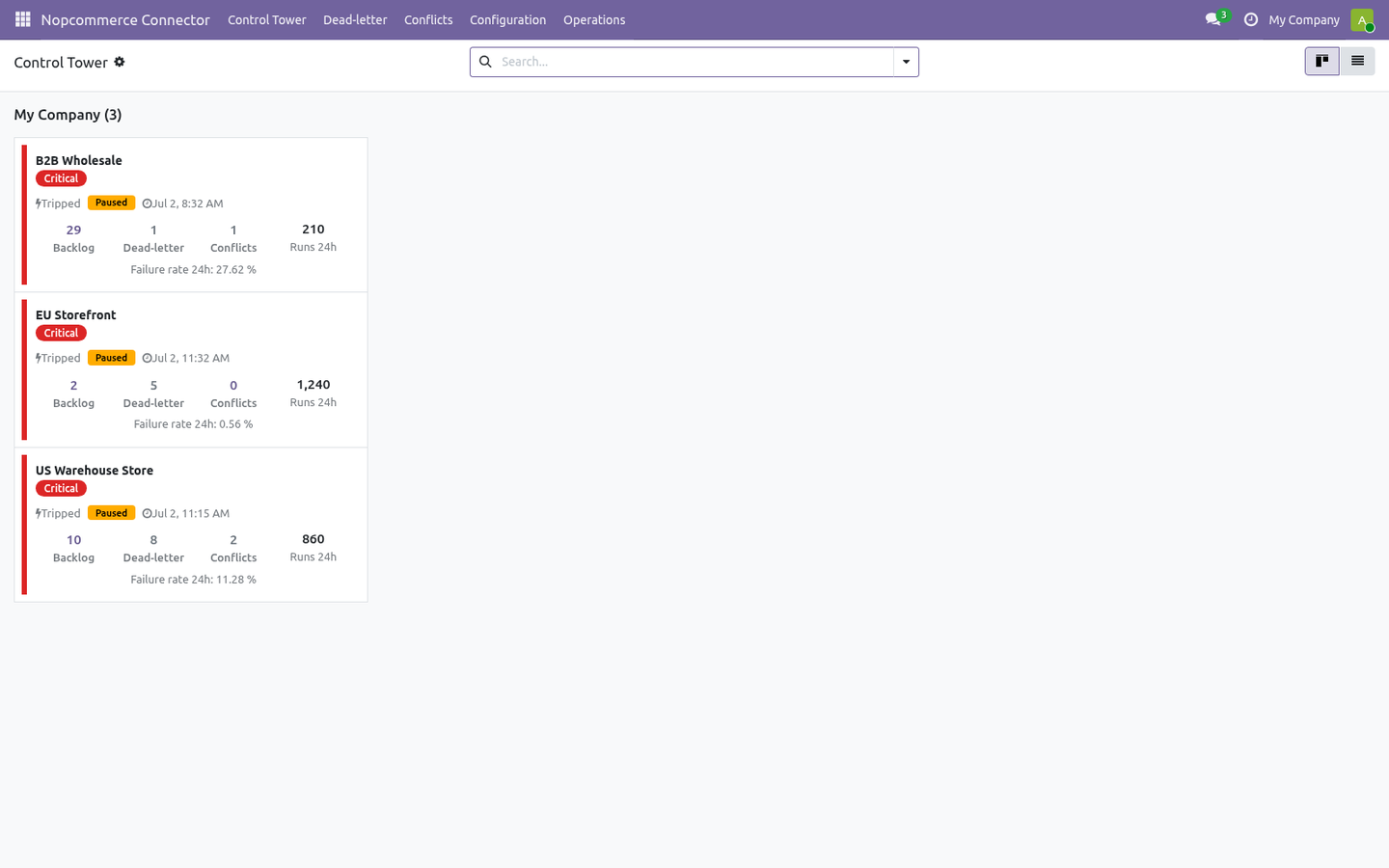
Resilient queue — every read/import action is a job with retry and exponential back-off. Circuit breaker — after repeated failures an instance auto-pauses (Tripped); the Auto Recover action reopens it once the database responds again. Rollback snapshots — when enabled, imports capture a snapshot so you can undo a batch from Operations ▸ Rollback Snapshots. SSRF guard — the connector refuses an internal/loopback/private storefront Base URL unless Allow internal host is explicitly enabled.
Troubleshooting. For anything else, Operations ▸ Logs records every database read and error with a timestamp. - Test Connection fails: "pymysql ... is required" The pymysql library is not installed on the Odoo server.
Run pip install pymysql and restart Odoo. - Test Connection fails: access denied / authentication error Wrong MySQL user or password, or the user lacks rights on this database. Re-check the MySQL User / Password and the GRANT SELECT from Step 1. - Test Connection fails: can't connect / host not reachable / timeout The Odoo server cannot reach the MySQL host:port.
Check the MySQL Host and Port, that MySQL's bind-address allows remote connections, and that port 3306 is open in the firewall. - Test Connection fails: "MySQL database name is required" The MySQL Database field is empty. Enter the nopCommerce schema name. Frequently asked questions.
Which versions are supported? Odoo 19.0 on the Odoo side. On the store side the connector was live-tested on nopCommerce 4.80 on MySQL/MariaDB and reads the standard 4.x schema. Validate your exact build with the bundled sample fixtures first.
Do I need nopCommerce installed to evaluate it? Not for the mapping. Bundled nopCommerce-row-shaped sample fixtures let you install the module, run schema introspection and explore the field mappings. A real import needs a reachable MySQL database.
Now the part most videos leave out: what this does not do. The connector reads products, customers and orders from the nopCommerce MySQL database and writes the corresponding Odoo records. The MySQL credentials are stored in admin-only fields. Read-only: the connector never writes to, updates or deletes anything in nopCommerce.
It opens the database connection only to run SELECT queries. In scope today: product/customer/order import, order-status mapping, scheduled sync, dry-run, validation and rollback. Out of scope / roadmap: refund/credit-note import and inbound webhooks are not yet supported. Export back to nopCommerce is not supported (read-only by design).
Tax auto-matching is best-effort, name-based and never auto-creates taxes; multi-warehouse stock routing is not handled. The complete manual is at docs dot bambooforge dot dev, the demo database is linked from the store page, and support answers within twenty-four hours. Links are in the description.
Transcript of the walkthrough (Odoo 18)
nopCommerce Connector. Read-only nopCommerce import: products, customers and orders read straight from the nopCommerce database on a schedule - no REST API needed. The connector imports data from nopCommerce into Odoo by reading the nopCommerce MySQL database directly (via the pymysql library) with the credentials you supply. nopCommerce has no built-in REST API, so there is no API key to generate and no plugin to install on the store side — only read access to the database.
It covers: In the next few minutes: nopcommerce connector, then matching the storefront total, then step 2 — create the connection in odoo, then step 3 — first sync (dry-run, then live), then order status mapping. Then what this app deliberately does not do, so you can tell before you buy whether it fits. Everything lives under Nopcommerce Connector then Control Tower then Dead-letter then Conflicts. nopCommerce Connector.
A read-only bridge from your nopCommerce store into Odoo 18: import products, customers and orders on a schedule by reading the nopCommerce MySQL database directly — with a resilient job queue, dry-run safety, validation and rollback so you stay in control. nopCommerce ships no REST API by default, so the connector never depends on one: it connects to the database with read-only credentials and never writes back. This page is the complete manual. If you follow it top to bottom you can install, connect, run your first sync, automate it, and fix the common issues without contacting support.
Matching the storefront total. A storefront charges shipping and grants discounts outside the product lines, so an order rebuilt from those lines alone is worth less than the order the customer paid for: the sale looks smaller than it was and never reconciles against the platform payout. the shipping charge is imported as its own order line, on a clearly named service product; whatever still separates Odoo from the platform total — platform discounts, fees, rounding — is posted as a single adjustment line rather than dropped; the platform total and the remaining difference are stored on the order and shown on its connector tab; an order that still does not match within Total Tolerance raises a validation warning, so the gap is visible instead of silent. With Match Storefront Totals on the instance (on by default): Step 2 — Create the connection in Odoo.
Open nopCommerce Connector ▸ Configuration ▸ Instances and create a record. A label for this store, e.g. My Live Store. Hostname or IP of the nopCommerce MySQL server.
Default 127.0.0.1. TCP port of the MySQL server. Default 3306. - MySQL Database Name of the nopCommerce database/schema, e.g.
nopcommerce. The read-only user from Step 1, e.g. odoo_ro (administrators only). - MySQL Password The password for that user (administrators only).
Then click Test Connection. The connector opens a database connection and runs SELECT 1. A green Connected state means the host, port, database name and credentials are correct. On the first successful connect, the default order-status mapping table is seeded automatically.
If it fails, the exact error is shown on the form and recorded in Logs (see Troubleshooting). Step 3 — First sync (dry-run, then live). New instances start with Dry-run ON. In dry-run, import jobs simulate writes: instead of changing data they produce Validation Results you can review under nopCommerce Connector ▸ Operations ▸ Validation Results.
This lets you confirm what would happen before anything is written. 1. On the instance, click Import Products (and/or Import Customers, Import Orders). This enqueues jobs; it does not block the UI.
2. Jobs are processed by the Nopcommerce Queue Processor scheduled action (every minute), or immediately if you run it manually from Operations ▸ Queue Jobs. 3. Review Validation Results while still in dry-run.
4. When satisfied, open the instance, turn Dry-run OFF, and run the imports again to write the records for real. Order status mapping. nopCommerce stores each order's status as a numeric OrderStatusId, which the connector normalizes to a status slug (pending, processing, complete, cancelled).
Under Configuration ▸ Order State Mappings each instance gets a default table that decides what happens to the Odoo sale order when an order arrives in a given status: - nopCommerce status Default Odoo action Confirm sale order Cancel sale order Change any row to Ignore (do nothing), Keep draft, Confirm sale order or Cancel sale order. Unknown/unmapped statuses default to Ignore, so a status you have not mapped never triggers a destructive transition. Field mapping & customization Field Mappings (Configuration) map nopCommerce columns to Odoo fields per model. Use Generate suggested mappings on the instance to seed the business-critical ones, then adjust.
The mapping board flags fields that need attention. Schema Fields lists the discovered nopCommerce columns per resource. Run Schema Introspection on the instance to refresh it (it samples live rows; if the database is unreachable it falls back to the bundled sample row so you can still review the mapping). Stock / images / tax are opt-in toggles on the instance: Sync stock (reads StockQuantity), Sync images (and max images), Sync taxes / Auto-match taxes (best effort, name-based, never auto-creates taxes).
They are off by default; turn on only what you need. Automation (scheduled actions). Sync is schedule-driven only. nopCommerce has no REST API and emits no events, so there are no real-time webhooks — the connector polls the database on a cron, like a database mirror.
The module ships these scheduled actions (Settings ▸ Technical ▸ Scheduled Actions): - Scheduled action - Nopcommerce Queue Processor Processes queued import jobs. - Nopcommerce Reconciliation Re-reads recent rows for enabled models and re-queues anything missing. - Nopcommerce Maintenance Recovers stale/locked jobs and trims old logs. - Nopcommerce Flow Scheduler Turn on Auto import / Auto reconcile per model on the instance to let the scheduled actions keep things in sync hands-free.
Safety features Read-only by design — the connector only ever runs SELECT queries against nopCommerce; it never writes, updates or deletes there. Use a read-only MySQL grant (Step 1) to enforce this at the database level. Dry-run mode — simulate writes and review Validation Results before going live. Business validation profiles — Minimal / Standard / Strict gate risky writes into Odoo.
Resilient queue — every read/import action is a job with retry and exponential back-off. Circuit breaker — after repeated failures an instance auto-pauses (Tripped); the Auto Recover action reopens it once the database responds again. Rollback snapshots — when enabled, imports capture a snapshot so you can undo a batch from Operations ▸ Rollback Snapshots. SSRF guard — the connector refuses an internal/loopback/private storefront Base URL unless Allow internal host is explicitly enabled.
Troubleshooting. For anything else, Operations ▸ Logs records every database read and error with a timestamp. - Test Connection fails: "pymysql ... is required" The pymysql library is not installed on the Odoo server.
Run pip install pymysql and restart Odoo. - Test Connection fails: access denied / authentication error Wrong MySQL user or password, or the user lacks rights on this database. Re-check the MySQL User / Password and the GRANT SELECT from Step 1. - Test Connection fails: can't connect / host not reachable / timeout The Odoo server cannot reach the MySQL host:port.
Check the MySQL Host and Port, that MySQL's bind-address allows remote connections, and that port 3306 is open in the firewall. - Test Connection fails: "MySQL database name is required" The MySQL Database field is empty. Enter the nopCommerce schema name. Frequently asked questions.
Which versions are supported? Odoo 18.0 on the Odoo side. On the store side the connector was live-tested on nopCommerce 4.80 on MySQL/MariaDB and reads the standard 4.x schema. Validate your exact build with the bundled sample fixtures first.
Do I need nopCommerce installed to evaluate it? Not for the mapping. Bundled nopCommerce-row-shaped sample fixtures let you install the module, run schema introspection and explore the field mappings. A real import needs a reachable MySQL database.
Now the part most videos leave out: what this does not do. The connector reads products, customers and orders from the nopCommerce MySQL database and writes the corresponding Odoo records. The MySQL credentials are stored in admin-only fields. Read-only: the connector never writes to, updates or deletes anything in nopCommerce.
It opens the database connection only to run SELECT queries. In scope today: product/customer/order import, order-status mapping, scheduled sync, dry-run, validation and rollback. Out of scope / roadmap: refund/credit-note import and inbound webhooks are not yet supported. Export back to nopCommerce is not supported (read-only by design).
Tax auto-matching is best-effort, name-based and never auto-creates taxes; multi-warehouse stock routing is not handled. The complete manual is at docs dot bambooforge dot dev, the demo database is linked from the store page, and support answers within twenty-four hours. Links are in the description.
Transcript of the walkthrough (Odoo 17)
nopCommerce Connector. Read-only nopCommerce import: products, customers and orders read straight from the nopCommerce database on a schedule - no REST API needed. The connector imports data from nopCommerce into Odoo by reading the nopCommerce MySQL database directly (via the pymysql library) with the credentials you supply. nopCommerce has no built-in REST API, so there is no API key to generate and no plugin to install on the store side — only read access to the database.
It covers: In the next few minutes: nopcommerce connector, then matching the storefront total, then step 2 — create the connection in odoo, then step 3 — first sync (dry-run, then live), then order status mapping. Then what this app deliberately does not do, so you can tell before you buy whether it fits. Everything lives under Nopcommerce Connector then Control Tower then Dead-letter then Conflicts. nopCommerce Connector.
A read-only bridge from your nopCommerce store into Odoo 17: import products, customers and orders on a schedule by reading the nopCommerce MySQL database directly — with a resilient job queue, dry-run safety, validation and rollback so you stay in control. nopCommerce ships no REST API by default, so the connector never depends on one: it connects to the database with read-only credentials and never writes back. This page is the complete manual. If you follow it top to bottom you can install, connect, run your first sync, automate it, and fix the common issues without contacting support.
Matching the storefront total. A storefront charges shipping and grants discounts outside the product lines, so an order rebuilt from those lines alone is worth less than the order the customer paid for: the sale looks smaller than it was and never reconciles against the platform payout. the shipping charge is imported as its own order line, on a clearly named service product; whatever still separates Odoo from the platform total — platform discounts, fees, rounding — is posted as a single adjustment line rather than dropped; the platform total and the remaining difference are stored on the order and shown on its connector tab; an order that still does not match within Total Tolerance raises a validation warning, so the gap is visible instead of silent. With Match Storefront Totals on the instance (on by default): Step 2 — Create the connection in Odoo.
Open nopCommerce Connector ▸ Configuration ▸ Instances and create a record. A label for this store, e.g. My Live Store. Hostname or IP of the nopCommerce MySQL server.
Default 127.0.0.1. TCP port of the MySQL server. Default 3306. - MySQL Database Name of the nopCommerce database/schema, e.g.
nopcommerce. The read-only user from Step 1, e.g. odoo_ro (administrators only). - MySQL Password The password for that user (administrators only).
Then click Test Connection. The connector opens a database connection and runs SELECT 1. A green Connected state means the host, port, database name and credentials are correct. On the first successful connect, the default order-status mapping table is seeded automatically.
If it fails, the exact error is shown on the form and recorded in Logs (see Troubleshooting). Step 3 — First sync (dry-run, then live). New instances start with Dry-run ON. In dry-run, import jobs simulate writes: instead of changing data they produce Validation Results you can review under nopCommerce Connector ▸ Operations ▸ Validation Results.
This lets you confirm what would happen before anything is written. 1. On the instance, click Import Products (and/or Import Customers, Import Orders). This enqueues jobs; it does not block the UI.
2. Jobs are processed by the Nopcommerce Queue Processor scheduled action (every minute), or immediately if you run it manually from Operations ▸ Queue Jobs. 3. Review Validation Results while still in dry-run.
4. When satisfied, open the instance, turn Dry-run OFF, and run the imports again to write the records for real. Order status mapping. nopCommerce stores each order's status as a numeric OrderStatusId, which the connector normalizes to a status slug (pending, processing, complete, cancelled).
Under Configuration ▸ Order State Mappings each instance gets a default table that decides what happens to the Odoo sale order when an order arrives in a given status: - nopCommerce status Default Odoo action Confirm sale order Cancel sale order Change any row to Ignore (do nothing), Keep draft, Confirm sale order or Cancel sale order. Unknown/unmapped statuses default to Ignore, so a status you have not mapped never triggers a destructive transition. Field mapping & customization Field Mappings (Configuration) map nopCommerce columns to Odoo fields per model. Use Generate suggested mappings on the instance to seed the business-critical ones, then adjust.
The mapping board flags fields that need attention. Schema Fields lists the discovered nopCommerce columns per resource. Run Schema Introspection on the instance to refresh it (it samples live rows; if the database is unreachable it falls back to the bundled sample row so you can still review the mapping). Stock / images / tax are opt-in toggles on the instance: Sync stock (reads StockQuantity), Sync images (and max images), Sync taxes / Auto-match taxes (best effort, name-based, never auto-creates taxes).
They are off by default; turn on only what you need. Automation (scheduled actions). Sync is schedule-driven only. nopCommerce has no REST API and emits no events, so there are no real-time webhooks — the connector polls the database on a cron, like a database mirror.
The module ships these scheduled actions (Settings ▸ Technical ▸ Scheduled Actions): - Scheduled action - Nopcommerce Queue Processor Processes queued import jobs. - Nopcommerce Reconciliation Re-reads recent rows for enabled models and re-queues anything missing. - Nopcommerce Maintenance Recovers stale/locked jobs and trims old logs. - Nopcommerce Flow Scheduler Turn on Auto import / Auto reconcile per model on the instance to let the scheduled actions keep things in sync hands-free.
Safety features Read-only by design — the connector only ever runs SELECT queries against nopCommerce; it never writes, updates or deletes there. Use a read-only MySQL grant (Step 1) to enforce this at the database level. Dry-run mode — simulate writes and review Validation Results before going live. Business validation profiles — Minimal / Standard / Strict gate risky writes into Odoo.
Resilient queue — every read/import action is a job with retry and exponential back-off. Circuit breaker — after repeated failures an instance auto-pauses (Tripped); the Auto Recover action reopens it once the database responds again. Rollback snapshots — when enabled, imports capture a snapshot so you can undo a batch from Operations ▸ Rollback Snapshots. SSRF guard — the connector refuses an internal/loopback/private storefront Base URL unless Allow internal host is explicitly enabled.
Troubleshooting. For anything else, Operations ▸ Logs records every database read and error with a timestamp. - Test Connection fails: "pymysql ... is required" The pymysql library is not installed on the Odoo server.
Run pip install pymysql and restart Odoo. - Test Connection fails: access denied / authentication error Wrong MySQL user or password, or the user lacks rights on this database. Re-check the MySQL User / Password and the GRANT SELECT from Step 1. - Test Connection fails: can't connect / host not reachable / timeout The Odoo server cannot reach the MySQL host:port.
Check the MySQL Host and Port, that MySQL's bind-address allows remote connections, and that port 3306 is open in the firewall. - Test Connection fails: "MySQL database name is required" The MySQL Database field is empty. Enter the nopCommerce schema name. Frequently asked questions.
Which versions are supported? Odoo 17.0 on the Odoo side. On the store side the connector was live-tested on nopCommerce 4.80 on MySQL/MariaDB and reads the standard 4.x schema. Validate your exact build with the bundled sample fixtures first.
Do I need nopCommerce installed to evaluate it? Not for the mapping. Bundled nopCommerce-row-shaped sample fixtures let you install the module, run schema introspection and explore the field mappings. A real import needs a reachable MySQL database.
Now the part most videos leave out: what this does not do. The connector reads products, customers and orders from the nopCommerce MySQL database and writes the corresponding Odoo records. The MySQL credentials are stored in admin-only fields. Read-only: the connector never writes to, updates or deletes anything in nopCommerce.
It opens the database connection only to run SELECT queries. In scope today: product/customer/order import, order-status mapping, scheduled sync, dry-run, validation and rollback. Out of scope / roadmap: refund/credit-note import and inbound webhooks are not yet supported. Export back to nopCommerce is not supported (read-only by design).
Tax auto-matching is best-effort, name-based and never auto-creates taxes; multi-warehouse stock routing is not handled. The complete manual is at docs dot bambooforge dot dev, the demo database is linked from the store page, and support answers within twenty-four hours. Links are in the description.
Transcript of the walkthrough (Odoo 16)
nopCommerce Connector. Read-only nopCommerce import: products, customers and orders read straight from the nopCommerce database on a schedule - no REST API needed. The connector imports data from nopCommerce into Odoo by reading the nopCommerce MySQL database directly (via the pymysql library) with the credentials you supply. nopCommerce has no built-in REST API, so there is no API key to generate and no plugin to install on the store side — only read access to the database.
It covers: In the next few minutes: nopcommerce connector, then matching the storefront total, then step 2 — create the connection in odoo, then step 3 — first sync (dry-run, then live), then order status mapping. Then what this app deliberately does not do, so you can tell before you buy whether it fits. Everything lives under Nopcommerce Connector then Control Tower then Dead-letter then Conflicts. nopCommerce Connector.
A read-only bridge from your nopCommerce store into Odoo 17: import products, customers and orders on a schedule by reading the nopCommerce MySQL database directly — with a resilient job queue, dry-run safety, validation and rollback so you stay in control. nopCommerce ships no REST API by default, so the connector never depends on one: it connects to the database with read-only credentials and never writes back. This page is the complete manual. If you follow it top to bottom you can install, connect, run your first sync, automate it, and fix the common issues without contacting support.
Matching the storefront total. A storefront charges shipping and grants discounts outside the product lines, so an order rebuilt from those lines alone is worth less than the order the customer paid for: the sale looks smaller than it was and never reconciles against the platform payout. the shipping charge is imported as its own order line, on a clearly named service product; whatever still separates Odoo from the platform total — platform discounts, fees, rounding — is posted as a single adjustment line rather than dropped; the platform total and the remaining difference are stored on the order and shown on its connector tab; an order that still does not match within Total Tolerance raises a validation warning, so the gap is visible instead of silent. With Match Storefront Totals on the instance (on by default): Step 2 — Create the connection in Odoo.
Open nopCommerce Connector ▸ Configuration ▸ Instances and create a record. A label for this store, e.g. My Live Store. Hostname or IP of the nopCommerce MySQL server.
Default 127.0.0.1. TCP port of the MySQL server. Default 3306. - MySQL Database Name of the nopCommerce database/schema, e.g.
nopcommerce. The read-only user from Step 1, e.g. odoo_ro (administrators only). - MySQL Password The password for that user (administrators only).
Then click Test Connection. The connector opens a database connection and runs SELECT 1. A green Connected state means the host, port, database name and credentials are correct. On the first successful connect, the default order-status mapping table is seeded automatically.
If it fails, the exact error is shown on the form and recorded in Logs (see Troubleshooting). Step 3 — First sync (dry-run, then live). New instances start with Dry-run ON. In dry-run, import jobs simulate writes: instead of changing data they produce Validation Results you can review under nopCommerce Connector ▸ Operations ▸ Validation Results.
This lets you confirm what would happen before anything is written. 1. On the instance, click Import Products (and/or Import Customers, Import Orders). This enqueues jobs; it does not block the UI.
2. Jobs are processed by the Nopcommerce Queue Processor scheduled action (every minute), or immediately if you run it manually from Operations ▸ Queue Jobs. 3. Review Validation Results while still in dry-run.
4. When satisfied, open the instance, turn Dry-run OFF, and run the imports again to write the records for real. Order status mapping. nopCommerce stores each order's status as a numeric OrderStatusId, which the connector normalizes to a status slug (pending, processing, complete, cancelled).
Under Configuration ▸ Order State Mappings each instance gets a default table that decides what happens to the Odoo sale order when an order arrives in a given status: - nopCommerce status Default Odoo action Confirm sale order Cancel sale order Change any row to Ignore (do nothing), Keep draft, Confirm sale order or Cancel sale order. Unknown/unmapped statuses default to Ignore, so a status you have not mapped never triggers a destructive transition. Field mapping & customization Field Mappings (Configuration) map nopCommerce columns to Odoo fields per model. Use Generate suggested mappings on the instance to seed the business-critical ones, then adjust.
The mapping board flags fields that need attention. Schema Fields lists the discovered nopCommerce columns per resource. Run Schema Introspection on the instance to refresh it (it samples live rows; if the database is unreachable it falls back to the bundled sample row so you can still review the mapping). Stock / images / tax are opt-in toggles on the instance: Sync stock (reads StockQuantity), Sync images (and max images), Sync taxes / Auto-match taxes (best effort, name-based, never auto-creates taxes).
They are off by default; turn on only what you need. Automation (scheduled actions). Sync is schedule-driven only. nopCommerce has no REST API and emits no events, so there are no real-time webhooks — the connector polls the database on a cron, like a database mirror.
The module ships these scheduled actions (Settings ▸ Technical ▸ Scheduled Actions): - Scheduled action - Nopcommerce Queue Processor Processes queued import jobs. - Nopcommerce Reconciliation Re-reads recent rows for enabled models and re-queues anything missing. - Nopcommerce Maintenance Recovers stale/locked jobs and trims old logs. - Nopcommerce Flow Scheduler Turn on Auto import / Auto reconcile per model on the instance to let the scheduled actions keep things in sync hands-free.
Safety features Read-only by design — the connector only ever runs SELECT queries against nopCommerce; it never writes, updates or deletes there. Use a read-only MySQL grant (Step 1) to enforce this at the database level. Dry-run mode — simulate writes and review Validation Results before going live. Business validation profiles — Minimal / Standard / Strict gate risky writes into Odoo.
Resilient queue — every read/import action is a job with retry and exponential back-off. Circuit breaker — after repeated failures an instance auto-pauses (Tripped); the Auto Recover action reopens it once the database responds again. Rollback snapshots — when enabled, imports capture a snapshot so you can undo a batch from Operations ▸ Rollback Snapshots. SSRF guard — the connector refuses an internal/loopback/private storefront Base URL unless Allow internal host is explicitly enabled.
Troubleshooting. For anything else, Operations ▸ Logs records every database read and error with a timestamp. - Test Connection fails: "pymysql ... is required" The pymysql library is not installed on the Odoo server.
Run pip install pymysql and restart Odoo. - Test Connection fails: access denied / authentication error Wrong MySQL user or password, or the user lacks rights on this database. Re-check the MySQL User / Password and the GRANT SELECT from Step 1. - Test Connection fails: can't connect / host not reachable / timeout The Odoo server cannot reach the MySQL host:port.
Check the MySQL Host and Port, that MySQL's bind-address allows remote connections, and that port 3306 is open in the firewall. - Test Connection fails: "MySQL database name is required" The MySQL Database field is empty. Enter the nopCommerce schema name. Frequently asked questions.
Which versions are supported? Odoo 17.0 on the Odoo side. On the store side the connector was live-tested on nopCommerce 4.80 on MySQL/MariaDB and reads the standard 4.x schema. Validate your exact build with the bundled sample fixtures first.
Do I need nopCommerce installed to evaluate it? Not for the mapping. Bundled nopCommerce-row-shaped sample fixtures let you install the module, run schema introspection and explore the field mappings. A real import needs a reachable MySQL database.
Now the part most videos leave out: what this does not do. The connector reads products, customers and orders from the nopCommerce MySQL database and writes the corresponding Odoo records. The MySQL credentials are stored in admin-only fields. Read-only: the connector never writes to, updates or deletes anything in nopCommerce.
It opens the database connection only to run SELECT queries. In scope today: product/customer/order import, order-status mapping, scheduled sync, dry-run, validation and rollback. Out of scope / roadmap: refund/credit-note import and inbound webhooks are not yet supported. Export back to nopCommerce is not supported (read-only by design).
Tax auto-matching is best-effort, name-based and never auto-creates taxes; multi-warehouse stock routing is not handled. The complete manual is at docs dot bambooforge dot dev, the demo database is linked from the store page, and support answers within twenty-four hours. Links are in the description.
Key facts
- What it is
- Read-only nopCommerce import: products, customers and orders read straight from the nopCommerce database on a schedule - no REST API needed.
- For
- eCommerce
- Odoo versions
- 16.0, 17.0, 18.0, 19.0, 20.0 - Community and Enterprise
- Runs on
- Odoo.sh or Odoo you host yourself - not Odoo Online, which accepts no third-party apps
- Price
- 199 EUR, one-time, on the Odoo Apps Store
- Technical name
- bambooforge_nopcommerce_connector
- Run for real
- Tested for real against nopCommerce 4.80 and the current release: 47 products, 6 customers and 5 orders read straight from the store's MySQL database with 0 errors, every order total matching the source exactly.
- Not for
- The connector reads products, customers and orders from the nopCommerce MySQL database and writes the corresponding Odoo records. The MySQL credentials are stored in admin-only fields.; Read-only: the connector never writes to, updates or deletes anything in nopCommerce. It opens the database connection only to run SELECT queries.; In scope today: product/customer/order import, order-status mapping, scheduled sync, dry-run, validation and rollback.; Out of scope / roadmap: refund/credit-note import and inbound webhooks are not yet supported. Export back to nopCommerce is not supported (read-only by design). Tax auto-matching is best-effort, name-based and never auto-creates taxes; multi-warehouse stock routing is not handled.
- Manual last updated
- 2026-10-15
nopCommerce Connector
A read-only bridge from your nopCommerce store into Odoo 20: import products, customers and orders on a schedule by reading the nopCommerce MySQL database directly — with a resilient job queue, dry-run safety, validation and rollback so you stay in control. nopCommerce ships no REST API by default, so the connector never depends on one: it connects to the database with read-only credentials and never writes back.
This page is the complete manual. If you follow it top to bottom you can install, connect, run your first sync, automate it, and fix the common issues without contacting support.
Matching the storefront total
A storefront charges shipping and grants discounts outside the product lines, so an order rebuilt from those lines alone is worth less than the order the customer paid for: the sale looks smaller than it was and never reconciles against the platform payout.
With Match Storefront Totals on the instance (on by default):
the shipping charge is imported as its own order line, on a clearly named service product;
whatever still separates Odoo from the platform total — platform discounts, fees, rounding — is posted as a single adjustment line rather than dropped;
the platform total and the remaining difference are stored on the order and shown on its connector tab;
an order that still does not match within Total Tolerance raises a validation warning, so the gap is visible instead of silent.
Imported lines deliberately carry no Odoo tax: the storefront has already computed tax and it is kept on the order's own tax amount field. Switch the option off if you would rather Odoo recompute everything from your own price lists and tax rules.
Overview
The connector imports data from nopCommerce into Odoo by reading the nopCommerce MySQL database directly (via the pymysql library) with the credentials you supply. nopCommerce has no built-in REST API, so there is no API key to generate and no plugin to install on the store side — only read access to the database. It covers:
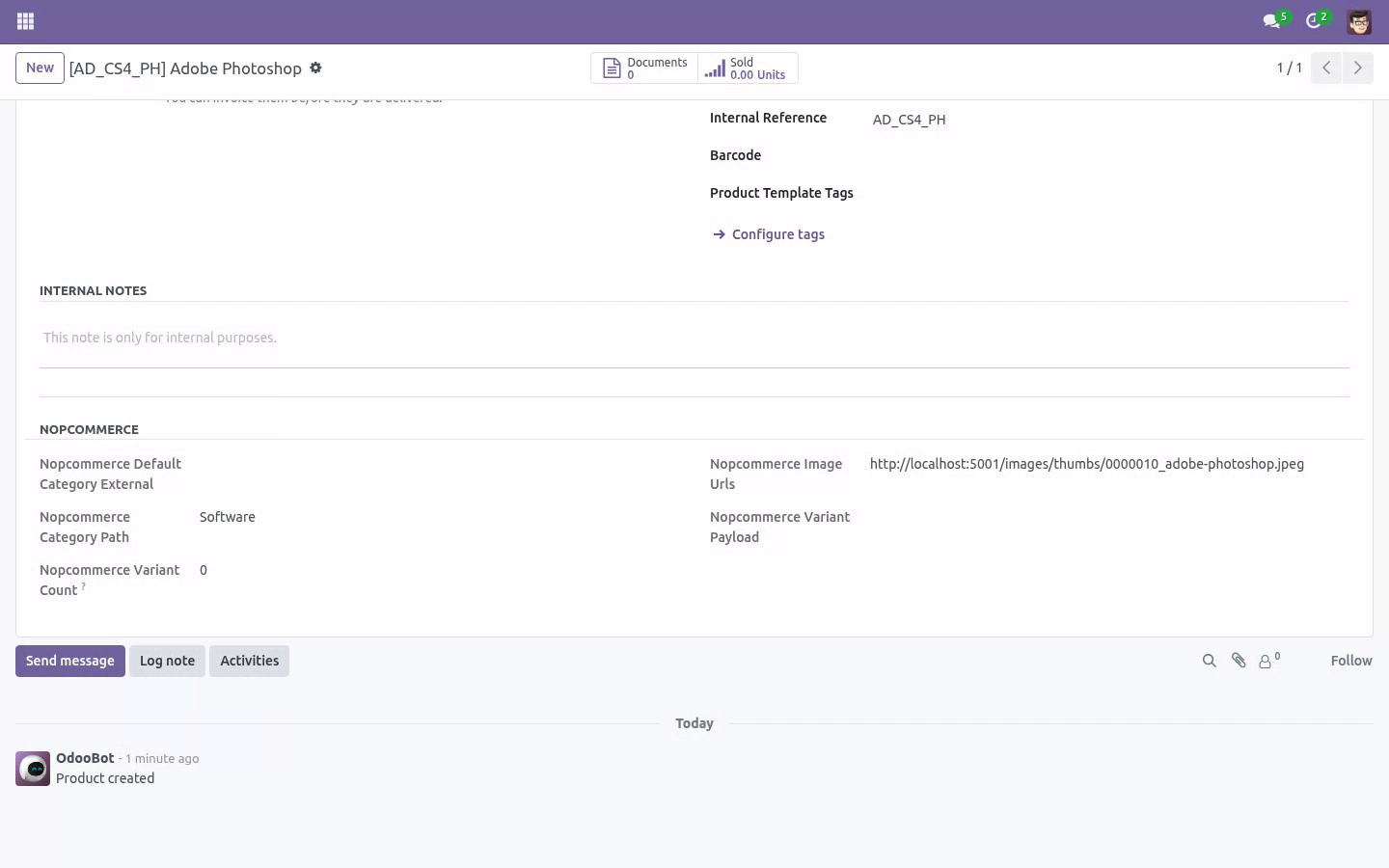
Products — import nopCommerce products into Odoo product templates (name, SKU, price, categories; optionally stock and image URLs).
Customers — import nopCommerce customers (name, email, company, phone, role) into Odoo contacts.
Orders — import nopCommerce orders into Odoo sale orders (line items, totals, payment method), mapping each order's nopCommerce status to a sale-order action (keep draft, confirm, cancel, or ignore).
Direction of sync: Odoo ← nopCommerce (import only). The connector is read-only: it never writes to, updates, or deletes anything in nopCommerce, and nopCommerce never pushes to Odoo. Synchronisation runs on a schedule, like a database mirror. Money is read verbatim — nopCommerce stores decimal major units.
Every database read goes through a queue: nothing is written to Odoo until a job runs, jobs retry with back-off on transient failures, and a circuit breaker pauses an instance that keeps failing.
Tested against the real thing
Automated tests run against a bundled mock store on every release; the line below is the part no mock can give you - the connector pointed at the real platform, with real records and real order totals.
Tested for real against nopCommerce 4.80 and the current release: 47 products, 6 customers and 5 orders read straight from the store's MySQL database with 0 errors, every order total matching the source exactly.
Requirements
Odoo: 20.0, Community or Enterprise.
nopCommerce: live-tested against nopCommerce 4.80 on MySQL/MariaDB. The connector reads the standard nopCommerce schema (PascalCase tables/columns), so the 4.x line on MySQL is supported. The MySQL server must be reachable from the Odoo server.
Python: the Odoo server needs the pymysql library (pip install pymysql). It is the only extra dependency; without it the connector cannot open a database connection and Test Connection fails with a clear message.
Odoo access: any internal user can use the connector screens. The MySQL User and Password are stored in system-only fields, so only the Settings / Administration user can read or change them.
Network: direct TCP connectivity from the Odoo server to the nopCommerce MySQL port (default 3306). By default the connector refuses internal/loopback/private storefront hosts as an SSRF safeguard (see Safety features).
Installation
Install the pymysql Python library on the Odoo server (pip install pymysql) and restart Odoo so it is importable.
Copy bambooforge_nopcommerce_connector into your Odoo addons path.
Restart the Odoo service.
Open Apps, click Update Apps List, search for nopCommerce, and press Activate / Install. Dependencies (Sales, Contacts, Invoicing) install automatically.
No live nopCommerce store is required to evaluate the mapping: a bundled set of nopCommerce-row-shaped mock fixtures lets you install the module, run schema introspection and explore the field mappings against sample data. Running a real import, however, needs a reachable MySQL database (see Step 1).
Step 1 — Grant read-only access to the nopCommerce MySQL database
The connector authenticates by connecting to the nopCommerce database, so the first step is on your database server, not in the nopCommerce admin. Create a dedicated MySQL user that can only read the nopCommerce database, and make sure the Odoo server can reach it over the network.
Open a MySQL/MariaDB client (e.g. mysql CLI, phpMyAdmin) as an administrator on the server that hosts the nopCommerce database.
Create a read-only user and grant it SELECT on the nopCommerce database only. Replace the database name, username, password and host to match your setup:
CREATE USER 'odoo_ro'@'%' IDENTIFIED BY 'a-strong-password';
GRANT SELECT ON nopcommerce.* TO 'odoo_ro'@'%';
FLUSH PRIVILEGES;
Grant SELECT only — the connector never needs INSERT, UPDATE or DELETE. A read-only grant is the safest way to guarantee nopCommerce is never modified. If your Odoo server has a fixed IP, replace '%' with that IP for a tighter grant (e.g. 'odoo_ro'@'10.0.0.5').
Allow the connection over the network:
Make sure MySQL listens on an address the Odoo server can reach (check bind-address in my.cnf; 127.0.0.1 only allows connections from the same host).
Open the MySQL TCP port (default 3306) in any firewall between the Odoo server and the database server.
If Odoo and nopCommerce share one host, the database is reachable at 127.0.0.1:3306 — but note that a loopback/private host triggers the SSRF guard on the storefront URL (see Step 2 and Safety features).
From the Odoo server, confirm the user can connect and read, for example:
mysql -h <db-host> -P 3306 -u odoo_ro -p nopcommerce -e "SELECT 1;"
A clean 1 means the credentials, network path and port are correct.
Step 2 — Create the connection in Odoo
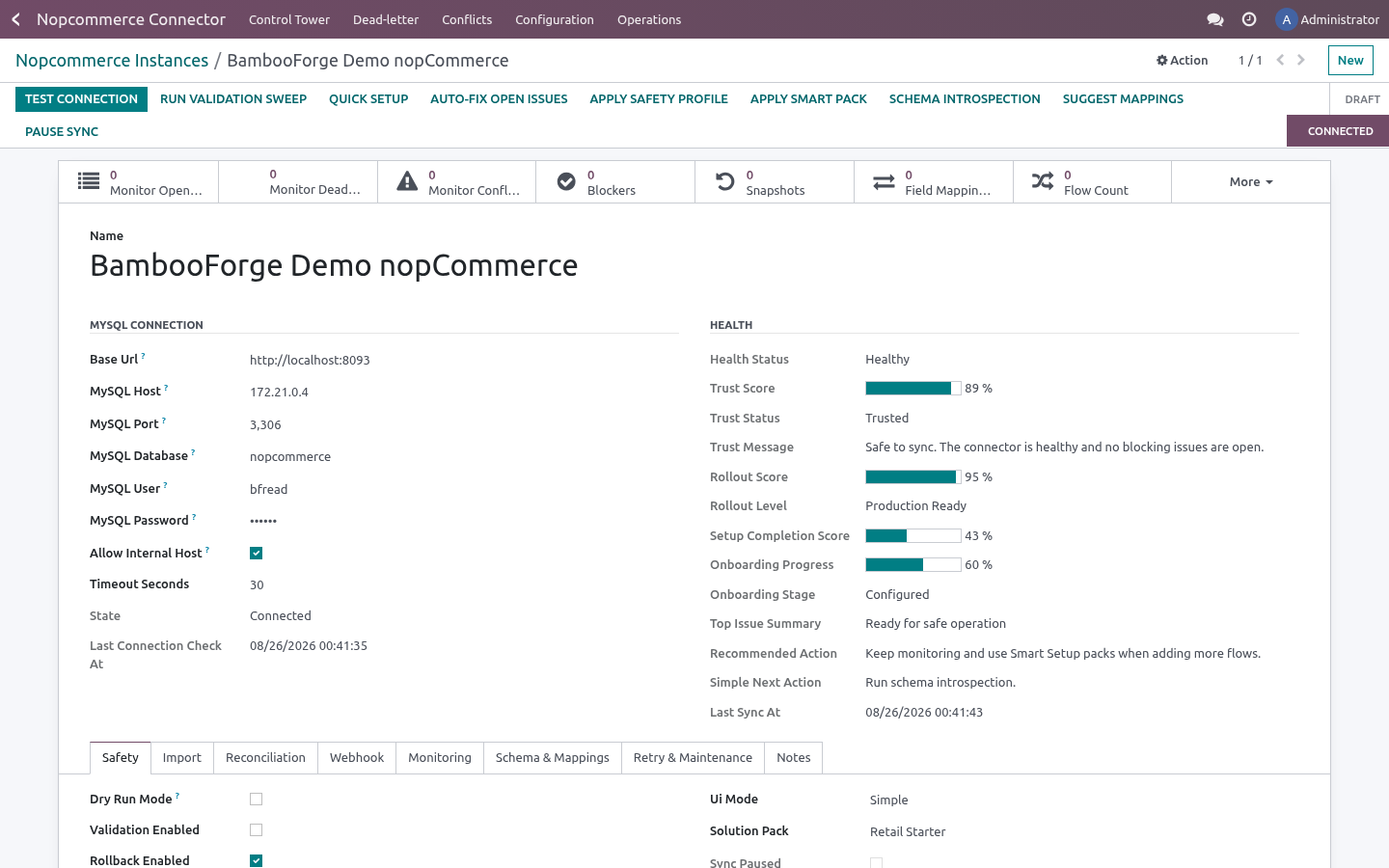
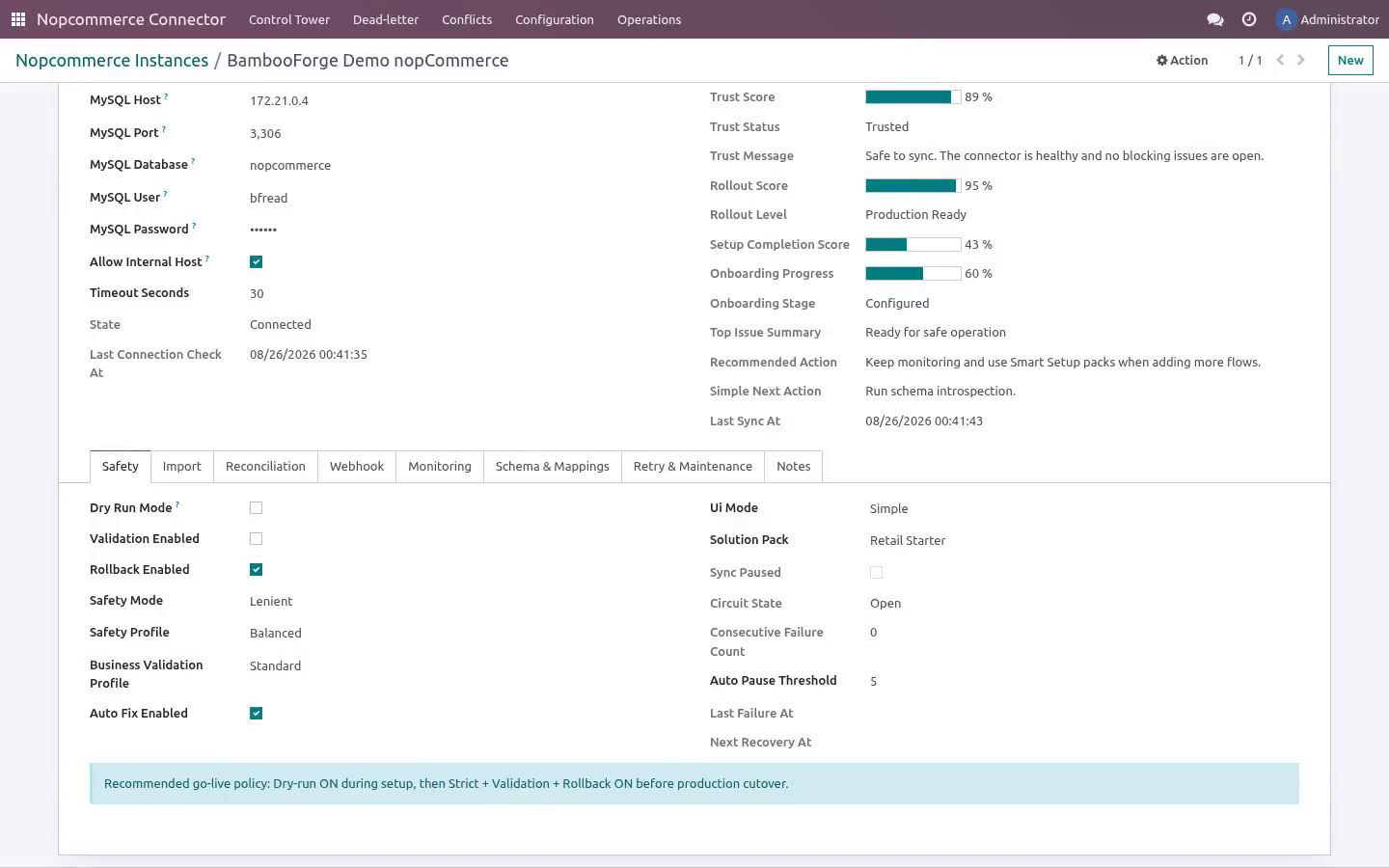
Open nopCommerce Connector ▸ Configuration ▸ Instances and create a record.
Key fields:
Field |
What to enter |
|---|---|
Name |
A label for this store, e.g. My Live Store. |
MySQL Host |
Hostname or IP of the nopCommerce MySQL server. Default 127.0.0.1. |
MySQL Port |
TCP port of the MySQL server. Default 3306. |
MySQL Database |
Name of the nopCommerce database/schema, e.g. nopcommerce. |
MySQL User |
The read-only user from Step 1, e.g. odoo_ro (administrators only). |
MySQL Password |
The password for that user (administrators only). |
Base URL |
Your storefront root, e.g. https://store.example.com. Used only to build product image links (/images/thumbs/...); it is not used for data access. |
Allow internal host |
Off by default. Turn on only to point the storefront Base URL at localhost or a private network (lowers the SSRF guard — see Safety features). |
Then click Test Connection. The connector opens a database connection and runs SELECT 1. A green Connected state means the host, port, database name and credentials are correct. On the first successful connect, the default order-status mapping table is seeded automatically. If it fails, the exact error is shown on the form and recorded in Logs (see Troubleshooting).
Tip: use Quick Setup (button on the instance) to pick a use case (catalog only, B2C full sync, …), seed default field mappings and order-status rules, and apply a recommended schedule in one step.
Step 3 — First sync (dry-run, then live)
New instances start with Dry-run ON. In dry-run, import jobs simulate writes: instead of changing data they produce Validation Results you can review under nopCommerce Connector ▸ Operations ▸ Validation Results. This lets you confirm what would happen before anything is written.
To run a first import:
On the instance, click Import Products (and/or Import Customers, Import Orders). This enqueues jobs; it does not block the UI.
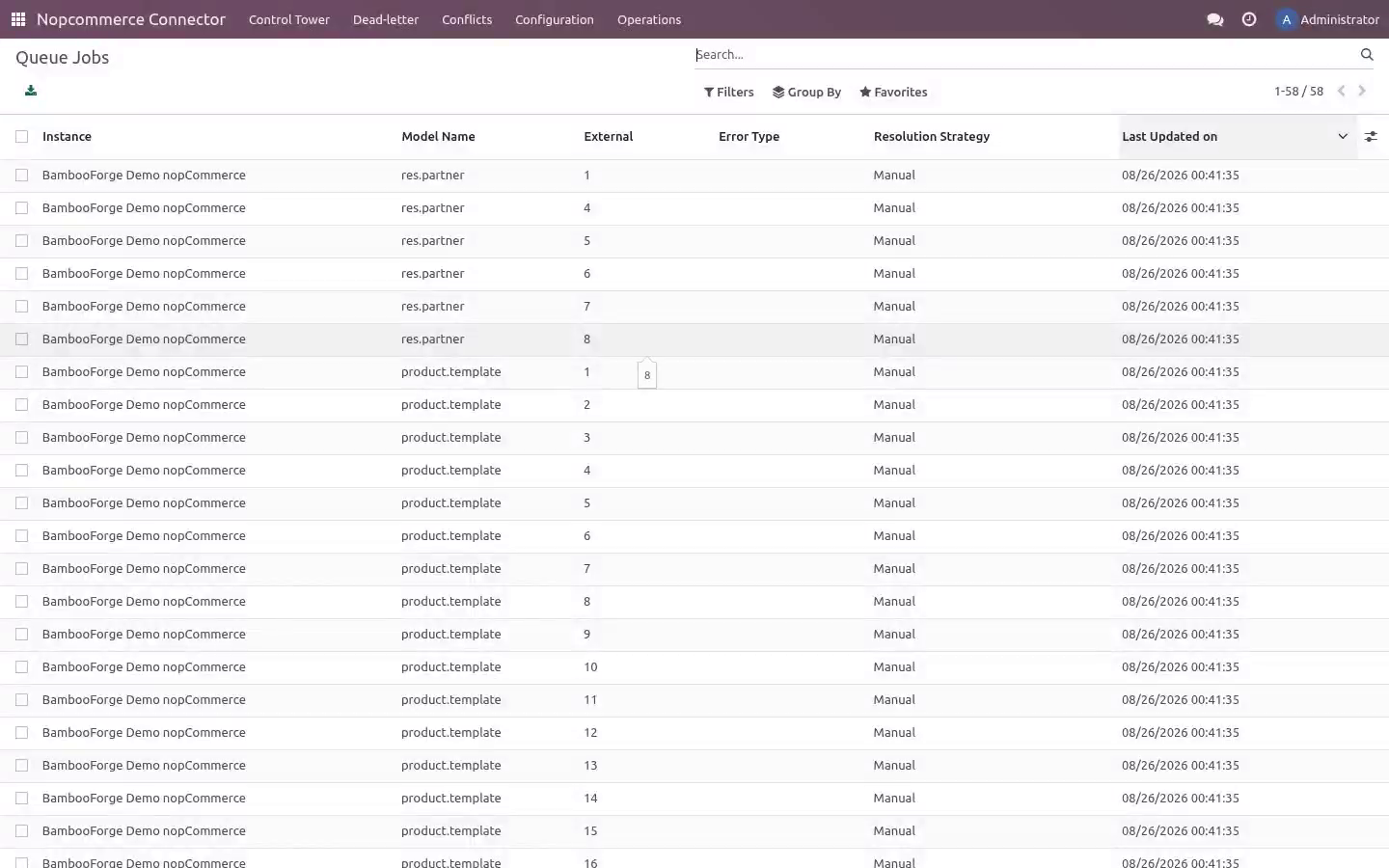
Jobs are processed by the nopCommerce Queue Processor scheduled action (every minute), or immediately if you run it manually from Operations ▸ Queue Jobs.
Review Validation Results while still in dry-run.
When satisfied, open the instance, turn Dry-run OFF, and run the imports again to write the records for real.
Imported records land in the standard Odoo apps: Sales ▸ Products, Contacts, and Sales ▸ Orders. Each carries its nopCommerce reference so re-imports update the same record instead of duplicating it.
Order status mapping
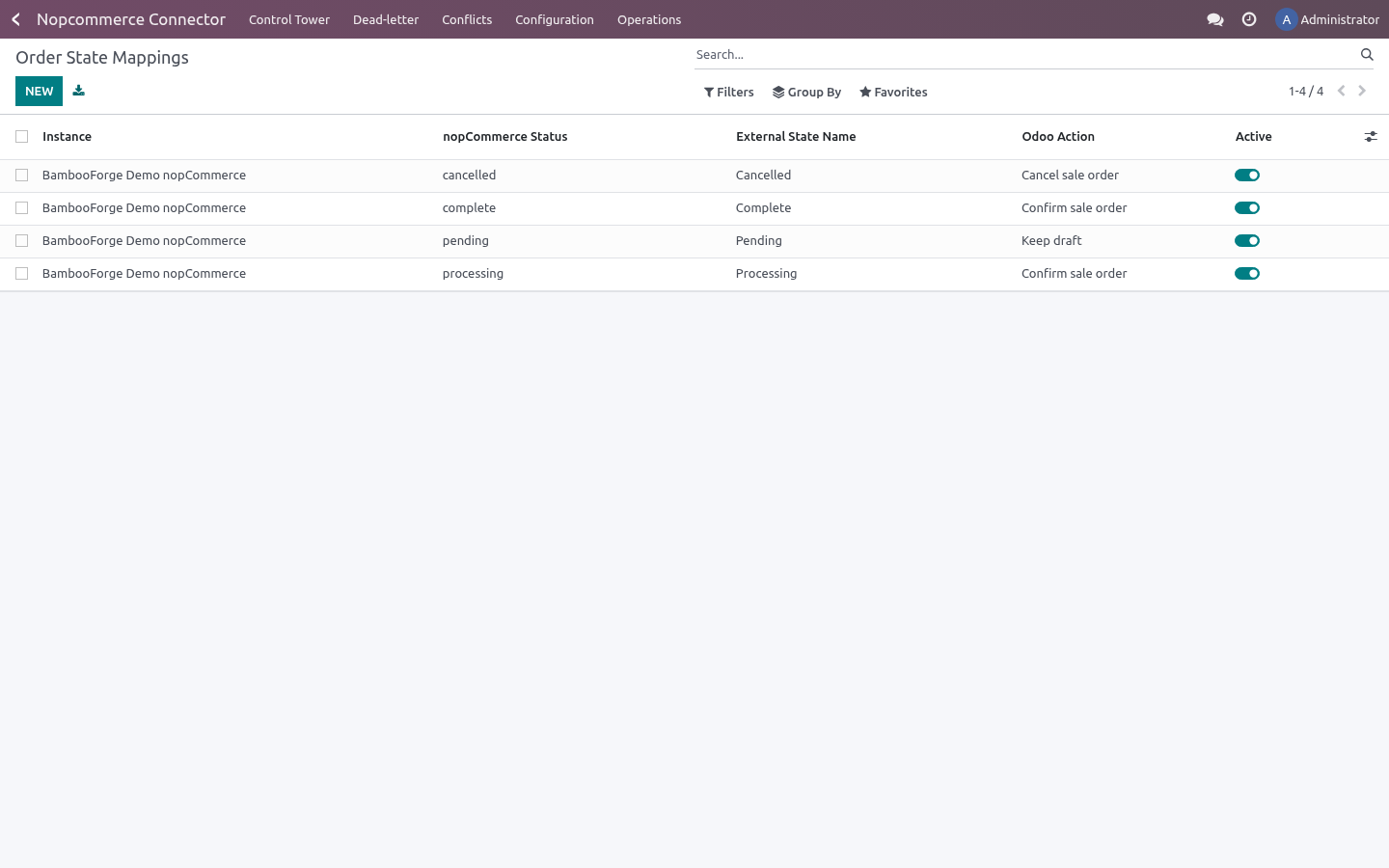
nopCommerce stores each order's status as a numeric OrderStatusId, which the connector normalizes to a status slug (pending, processing, complete, cancelled). Under Configuration ▸ Order State Mappings each instance gets a default table that decides what happens to the Odoo sale order when an order arrives in a given status:
nopCommerce status |
Default Odoo action |
|---|---|
pending |
Keep draft |
processing |
Confirm sale order |
complete |
Confirm sale order |
cancelled |
Cancel sale order |
Change any row to Ignore (do nothing), Keep draft, Confirm sale order or Cancel sale order. Unknown/unmapped statuses default to Ignore, so a status you have not mapped never triggers a destructive transition.
Field mapping & customization
Field Mappings (Configuration) map nopCommerce columns to Odoo fields per model. Use Generate suggested mappings on the instance to seed the business-critical ones, then adjust. The mapping board flags fields that need attention.
Schema Fields lists the discovered nopCommerce columns per resource. Run Schema Introspection on the instance to refresh it (it samples live rows; if the database is unreachable it falls back to the bundled sample row so you can still review the mapping).
Stock / images / tax are opt-in toggles on the instance: Sync stock (reads StockQuantity), Sync images (and max images), Sync taxes / Auto-match taxes (best effort, name-based, never auto-creates taxes). They are off by default; turn on only what you need.
Automation (scheduled actions)
Sync is schedule-driven only. nopCommerce has no REST API and emits no events, so there are no real-time webhooks — the connector polls the database on a cron, like a database mirror. The module ships these scheduled actions (Settings ▸ Technical ▸ Scheduled Actions):
Scheduled action |
Default |
Purpose |
|---|---|---|
nopCommerce Queue Processor |
every 1 min |
Processes queued import jobs. |
nopCommerce Reconciliation |
every 15 min |
Re-reads recent rows for enabled models and re-queues anything missing. |
nopCommerce Maintenance |
every 1 hr |
Recovers stale/locked jobs and trims old logs. |
nopCommerce Flow Scheduler |
every 5 min |
Runs scheduled sync flows. |
nopCommerce Flow Metrics |
every 1 hr |
Aggregates flow-run metrics. |
nopCommerce Auto Recover |
every 15 min |
Reopens a tripped circuit breaker once the database is healthy. |
Turn on Auto import / Auto reconcile per model on the instance to let the scheduled actions keep things in sync hands-free.
Safety features
Read-only by design — the connector only ever runs SELECT queries against nopCommerce; it never writes, updates or deletes there. Use a read-only MySQL grant (Step 1) to enforce this at the database level.
Dry-run mode — simulate writes and review Validation Results before going live.
Business validation profiles — Minimal / Standard / Strict gate risky writes into Odoo.
Resilient queue — every read/import action is a job with retry and exponential back-off.
Circuit breaker — after repeated failures an instance auto-pauses (Tripped); the Auto Recover action reopens it once the database responds again.
Rollback snapshots — when enabled, imports capture a snapshot so you can undo a batch from Operations ▸ Rollback Snapshots.
SSRF guard — the connector refuses an internal/loopback/private storefront Base URL unless Allow internal host is explicitly enabled.
Where nopCommerce shows up in Odoo
The connector stays out of the way on records that have nothing to do with nopCommerce:
Sales orders - the nopCommerce tab, Queue nopCommerce Export and nopCommerce Binding appear only on orders that came from nopCommerce, are bound to nopCommerce, or belong to a customer bound to nopCommerce.
Products and contacts - the nopCommerce tab appears once an active nopCommerce connection exists; the nopCommerce Binding button inside it appears once the record is bound.
List views, the sync queue and the control tower are unchanged.
Troubleshooting
Symptom |
Cause and fix |
|---|---|
Test Connection fails: "pymysql ... is required" |
The pymysql library is not installed on the Odoo server. Run pip install pymysql and restart Odoo. |
Test Connection fails: access denied / authentication error |
Wrong MySQL user or password, or the user lacks rights on this database. Re-check the MySQL User / Password and the GRANT SELECT from Step 1. |
Test Connection fails: can't connect / host not reachable / timeout |
The Odoo server cannot reach the MySQL host:port. Check the MySQL Host and Port, that MySQL's bind-address allows remote connections, and that port 3306 is open in the firewall. |
Test Connection fails: "MySQL database name is required" |
The MySQL Database field is empty. Enter the nopCommerce schema name. |
"Base URL ... is not allowed" / refused internal host |
The storefront Base URL points at localhost or a private IP. Enable Allow internal host on the instance (test/self-hosted only). |
Orders import but never confirm |
The order's nopCommerce status is mapped to Keep draft or Ignore. Adjust Order State Mappings. |
Jobs stay in Pending |
The Queue Processor is off or the instance is paused. Check Scheduled Actions is active and the instance is not Paused. |
Instance shows Tripped |
Circuit breaker tripped after repeated failures. Fix the database/credentials; Auto Recover reopens it, or click Resume. |
Records imported twice |
Imports are keyed by the nopCommerce id, so this should not happen. If it does, check that two instances do not point at the same database. |
Nothing happens after Import |
You are in Dry-run. Review Validation Results, then turn dry-run off and re-run. |
For anything else, Operations ▸ Logs records every database read and error with a timestamp.
Frequently asked questions
Which versions are supported? Odoo 20.0 on the Odoo side. On the store side the connector was live-tested on nopCommerce 4.80 on MySQL/MariaDB and reads the standard 4.x schema. Validate your exact build with the bundled sample fixtures first.
Do I need nopCommerce installed to evaluate it? Not for the mapping. Bundled nopCommerce-row-shaped sample fixtures let you install the module, run schema introspection and explore the field mappings. A real import needs a reachable MySQL database.
How does authentication work? There is no API key. nopCommerce has no REST API, so the connector connects to the nopCommerce MySQL database with read-only credentials (host, port, database, user, password). Generate those credentials on your database server (see Step 1).
Does this write anything back to nopCommerce? No. The connector is read-only: it only runs SELECT queries and never writes, updates or deletes in nopCommerce. Use a read-only MySQL grant to enforce this at the database level.
How does real-time sync work? There is no real-time/webhook path — nopCommerce has no REST API and emits no events. Sync is scheduled: the connector polls the database on a cron (every minute for the queue, every 15 minutes for reconciliation). Tighten the cron interval if you need fresher data.
Is it safe to run against production data? Yes. It only reads nopCommerce. On the Odoo side, dry-run is ON by default, validation blocks risky writes, and rollback snapshots let you undo. You decide when to go live.
What support and refund policy do I get? Every request is answered within 24 hours, setup help included. If you report a bug within 2 months of purchase and it is not resolved within 15 days, you are entitled to a full money-back refund.
Data, privacy & limits
The connector reads products, customers and orders from the nopCommerce MySQL database and writes the corresponding Odoo records. The MySQL credentials are stored in admin-only fields.
Read-only: the connector never writes to, updates or deletes anything in nopCommerce. It opens the database connection only to run SELECT queries.
In scope today: product/customer/order import, order-status mapping, scheduled sync, dry-run, validation and rollback.
Out of scope / roadmap: refund/credit-note import and inbound webhooks are not yet supported. Export back to nopCommerce is not supported (read-only by design). Tax auto-matching is best-effort, name-based and never auto-creates taxes; multi-warehouse stock routing is not handled.
Support & updates
Support: support@bambooforge.dev — answered within 24 hours, setup help included.
Refund: report a bug within 2 months of purchase; if unresolved within 15 days, full refund.
Full source is included. Updates track the supported Odoo 20 / nopCommerce 4.x line.
Upgrading & version compatibility
This build targets Odoo 20.0. Each Odoo major series (16.0, 17.0, 18.0, 19.0, 20.0) has its own dedicated build of this module — always install the build that matches your Odoo version. Mixing a build with a different Odoo series is not supported.
Patch upgrades (same series, e.g. 20.0.1.0.0 → later)
Back up your database and filestore first.
Replace the module folder with the newer build.
Restart Odoo with the module updated:
./odoo-bin -c your.conf -u bambooforge_nopcommerce_connector -d your_db
Odoo applies any schema/data changes automatically. Your existing records and configuration are preserved.
Cross-version migration (moving to a newer Odoo)
Upgrading Odoo itself is a database migration handled by Odoo's standard upgrade tooling. When you migrate the database to the next Odoo series, install the matching build of this module for that series. Data created by this module carries over with the database migration.
After any upgrade the module's scheduled actions resume on their normal cadence — no manual re-activation is required.
Uninstallation
You can remove this module at any time from Apps → (this module) → Uninstall, or from the command line. Uninstalling is clean and reversible by reinstalling — but note what is and is not deleted.
What is removed
The module's own tables and every record in them (20 models, prefixed nopcommerce.*) — this is the data this module created.
The menus, actions, views and reports this module installed.
Its scheduled actions (cron jobs) — they stop immediately on uninstall.
Connection records, credentials, field mappings, queue jobs and sync logs stored in Odoo.
What is preserved
Your remote platform is never touched. Uninstalling only removes the Odoo-side connector; products, customers and orders on the external store/service are untouched.
Records already imported into standard Odoo models (e.g. contacts, products, sales orders) remain — they are ordinary Odoo records once created.
Attachments and chatter messages on standard records are kept.
As always, take a database backup before uninstalling in production.
Changelog
20.0.1.2.5
Built for Odoo 20: record rules and access rights rewritten onto Odoo 20's single ir.access model, the screens rebuilt on Owl 3, and every icon moved to the icon set Odoo 20 ships.
20.0.1.0.0
Current release for Odoo 20.0. This build includes:
Read-only Odoo 20 <- nopCommerce connector: imports products, customers and orders by reading the nopCommerce MySQL database directly (no REST API needed) on a schedule.
With a live Sync Control Tower, resilient queue, dead-letter console, conflict workbench and dry-run safety.
Feature additions and fixes ship as new builds on the Odoo Apps store; this page and the module's version reflect the current published release. Always keep the build matched to your Odoo series (see Upgrading & version compatibility).
How we make sure it works
Before every release, 101 automated checks run against this app on Odoo 16, 17, 18, 19 and 20. Among them:
Nothing at all is an empty row not a crash.
A product shows its binding button only once bound.
Import to odoo true but dry run never moves stock.
Push stock read only raises even for negative.
Stock export job records clean skip no write.
Tested for real against nopCommerce 4.80 and the current release: 47 products, 6 customers and 5 orders read straight from the store's MySQL database with 0 errors, every order total matching the source exactly.
The complete list is in the source you receive.