 BambooForge Labs
Farm & Crop Management for Agriculture
Farm and crop management: cycles per field, a spray record an inspector can read, withholding periods that stop a harvest, cost per kilo.
Available for Odoo 16.0, Odoo 17.0, Odoo 18.0, Odoo 19.0, Odoo 20.0. Technical name bambooforge_farm.
Transcript of the walkthrough (Odoo 20)
Farm & Crop Management for Agriculture. Farm and crop management: cycles per field, a spray record an inspector can read, withholding periods that stop a harvest, cost per kilo. Said before you buy, because it is the half that decides whether the app fits: In the next few minutes: farm & crop management for agriculture, then the withholding period, then the spray record, then the costing, then the land. Then what this app deliberately does not do, so you can tell before you buy whether it fits.
Everything lives under Farm then Crop cycles then Field record then Fields. 1. Copy bambooforge_farm into your addons path and update the app list, or install the ZIP from the Odoo Apps Store. Community only; it depends on base, base_setup, mail, product and uom.
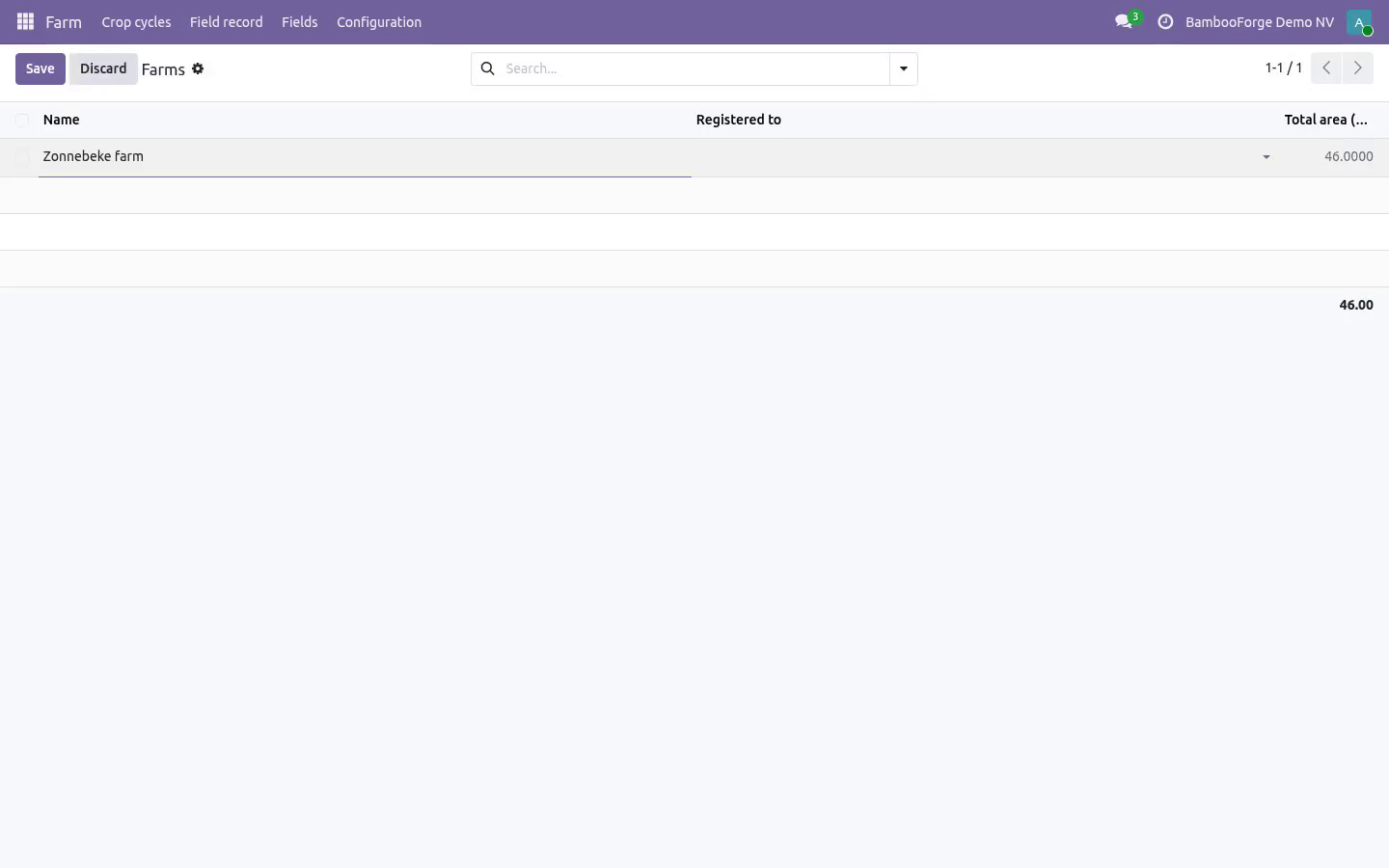
2. Install Farm & Crop Management for Agriculture. 3. Create the farms, then the fields with their real measured area.
4. Create the crops with their unit and expected yield. 5. Create the inputs with their withholding days and registration numbers.
6. Put spray licence numbers on the operators' user records before the first spray, or the first spray cannot be signed off. Farm & Crop Management for Agriculture. Built around the two things a farm gets audited on and the one number it never knows.
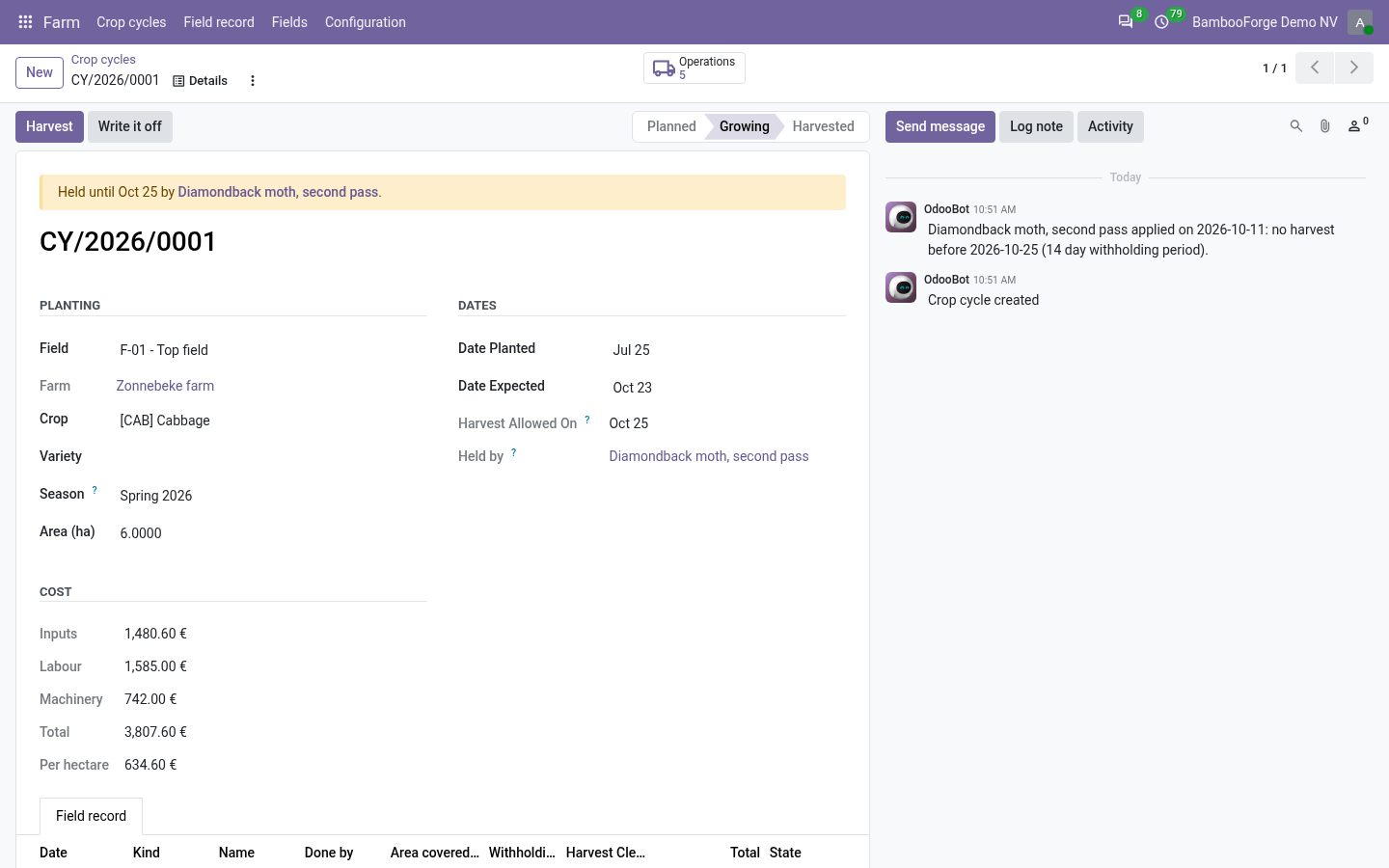
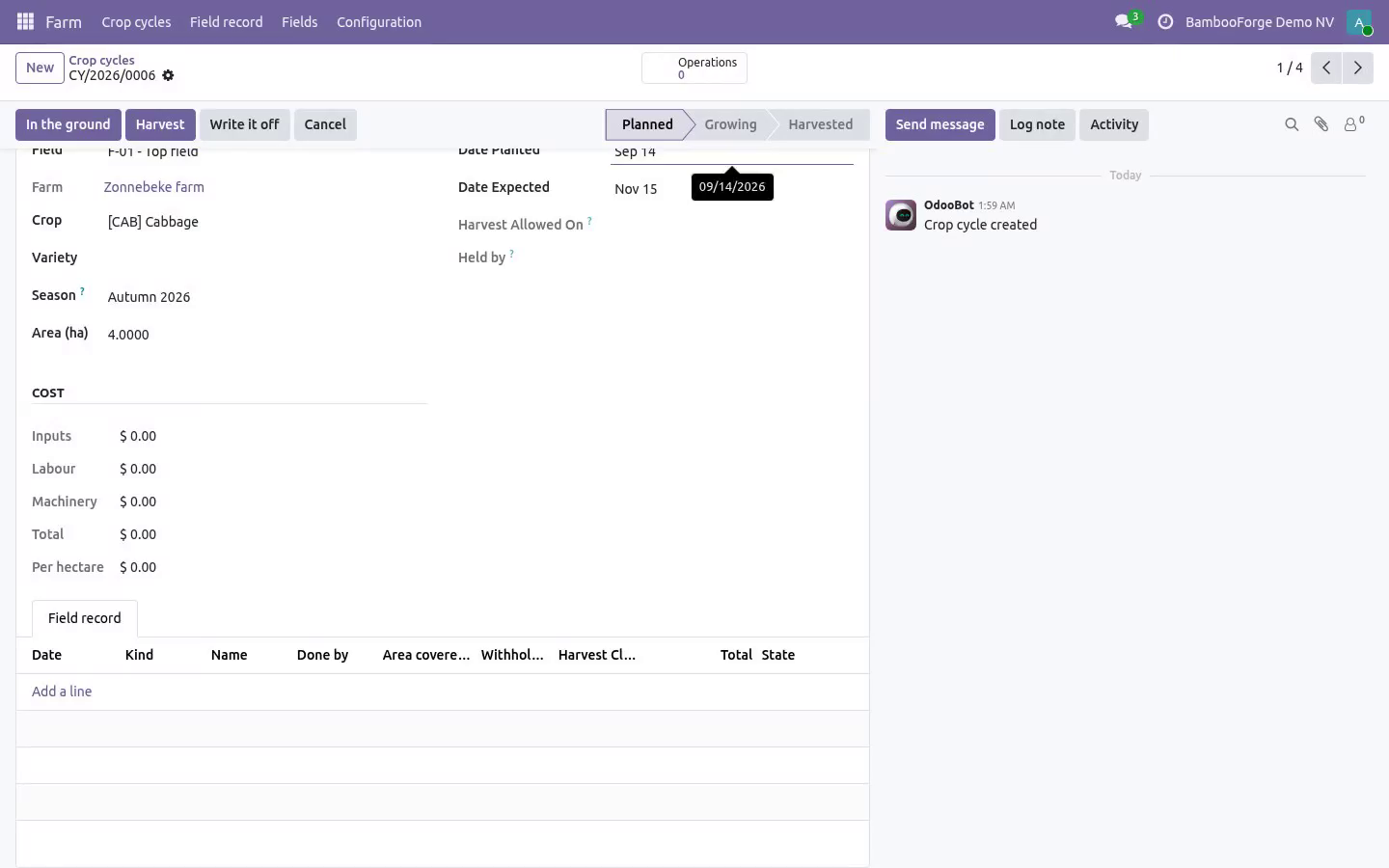
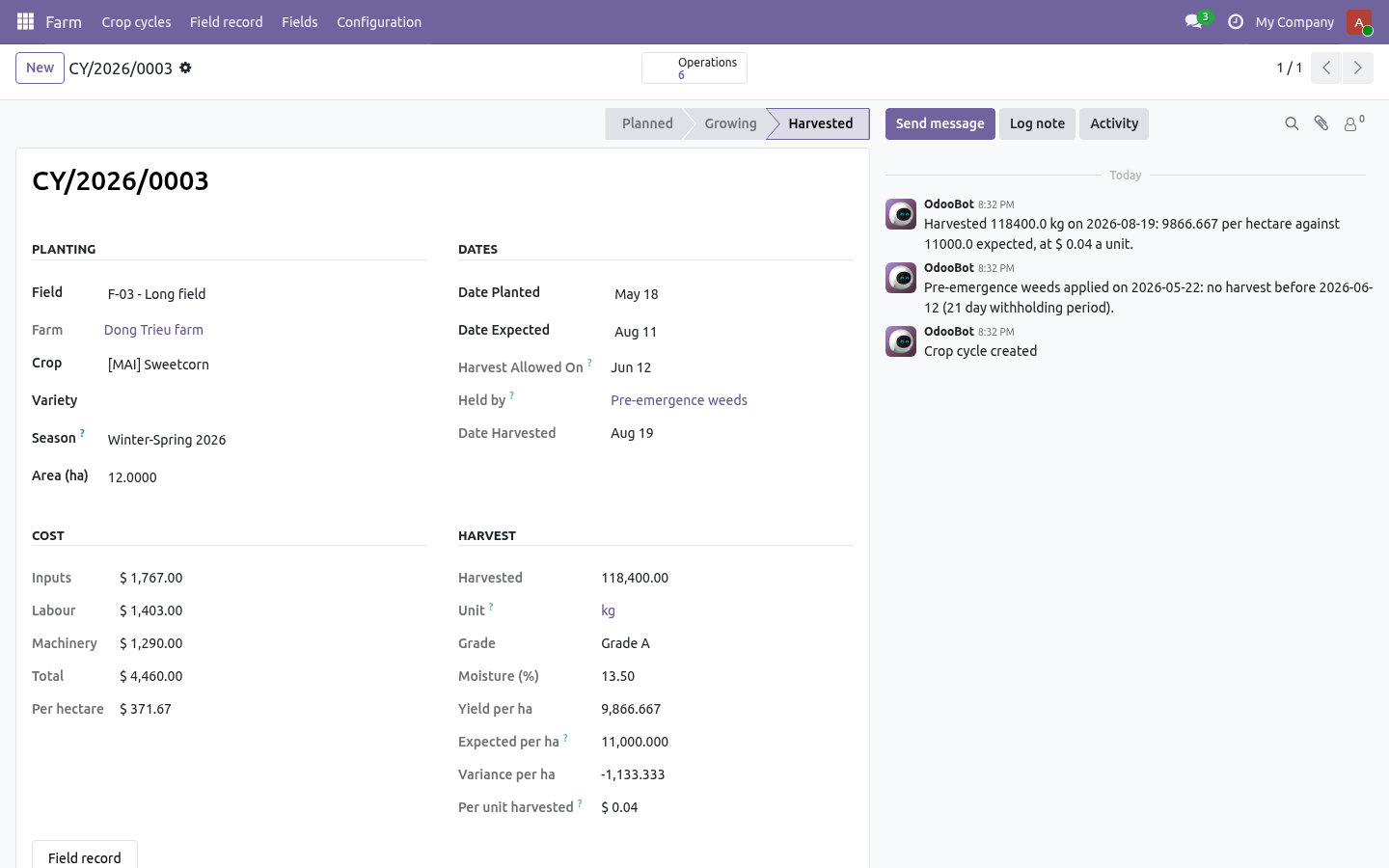
The withholding period Every input carries a withholding period in days and the registration number off its label. Zero for a fertiliser; never zero for a plant protection product unless the label really says so. Signing off a spray sets an earliest legal harvest date on the crop cycle, taken from the longest period among the products applied. The cycle names the spray that is holding it.
Harvesting before that date is refused, and the refusal names the product, the day it was applied and the number of days. Cutting inside a withholding period is a rejected load, a failed residue test and, in most places, an offence. The harvest date itself is bounded: not in the future, not before the crop went in the ground. A date in the future clears every withholding period ever recorded, which is the one keystroke that would walk a load straight out of the field.
A spray planned for next week holds nothing back - only signed-off work counts. A spray still sitting as planned and dated before the harvest is a different animal: it is a withholding period nobody counted, and the harvest is refused until somebody says whether it happened. Work cannot be recorded or signed off on a cycle that has been harvested, written off or cancelled unless it is marked as a late entry. When a late entry proves the crop was cut inside a withholding period, a red flag is written on the cycle naming the day it was cut and the day it could legally have been.
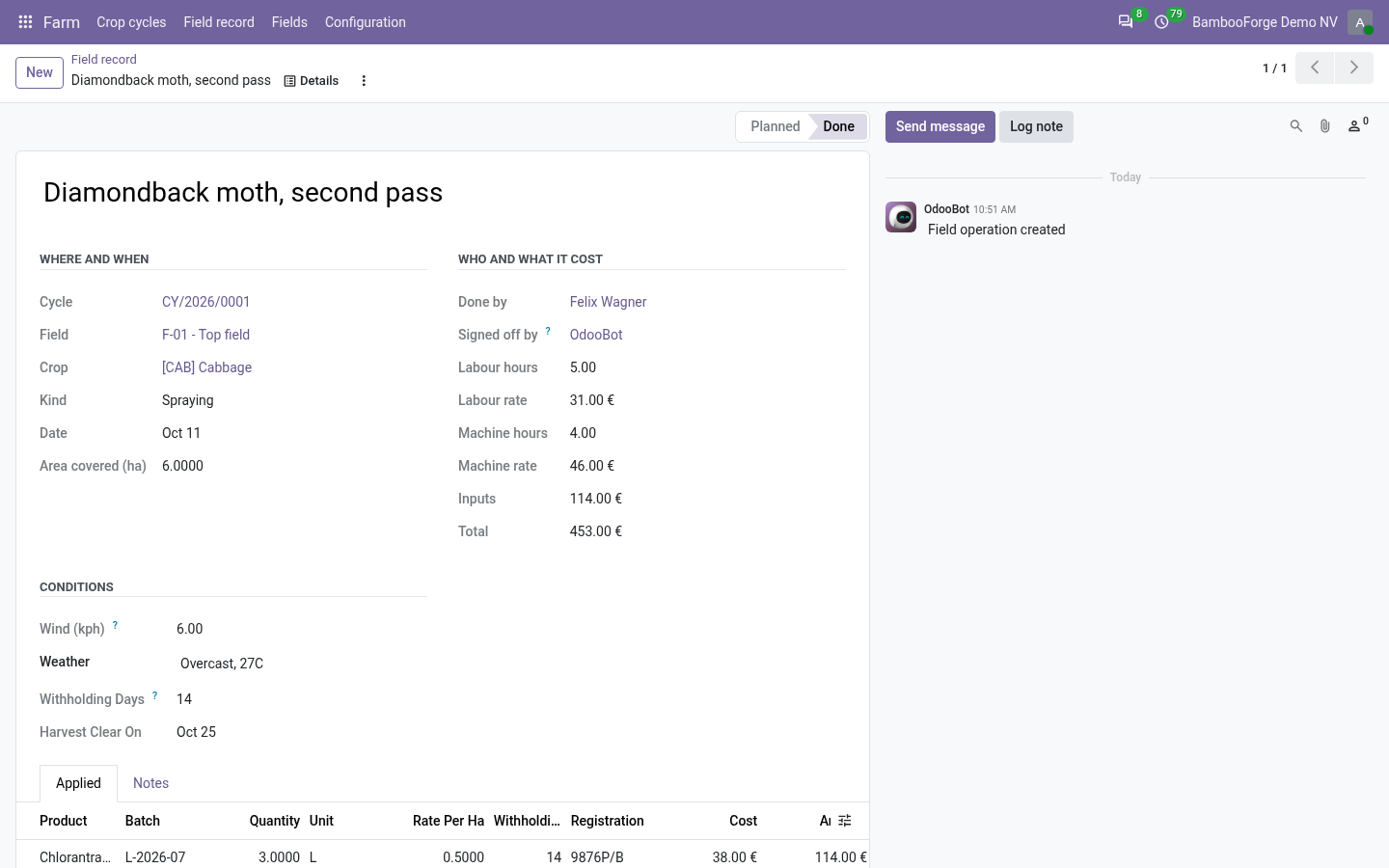
The spray record Product, batch, registration number, quantity, the rate that actually went on per hectare, the operator, the wind and the weather. An operation that says something was applied but names no product cannot be signed off. It is the entry an inspector reads first. A pesticide, herbicide or fungicide cannot be applied by an operator with no spray licence on file, and not with one that had expired on the day.
The rule follows the product, not the box somebody ticked: a herbicide recorded under Weeding is still a herbicide and still needs a licensed operator. Who signed it off is recorded from the session, next to the operator somebody typed in. A signed entry cannot be deleted, and neither can a cycle that carries one or that has been harvested or written off. Corrections are new entries; the field record is not something you tidy up.
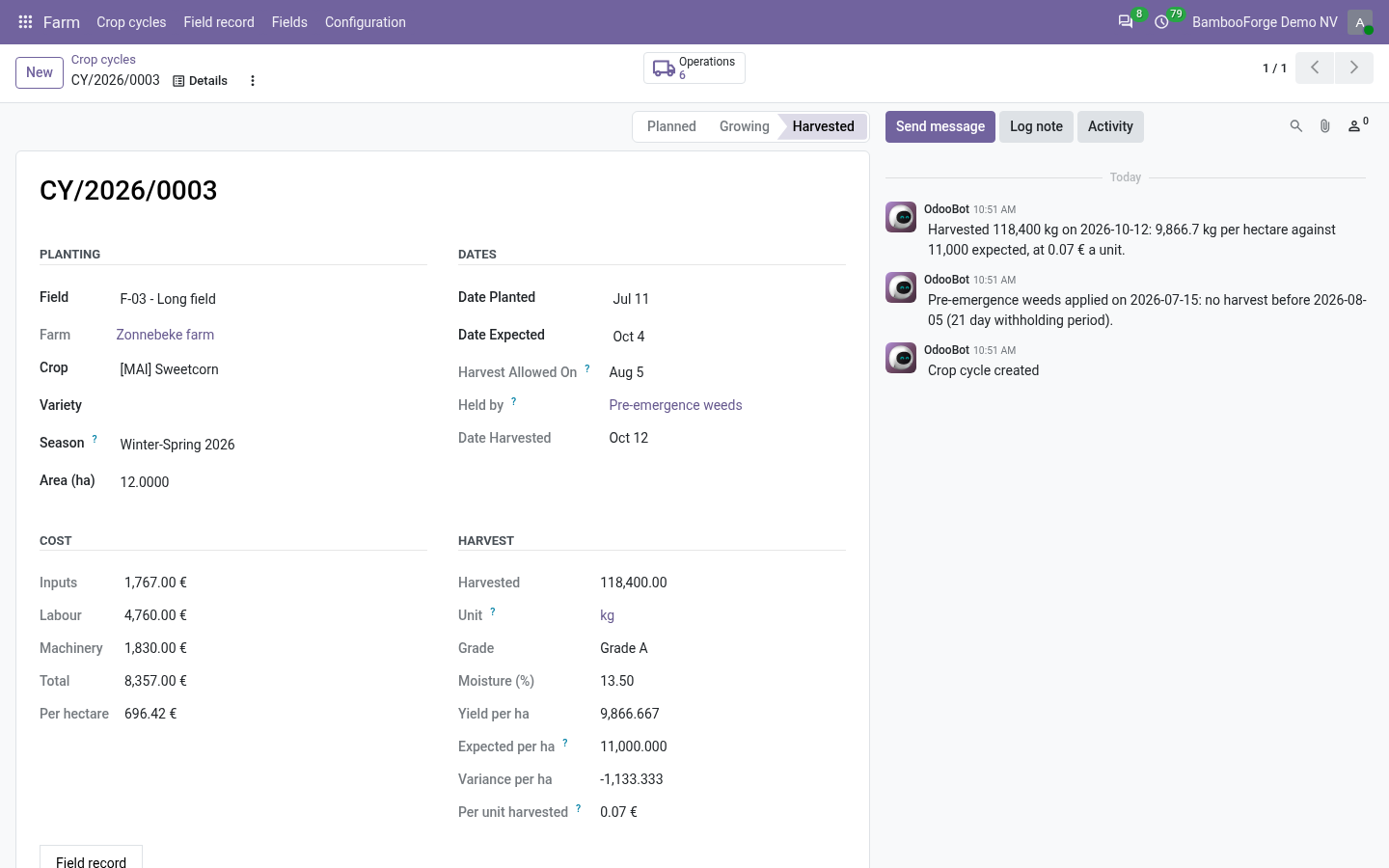
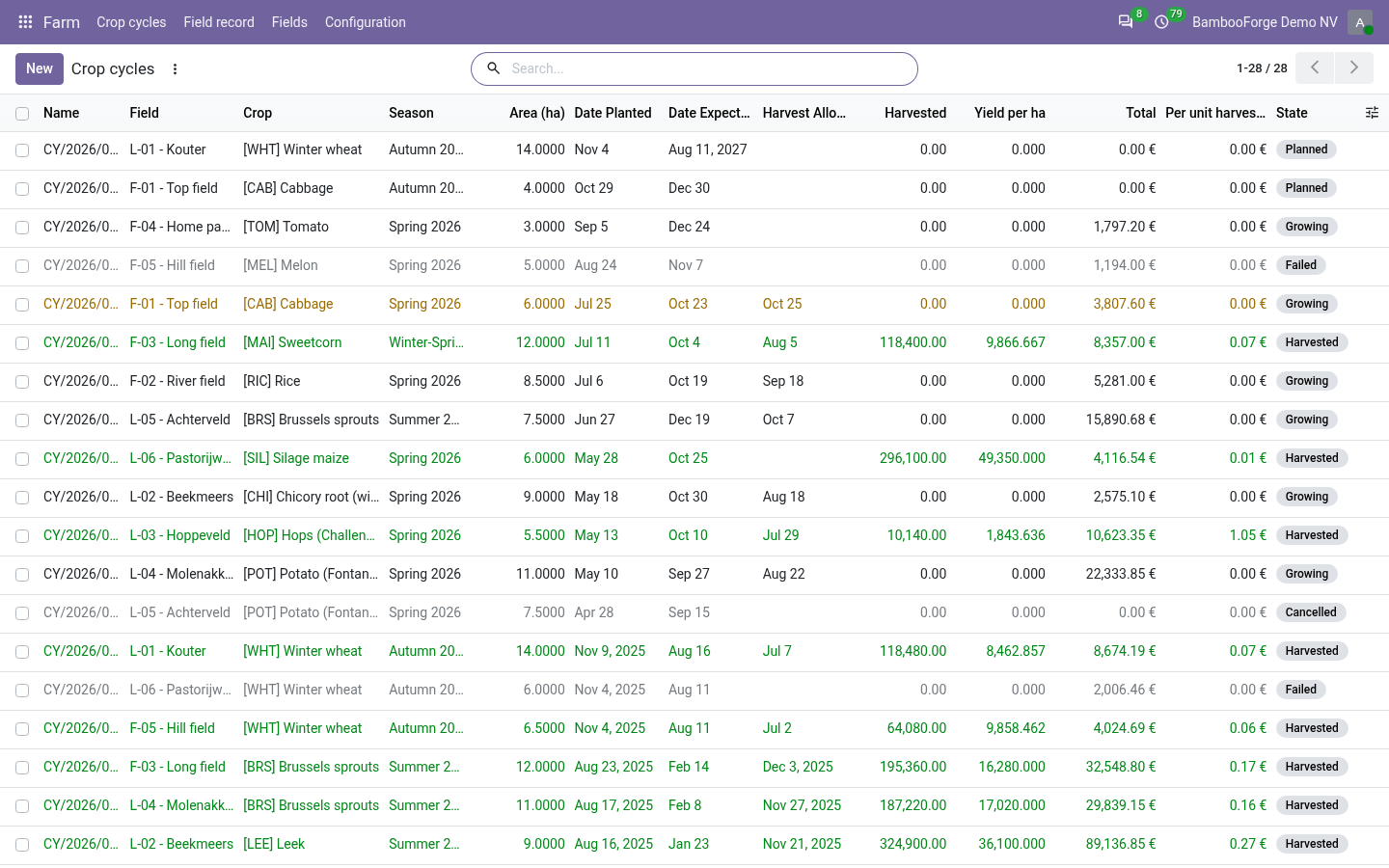
The costing Inputs, labour and machinery roll up from signed-off operations onto the cycle: total, per hectare and per unit harvested. The yield is measured against the expected yield for that crop, so a season ends with a variance rather than a feeling. A crop written off keeps its cost. The money was spent either way, and a failed field that shows zero teaches nobody anything.
The land Harvesting, cancelling or writing off a cycle frees the ground again. Every cycle ever grown on a parcel stays on it - what went in, what it cost, what came off. Which is what the rotation, a buyer and an organic inspector all ask for. The season A crop cycle runs planned -> growing -> harvested, or is written off, or is cancelled while nothing has been done to it.
The harvest is recorded through a short form that insists on a weight that is a weight and a moisture that is a percentage, and warns on screen while a spray - or a date in the future - stands in the way. Crops coming due within a week - and crops still held by a spray land on the list of whoever planned the cycle, or of a manager if they have left the farm. Once each, even after the reminder has been dealt with, and the date on it follows the hold every time another spray is signed off. Roles Field operator - records what was done in the field and what was applied.
Cannot plan a season, harvest, or configure. Farm manager - plans the season, opens and closes cycles, records the harvest, and configures farms, fields, crops and inputs. How we make sure it works. Before every release, 127 automated checks run against this app on Odoo 16, 17, 18, 19 and 20.
Among them: A spray cannot be signed off on a written off cycle. A cycle cannot be planted on another company's field. A spray that names no product cannot be signed off. A cycle with work on it cannot be cancelled.
A signed entry cannot be repointed at another cycle. The complete list is in the source you receive. Questions people ask. Which Odoo versions does it run on?
Odoo 16.0, 17.0, 18.0, 19.0, 20.0, on the series you buy it for; each series is its own listing. Community or Enterprise? Both. It needs no Enterprise app.
Support The complete manual is at docs dot bambooforge dot dev, the demo database is linked from the store page, and support answers within twenty-four hours. Links are in the description.
Transcript of the walkthrough (Odoo 19)
Farm & Crop Management for Agriculture. Farm and crop management: cycles per field, a spray record an inspector can read, withholding periods that stop a harvest, cost per kilo. Set up in this order: farms, then fields with their real measured area, then crops with their unit and expected yield, then inputs with their withholding days and registration numbers. Put spray licence numbers on the operators' user records before the first spray, or the first spray cannot be signed off.
support@bambooforge.dev In the next few minutes: farm & crop management for agriculture, then the withholding period, then the spray record, then the costing, then the land. Then what this app deliberately does not do, so you can tell before you buy whether it fits. Everything lives under Farm then Crop cycles then Field record then Fields. Community only.
Depends on base, base_setup, mail, product and uom; no Enterprise module is involved. Farm & Crop Management for Agriculture. Built around the two things a farm gets audited on and the one number it never knows. The withholding period Every input carries a withholding period in days and the registration number off its label.
Zero for a fertiliser; never zero for a plant protection product unless the label really says so. Signing off a spray sets an earliest legal harvest date on the crop cycle, taken from the longest period among the products applied. The cycle names the spray that is holding it. Harvesting before that date is refused, and the refusal names the product, the day it was applied and the number of days.
Cutting inside a withholding period is a rejected load, a failed residue test and, in most places, an offence. The harvest date itself is bounded: not in the future, not before the crop went in the ground. A date in the future clears every withholding period ever recorded, which is the one keystroke that would walk a load straight out of the field. A spray planned for next week holds nothing back - only signed-off work counts.
A spray still sitting as planned and dated before the harvest is a different animal: it is a withholding period nobody counted, and the harvest is refused until somebody says whether it happened. Work cannot be recorded or signed off on a cycle that has been harvested, written off or cancelled unless it is marked as a late entry. When a late entry proves the crop was cut inside a withholding period, a red flag is written on the cycle naming the day it was cut and the day it could legally have been. The spray record Product, batch, registration number, quantity, the rate that actually went on per hectare, the operator, the wind and the weather.
An operation that says something was applied but names no product cannot be signed off. It is the entry an inspector reads first. A pesticide, herbicide or fungicide cannot be applied by an operator with no spray licence on file, and not with one that had expired on the day. The rule follows the product, not the box somebody ticked: a herbicide recorded under Weeding is still a herbicide and still needs a licensed operator.
Who signed it off is recorded from the session, next to the operator somebody typed in. A signed entry cannot be deleted, and neither can a cycle that carries one or that has been harvested or written off. Corrections are new entries; the field record is not something you tidy up. The costing Inputs, labour and machinery roll up from signed-off operations onto the cycle: total, per hectare and per unit harvested.
The yield is measured against the expected yield for that crop, so a season ends with a variance rather than a feeling. A crop written off keeps its cost. The money was spent either way, and a failed field that shows zero teaches nobody anything. The land Harvesting, cancelling or writing off a cycle frees the ground again.
Every cycle ever grown on a parcel stays on it - what went in, what it cost, what came off. Which is what the rotation, a buyer and an organic inspector all ask for. The season A crop cycle runs planned -> growing -> harvested, or is written off, or is cancelled while nothing has been done to it. The harvest is recorded through a short form that insists on a weight that is a weight and a moisture that is a percentage, and warns on screen while a spray - or a date in the future - stands in the way.
Crops coming due within a week - and crops still held by a spray land on the list of whoever planned the cycle, or of a manager if they have left the farm. Once each, even after the reminder has been dealt with, and the date on it follows the hold every time another spray is signed off. Roles Field operator - records what was done in the field and what was applied. Cannot plan a season, harvest, or configure.
Farm manager - plans the season, opens and closes cycles, records the harvest, and configures farms, fields, crops and inputs. Support The complete manual is at docs dot bambooforge dot dev, the demo database is linked from the store page, and support answers within twenty-four hours. Links are in the description.
Transcript of the walkthrough (Odoo 18)
Farm & Crop Management for Agriculture. Farm and crop management: cycles per field, a spray record an inspector can read, withholding periods that stop a harvest, cost per kilo. Set up in this order: farms, then fields with their real measured area, then crops with their unit and expected yield, then inputs with their withholding days and registration numbers. Put spray licence numbers on the operators' user records before the first spray, or the first spray cannot be signed off.
support@bambooforge.dev In the next few minutes: farm & crop management for agriculture, then the withholding period, then the spray record, then the costing, then the land. Then what this app deliberately does not do, so you can tell before you buy whether it fits. Everything lives under Farm then Crop cycles then Field record then Fields. Community only.
Depends on base, base_setup, mail, product and uom; no Enterprise module is involved. Farm & Crop Management for Agriculture. Built around the two things a farm gets audited on and the one number it never knows. The withholding period Every input carries a withholding period in days and the registration number off its label.
Zero for a fertiliser; never zero for a plant protection product unless the label really says so. Signing off a spray sets an earliest legal harvest date on the crop cycle, taken from the longest period among the products applied. The cycle names the spray that is holding it. Harvesting before that date is refused, and the refusal names the product, the day it was applied and the number of days.
Cutting inside a withholding period is a rejected load, a failed residue test and, in most places, an offence. The harvest date itself is bounded: not in the future, not before the crop went in the ground. A date in the future clears every withholding period ever recorded, which is the one keystroke that would walk a load straight out of the field. A spray planned for next week holds nothing back - only signed-off work counts.
A spray still sitting as planned and dated before the harvest is a different animal: it is a withholding period nobody counted, and the harvest is refused until somebody says whether it happened. Work cannot be recorded or signed off on a cycle that has been harvested, written off or cancelled unless it is marked as a late entry. When a late entry proves the crop was cut inside a withholding period, a red flag is written on the cycle naming the day it was cut and the day it could legally have been. The spray record Product, batch, registration number, quantity, the rate that actually went on per hectare, the operator, the wind and the weather.
An operation that says something was applied but names no product cannot be signed off. It is the entry an inspector reads first. A pesticide, herbicide or fungicide cannot be applied by an operator with no spray licence on file, and not with one that had expired on the day. The rule follows the product, not the box somebody ticked: a herbicide recorded under Weeding is still a herbicide and still needs a licensed operator.
Who signed it off is recorded from the session, next to the operator somebody typed in. A signed entry cannot be deleted, and neither can a cycle that carries one or that has been harvested or written off. Corrections are new entries; the field record is not something you tidy up. The costing Inputs, labour and machinery roll up from signed-off operations onto the cycle: total, per hectare and per unit harvested.
The yield is measured against the expected yield for that crop, so a season ends with a variance rather than a feeling. A crop written off keeps its cost. The money was spent either way, and a failed field that shows zero teaches nobody anything. The land Harvesting, cancelling or writing off a cycle frees the ground again.
Every cycle ever grown on a parcel stays on it - what went in, what it cost, what came off. Which is what the rotation, a buyer and an organic inspector all ask for. The season A crop cycle runs planned -> growing -> harvested, or is written off, or is cancelled while nothing has been done to it. The harvest is recorded through a short form that insists on a weight that is a weight and a moisture that is a percentage, and warns on screen while a spray - or a date in the future - stands in the way.
Crops coming due within a week - and crops still held by a spray land on the list of whoever planned the cycle, or of a manager if they have left the farm. Once each, even after the reminder has been dealt with, and the date on it follows the hold every time another spray is signed off. Roles Field operator - records what was done in the field and what was applied. Cannot plan a season, harvest, or configure.
Farm manager - plans the season, opens and closes cycles, records the harvest, and configures farms, fields, crops and inputs. Support The complete manual is at docs dot bambooforge dot dev, the demo database is linked from the store page, and support answers within twenty-four hours. Links are in the description.
Transcript of the walkthrough (Odoo 17)
Farm & Crop Management for Agriculture. Farm and crop management: cycles per field, a spray record an inspector can read, withholding periods that stop a harvest, cost per kilo. Set up in this order: farms, then fields with their real measured area, then crops with their unit and expected yield, then inputs with their withholding days and registration numbers. Put spray licence numbers on the operators' user records before the first spray, or the first spray cannot be signed off.
support@bambooforge.dev In the next few minutes: farm & crop management for agriculture, then the withholding period, then the spray record, then the costing, then the land. Then what this app deliberately does not do, so you can tell before you buy whether it fits. Everything lives under Farm then Crop cycles then Field record then Fields. Community only.
Depends on base, base_setup, mail, product and uom; no Enterprise module is involved. Farm & Crop Management for Agriculture. Built around the two things a farm gets audited on and the one number it never knows. The withholding period Every input carries a withholding period in days and the registration number off its label.
Zero for a fertiliser; never zero for a plant protection product unless the label really says so. Signing off a spray sets an earliest legal harvest date on the crop cycle, taken from the longest period among the products applied. The cycle names the spray that is holding it. Harvesting before that date is refused, and the refusal names the product, the day it was applied and the number of days.
Cutting inside a withholding period is a rejected load, a failed residue test and, in most places, an offence. The harvest date itself is bounded: not in the future, not before the crop went in the ground. A date in the future clears every withholding period ever recorded, which is the one keystroke that would walk a load straight out of the field. A spray planned for next week holds nothing back - only signed-off work counts.
A spray still sitting as planned and dated before the harvest is a different animal: it is a withholding period nobody counted, and the harvest is refused until somebody says whether it happened. Work cannot be recorded or signed off on a cycle that has been harvested, written off or cancelled unless it is marked as a late entry. When a late entry proves the crop was cut inside a withholding period, a red flag is written on the cycle naming the day it was cut and the day it could legally have been. The spray record Product, batch, registration number, quantity, the rate that actually went on per hectare, the operator, the wind and the weather.
An operation that says something was applied but names no product cannot be signed off. It is the entry an inspector reads first. A pesticide, herbicide or fungicide cannot be applied by an operator with no spray licence on file, and not with one that had expired on the day. The rule follows the product, not the box somebody ticked: a herbicide recorded under Weeding is still a herbicide and still needs a licensed operator.
Who signed it off is recorded from the session, next to the operator somebody typed in. A signed entry cannot be deleted, and neither can a cycle that carries one or that has been harvested or written off. Corrections are new entries; the field record is not something you tidy up. The costing Inputs, labour and machinery roll up from signed-off operations onto the cycle: total, per hectare and per unit harvested.
The yield is measured against the expected yield for that crop, so a season ends with a variance rather than a feeling. A crop written off keeps its cost. The money was spent either way, and a failed field that shows zero teaches nobody anything. The land Harvesting, cancelling or writing off a cycle frees the ground again.
Every cycle ever grown on a parcel stays on it - what went in, what it cost, what came off. Which is what the rotation, a buyer and an organic inspector all ask for. The season A crop cycle runs planned -> growing -> harvested, or is written off, or is cancelled while nothing has been done to it. The harvest is recorded through a short form that insists on a weight that is a weight and a moisture that is a percentage, and warns on screen while a spray - or a date in the future - stands in the way.
Crops coming due within a week - and crops still held by a spray land on the list of whoever planned the cycle, or of a manager if they have left the farm. Once each, even after the reminder has been dealt with, and the date on it follows the hold every time another spray is signed off. Roles Field operator - records what was done in the field and what was applied. Cannot plan a season, harvest, or configure.
Farm manager - plans the season, opens and closes cycles, records the harvest, and configures farms, fields, crops and inputs. Support The complete manual is at docs dot bambooforge dot dev, the demo database is linked from the store page, and support answers within twenty-four hours. Links are in the description.
Transcript of the walkthrough (Odoo 16)
Farm & Crop Management for Agriculture. Farm and crop management: cycles per field, a spray record an inspector can read, withholding periods that stop a harvest, cost per kilo. Set up in this order: farms, then fields with their real measured area, then crops with their unit and expected yield, then inputs with their withholding days and registration numbers. Put spray licence numbers on the operators' user records before the first spray, or the first spray cannot be signed off.
support@bambooforge.dev In the next few minutes: farm & crop management for agriculture, then the withholding period, then the spray record, then the costing, then the land. Then what this app deliberately does not do, so you can tell before you buy whether it fits. Everything lives under Farm then Crop cycles then Field record then Fields. Community only.
Depends on base, base_setup, mail, product and uom; no Enterprise module is involved. Farm & Crop Management for Agriculture. Built around the two things a farm gets audited on and the one number it never knows. The withholding period Every input carries a withholding period in days and the registration number off its label.
Zero for a fertiliser; never zero for a plant protection product unless the label really says so. Signing off a spray sets an earliest legal harvest date on the crop cycle, taken from the longest period among the products applied. The cycle names the spray that is holding it. Harvesting before that date is refused, and the refusal names the product, the day it was applied and the number of days.
Cutting inside a withholding period is a rejected load, a failed residue test and, in most places, an offence. The harvest date itself is bounded: not in the future, not before the crop went in the ground. A date in the future clears every withholding period ever recorded, which is the one keystroke that would walk a load straight out of the field. A spray planned for next week holds nothing back - only signed-off work counts.
A spray still sitting as planned and dated before the harvest is a different animal: it is a withholding period nobody counted, and the harvest is refused until somebody says whether it happened. Work cannot be recorded or signed off on a cycle that has been harvested, written off or cancelled unless it is marked as a late entry. When a late entry proves the crop was cut inside a withholding period, a red flag is written on the cycle naming the day it was cut and the day it could legally have been. The spray record Product, batch, registration number, quantity, the rate that actually went on per hectare, the operator, the wind and the weather.
An operation that says something was applied but names no product cannot be signed off. It is the entry an inspector reads first. A pesticide, herbicide or fungicide cannot be applied by an operator with no spray licence on file, and not with one that had expired on the day. The rule follows the product, not the box somebody ticked: a herbicide recorded under Weeding is still a herbicide and still needs a licensed operator.
Who signed it off is recorded from the session, next to the operator somebody typed in. A signed entry cannot be deleted, and neither can a cycle that carries one or that has been harvested or written off. Corrections are new entries; the field record is not something you tidy up. The costing Inputs, labour and machinery roll up from signed-off operations onto the cycle: total, per hectare and per unit harvested.
The yield is measured against the expected yield for that crop, so a season ends with a variance rather than a feeling. A crop written off keeps its cost. The money was spent either way, and a failed field that shows zero teaches nobody anything. The land Harvesting, cancelling or writing off a cycle frees the ground again.
Every cycle ever grown on a parcel stays on it - what went in, what it cost, what came off. Which is what the rotation, a buyer and an organic inspector all ask for. The season A crop cycle runs planned -> growing -> harvested, or is written off, or is cancelled while nothing has been done to it. The harvest is recorded through a short form that insists on a weight that is a weight and a moisture that is a percentage, and warns on screen while a spray - or a date in the future - stands in the way.
Crops coming due within a week - and crops still held by a spray land on the list of whoever planned the cycle, or of a manager if they have left the farm. Once each, even after the reminder has been dealt with, and the date on it follows the hold every time another spray is signed off. Roles Field operator - records what was done in the field and what was applied. Cannot plan a season, harvest, or configure.
Farm manager - plans the season, opens and closes cycles, records the harvest, and configures farms, fields, crops and inputs. Support The complete manual is at docs dot bambooforge dot dev, the demo database is linked from the store page, and support answers within twenty-four hours. Links are in the description.
Key facts
- What it is
- Farm and crop management: cycles per field, a spray record an inspector can read, withholding periods that stop a harvest, cost per kilo.
- For
- Industries
- Odoo versions
- 16.0, 17.0, 18.0, 19.0, 20.0 - Community and Enterprise
- Runs on
- Odoo.sh or Odoo you host yourself - not Odoo Online, which accepts no third-party apps
- Price
- 119 EUR, one-time, on the Odoo Apps Store
- Technical name
- bambooforge_farm
- Not for
- Said before you buy, because it is the half that decides whether the app fits:; Count planned work: a spray planned for next week holds nothing back - only signed-off work counts.; Sign off an operation that names no product, or record work on a harvested or cancelled cycle unless marked as a late entry.
- Manual last updated
- 2026-10-15
Farm & Crop Management for Agriculture
Built around the two things a farm gets audited on and the one number it never knows.
The withholding period
Every input carries a withholding period in days and the registration number off its label. Zero for a fertiliser; never zero for a plant protection product unless the label really says so.
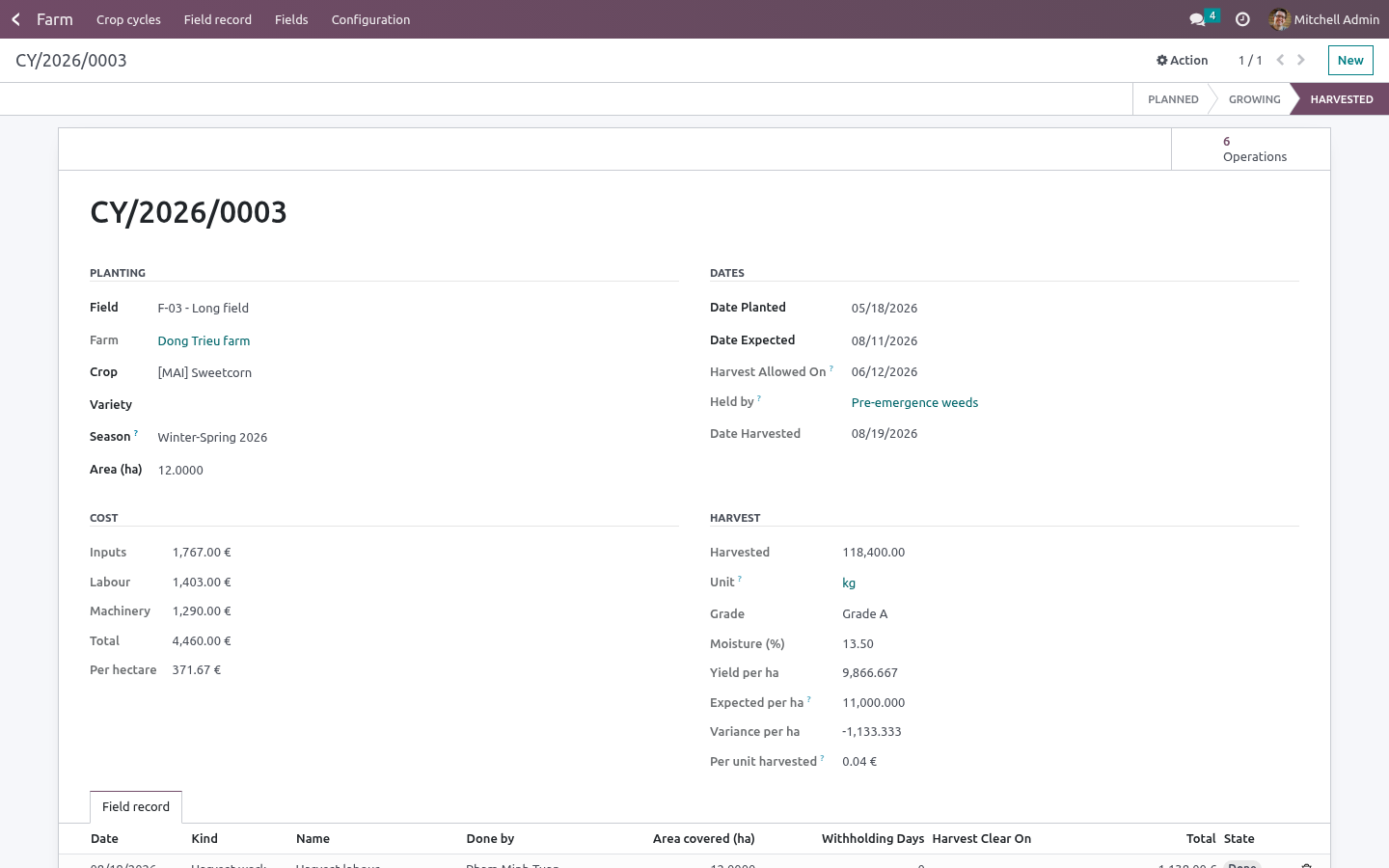
Signing off a spray sets an earliest legal harvest date on the crop cycle, taken from the longest period among the products applied. The cycle names the spray that is holding it.
Harvesting before that date is refused, and the refusal names the product, the day it was applied and the number of days. Cutting inside a withholding period is a rejected load, a failed residue test and, in most places, an offence.
The harvest date itself is bounded: not in the future, not before the crop went in the ground. A date in the future clears every withholding period ever recorded, which is the one keystroke that would walk a load straight out of the field.
A spray planned for next week holds nothing back - only signed-off work counts. A spray still sitting as planned and dated before the harvest is a different animal: it is a withholding period nobody counted, and the harvest is refused until somebody says whether it happened.
Work cannot be recorded or signed off on a cycle that has been harvested, written off or cancelled unless it is marked as a late entry. When a late entry proves the crop was cut inside a withholding period, a red flag is written on the cycle naming the day it was cut and the day it could legally have been.
The spray record
Product, batch, registration number, quantity, the rate that actually went on per hectare, the operator, the wind and the weather.
An operation that says something was applied but names no product cannot be signed off. It is the entry an inspector reads first.
A pesticide, herbicide or fungicide cannot be applied by an operator with no spray licence on file, and not with one that had expired on the day. The rule follows the product, not the box somebody ticked: a herbicide recorded under Weeding is still a herbicide and still needs a licensed operator.
The withholding period and the registration are copied onto the line as it is applied, not read through a relation, and they are never typed in - anything a client, an import or an RPC call sends for them is dropped and re-read from the label. Correct a line from a fertiliser to a pesticide and it becomes a pesticide, period and all. If the label changes next year, what happened this year stays what happened this year.
A signed entry is locked: its date, kind, operator, products, area, hours, rates and wind are what happened. Its state moves only through Done and Cancel, so it cannot be written back to cancelled and take its withholding period and its cost with it, and it cannot be repointed at another crop. Notes and the weather stay editable, because a note is not the record.
Who signed it off is recorded from the session, next to the operator somebody typed in.
A signed entry cannot be deleted, and neither can a cycle that carries one or that has been harvested or written off. Corrections are new entries; the field record is not something you tidy up.
The costing
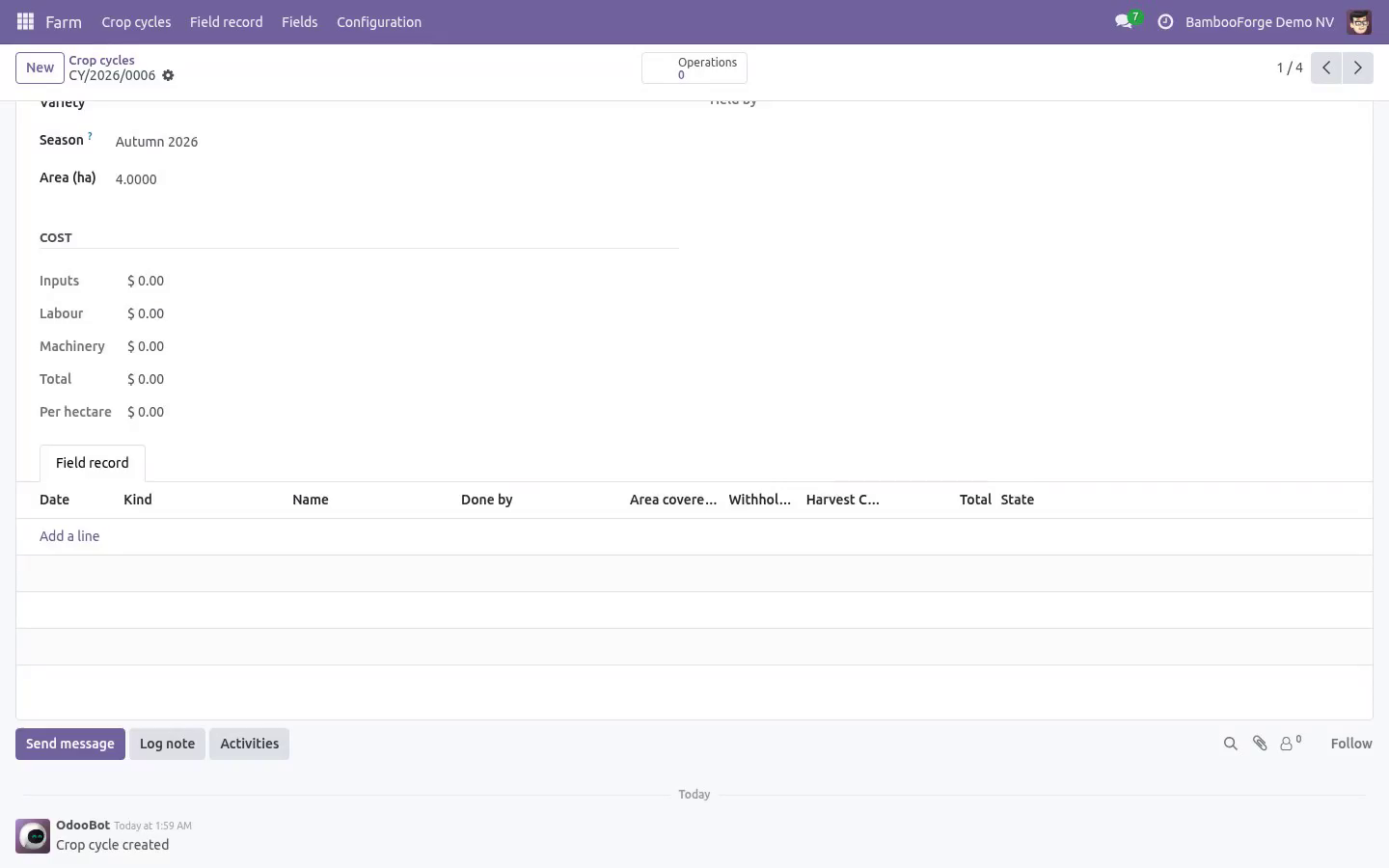
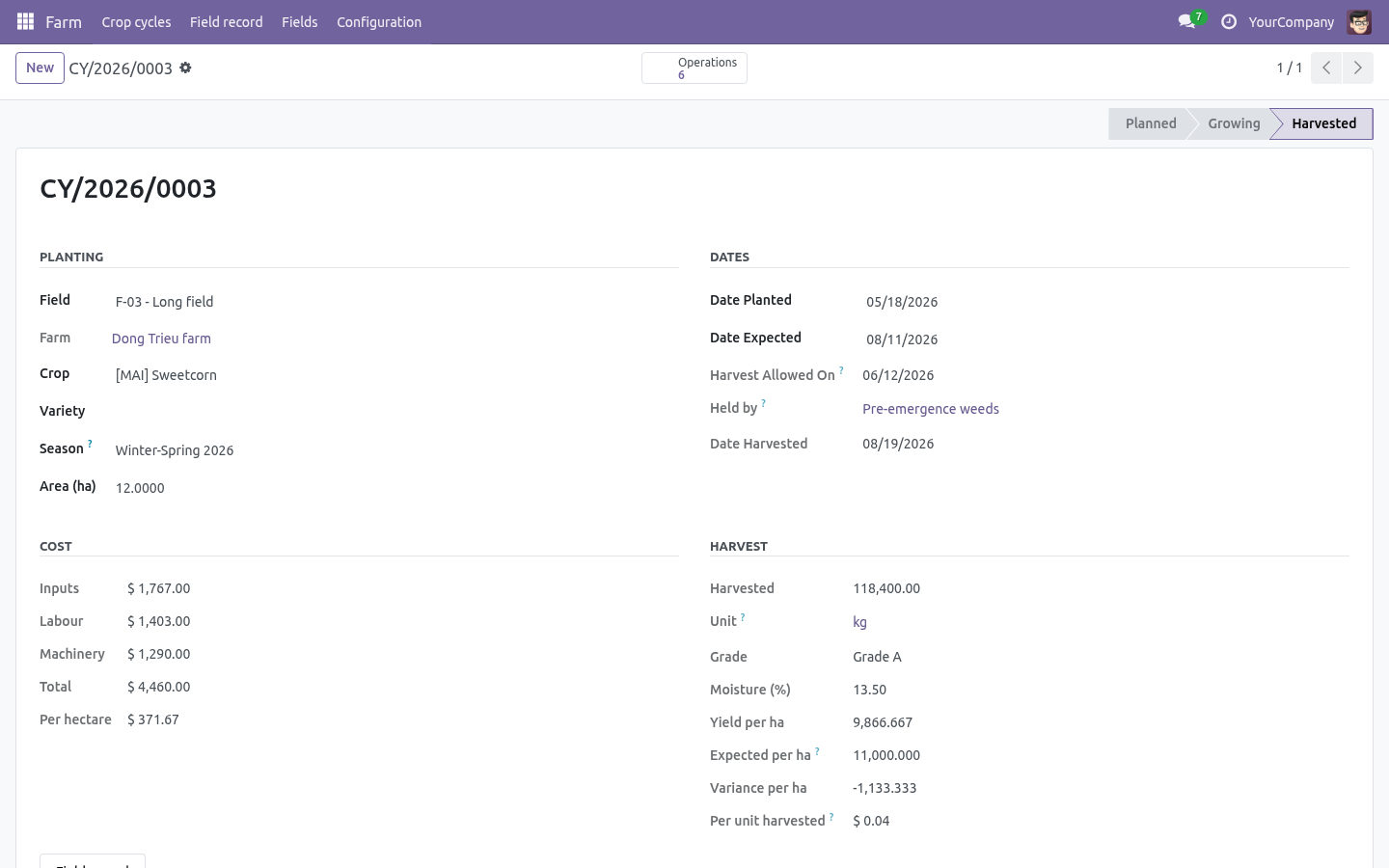
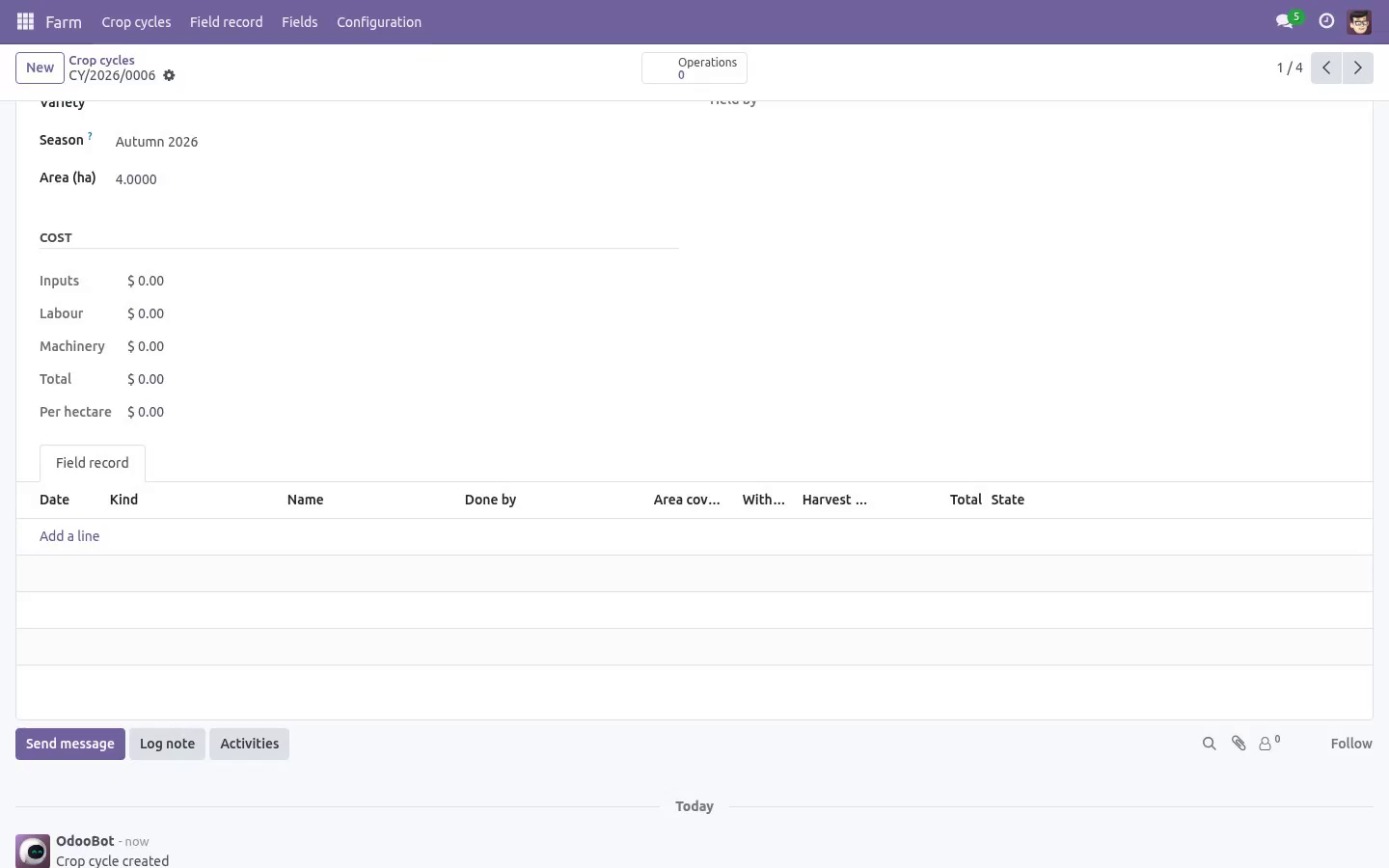
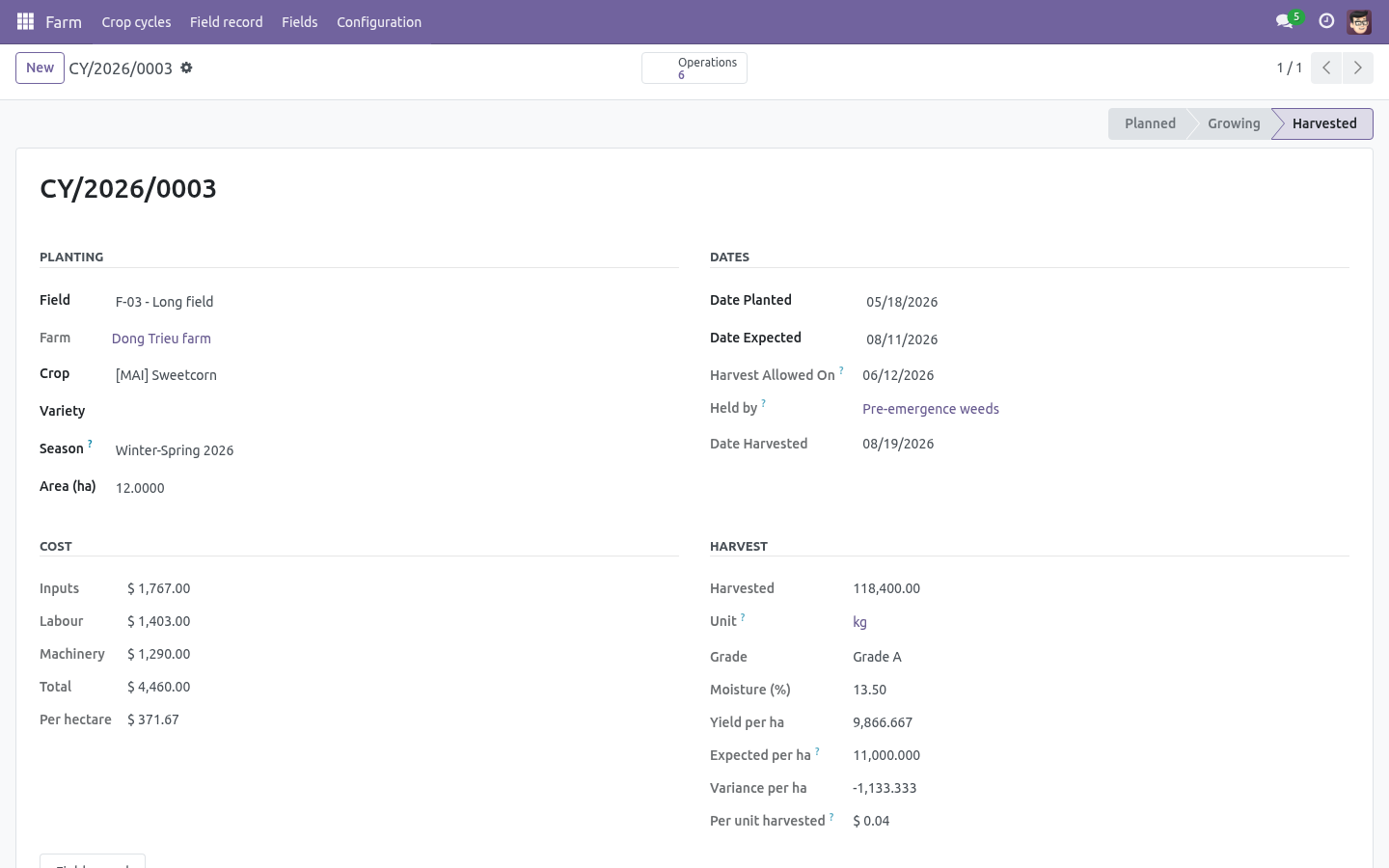
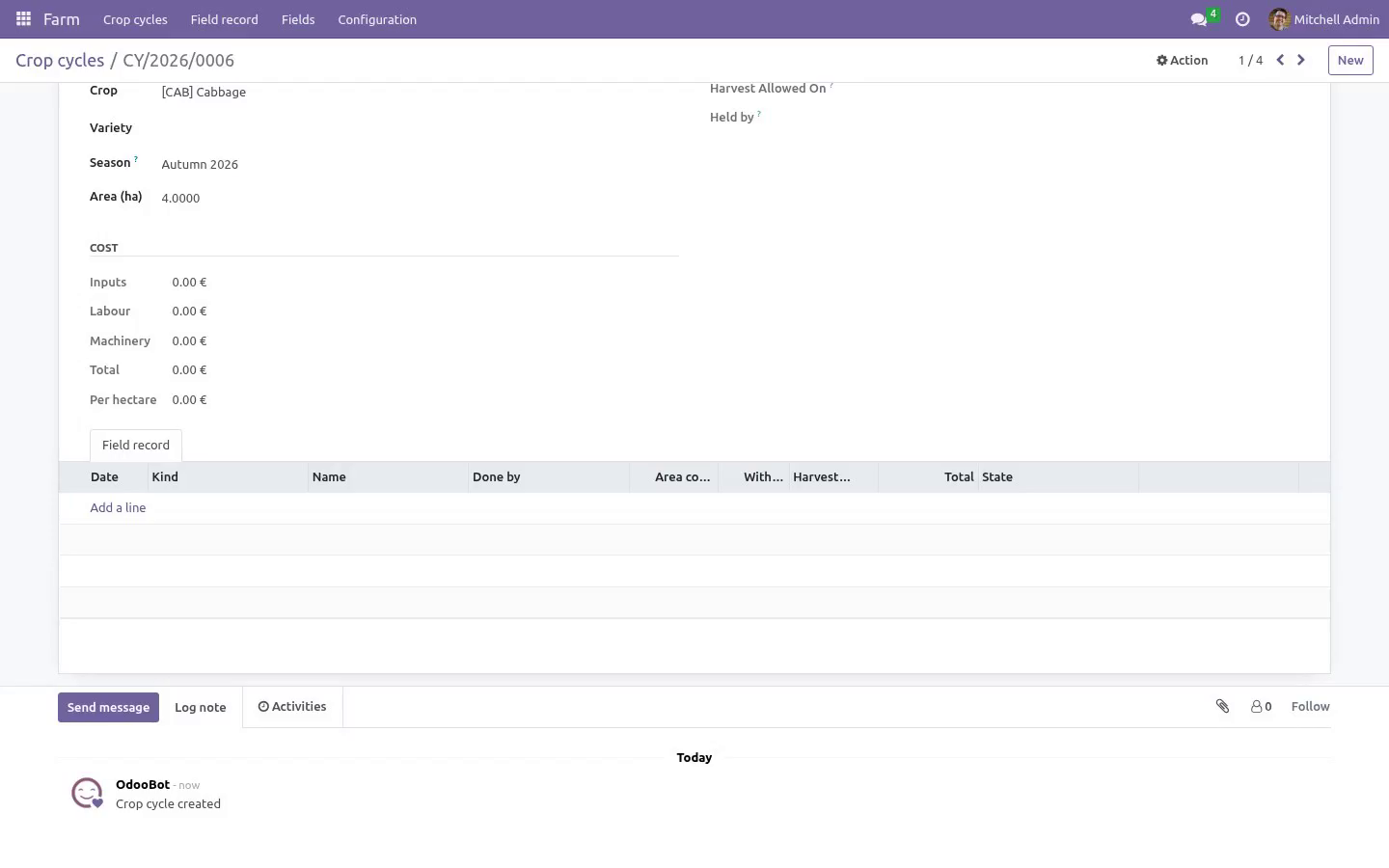
Inputs, labour and machinery roll up from signed-off operations onto the cycle: total, per hectare and per unit harvested.
The yield is measured against the expected yield for that crop, so a season ends with a variance rather than a feeling.
A crop written off keeps its cost. The money was spent either way, and a failed field that shows zero teaches nobody anything.
The land
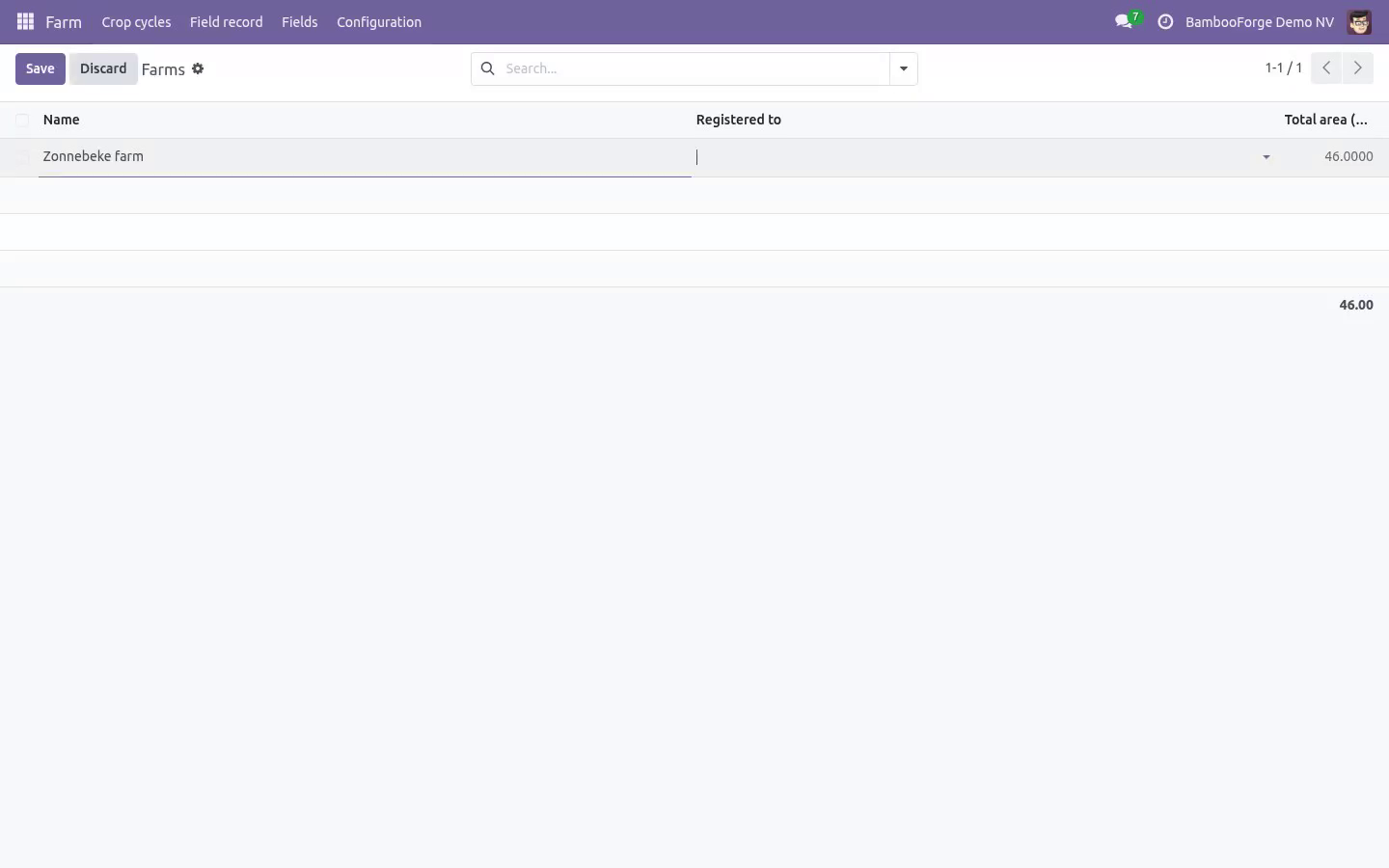
Live cycles on a field cannot add up to more than its area, and an operation cannot cover more hectares than were planted. The rule is checked from both ends: a field's area cannot be corrected downwards under the crops already standing on it, and the parcel is locked while it is checked, so two cycles entered at the same moment on two screens cannot both fit on ground that holds one of them.
Harvesting, cancelling or writing off a cycle frees the ground again.
Every cycle ever grown on a parcel stays on it - what went in, what it cost, what came off. Which is what the rotation, a buyer and an organic inspector all ask for.
The season
A crop cycle runs planned -> growing -> harvested, or is written off, or is cancelled while nothing has been done to it.
The harvest is recorded through a short form that insists on a weight that is a weight and a moisture that is a percentage, and warns on screen while a spray - or a date in the future - stands in the way.
Crops coming due within a week - and crops still held by a spray - land on the list of whoever planned the cycle, or of a manager if they have left the farm. Once each, even after the reminder has been dealt with, and the date on it follows the hold every time another spray is signed off.
Roles
Field operator - records what was done in the field and what was applied. Cannot plan a season, harvest, or configure.
Farm manager - plans the season, opens and closes cycles, records the harvest, and configures farms, fields, crops and inputs.
Installation
Copy bambooforge_farm into your addons path and update the app list, or install the ZIP from the Odoo Apps Store. Community only; it depends on base, base_setup, mail, product and uom.
Install Farm & Crop Management for Agriculture.
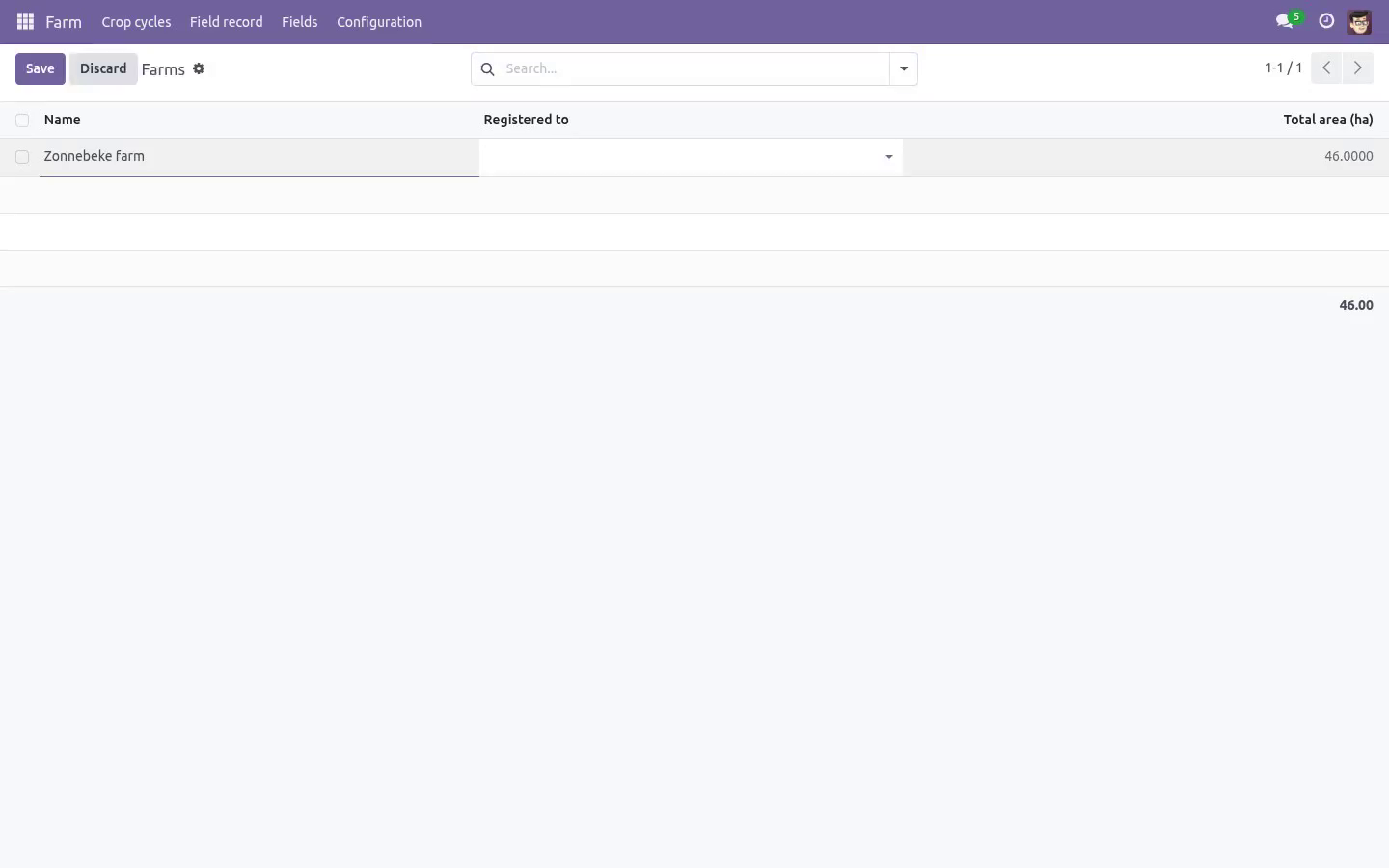
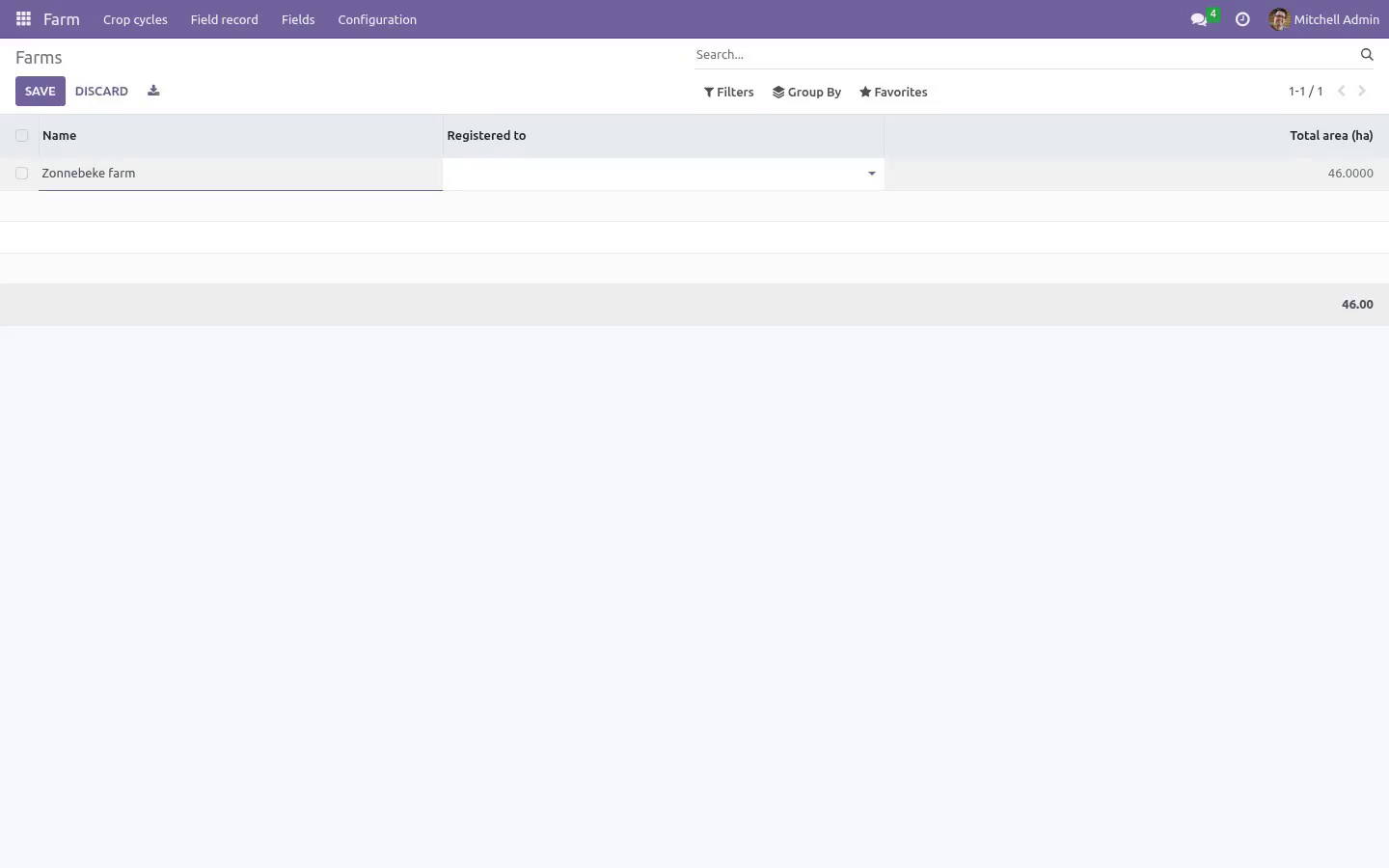
Create the farms, then the fields with their real measured area.
Create the crops with their unit and expected yield.
Create the inputs with their withholding days and registration numbers.
Put spray licence numbers on the operators' user records before the first spray, or the first spray cannot be signed off.
How we make sure it works
Before every release, 128 automated checks run against this app on Odoo 16, 17, 18, 19 and 20. Among them:
A spray cannot be signed off on a written off cycle.
A cycle cannot be planted on another company's field.
A spray that names no product cannot be signed off.
A cycle with work on it cannot be cancelled.
A signed entry cannot be repointed at another cycle.
The complete list is in the source you receive.
What it does not do
Said before you buy, because it is the half that decides whether the app fits:
Count planned work: a spray planned for next week holds nothing back - only signed-off work counts.
Sign off an operation that names no product, or record work on a harvested or cancelled cycle unless marked as a late entry.
Questions people ask
- Which Odoo versions does it run on?
Odoo 16.0, 17.0, 18.0, 19.0, 20.0, on the series you buy it for; each series is its own listing.
- Community or Enterprise?
Both. It needs no Enterprise app.
- What does it need?
The standard Discuss, Products, Settings, Units of Measure apps. No extra Python package.
- Where does it show up?
Under the Farm menu (Crop cycles, Field record, Fields, Configuration).
- Does anything leave my server?
No. It makes no call outside your Odoo server: no telemetry, no licence check, no third-party service.
- What happens if I uninstall it?
Odoo drops the app's own tables and fields; the standard records it worked on (contacts, orders, products) stay as they are.