 BambooForge Labs
Document Retention & Immutable Archive
Keep issued documents as long as the law requires and prove they were never touched: hash chain, retention dates, deletion blocked.
Available for Odoo 16.0, Odoo 17.0, Odoo 18.0, Odoo 19.0, Odoo 20.0. Technical name bambooforge_archive.
Transcript of the walkthrough (Odoo 20)
Document Retention & Immutable Archive. Keep issued documents as long as the law requires and prove they were never touched: hash chain, retention dates, deletion blocked. Most EU jurisdictions require accounting documents to be produceable for ten years, unaltered. Odoo stores attachments; it does not prove anything about them, and anyone with delete rights can remove one.
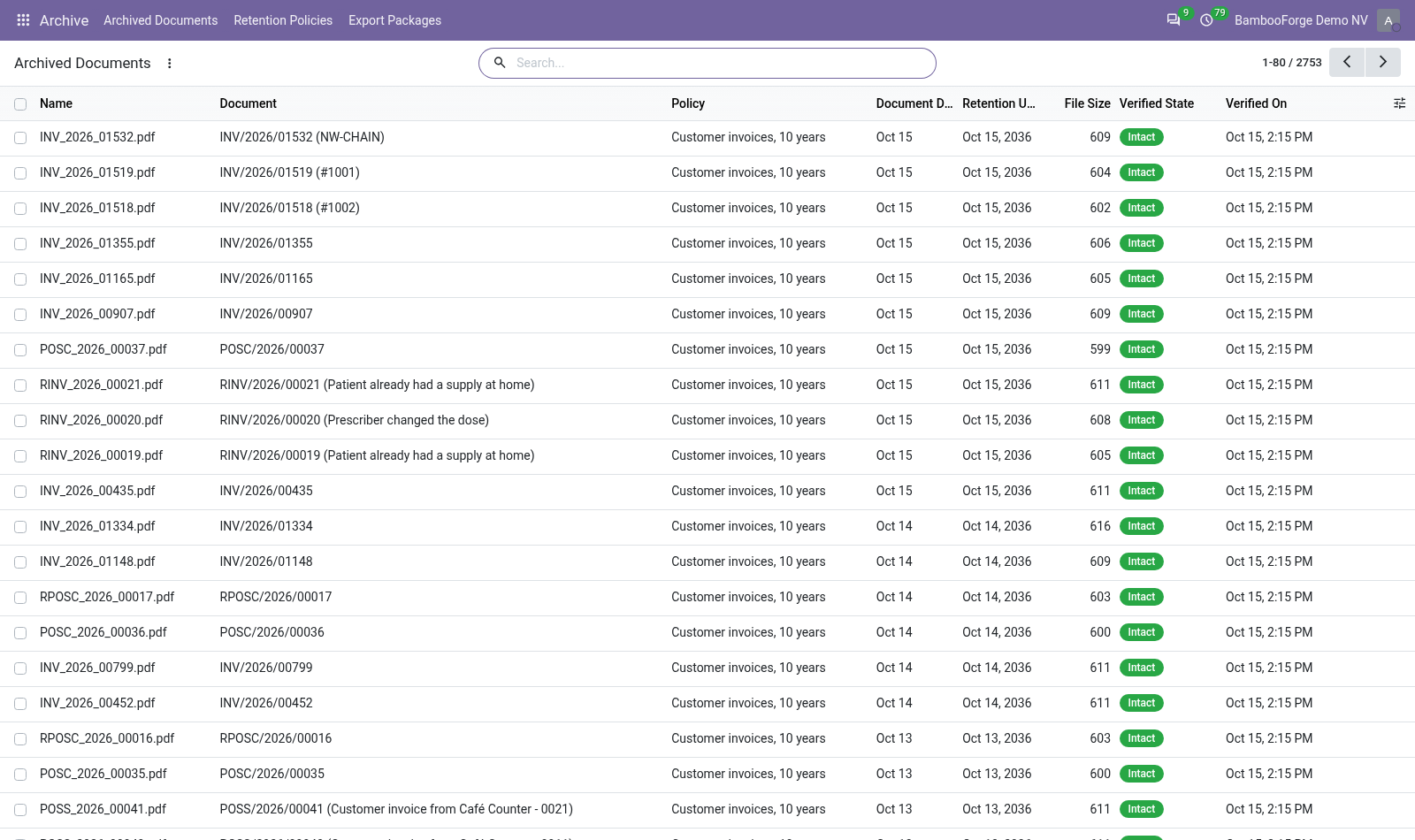
Archive ▸ Retention Policies In the next few minutes: what this is for, then policies, then the chain, then deletion, then handing it to an auditor. Then what this app deliberately does not do, so you can tell before you buy whether it fits. Everything lives under Archive then Archived Documents then Retention Policies then Export Packages. 1.
Copy bambooforge_archive into your addons path and update the app list, or install the ZIP from the Odoo Apps Store. 2. Install Document Retention & Immutable Archive. 3.
Open Archive - its menus are Archived Documents, Retention Policies, Export Packages. What this is for. Most EU jurisdictions require accounting documents to be produceable for ten years, unaltered. Odoo stores attachments; it does not prove anything about them, and anyone with delete rights can remove one.
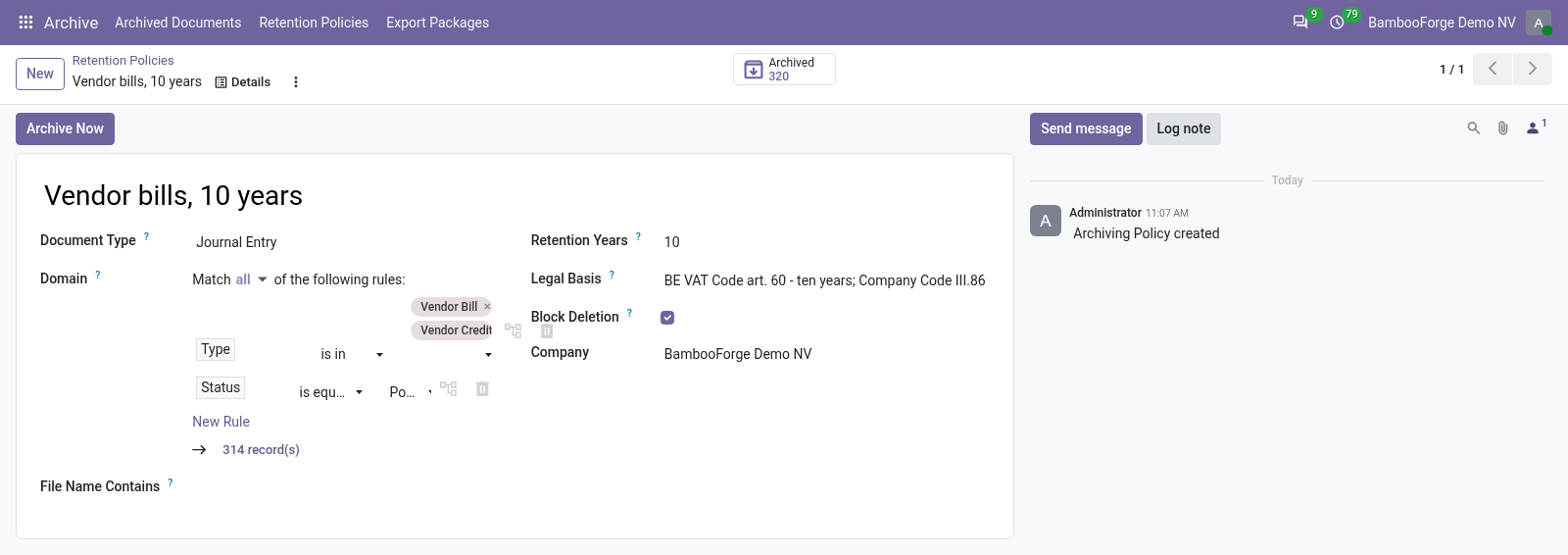
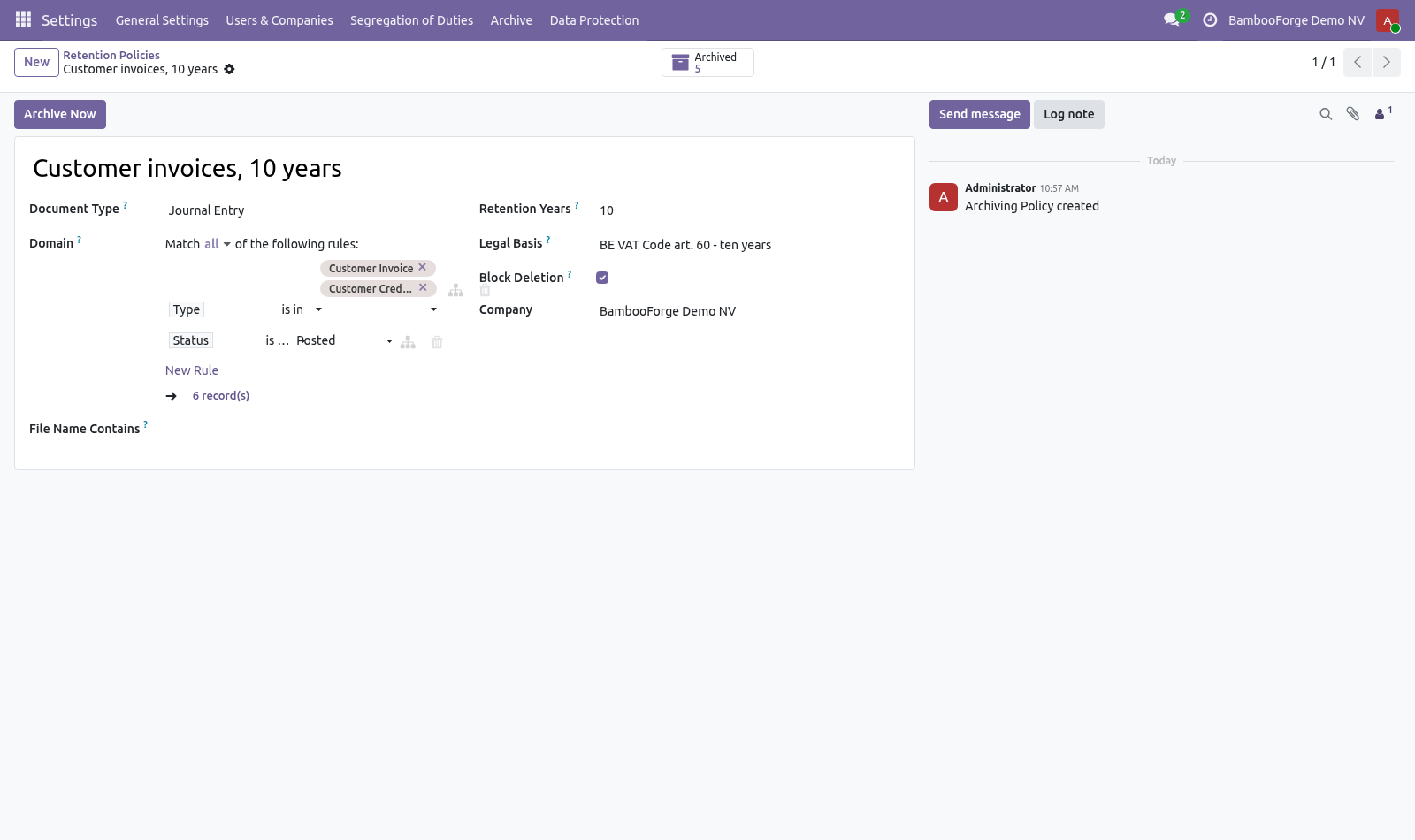
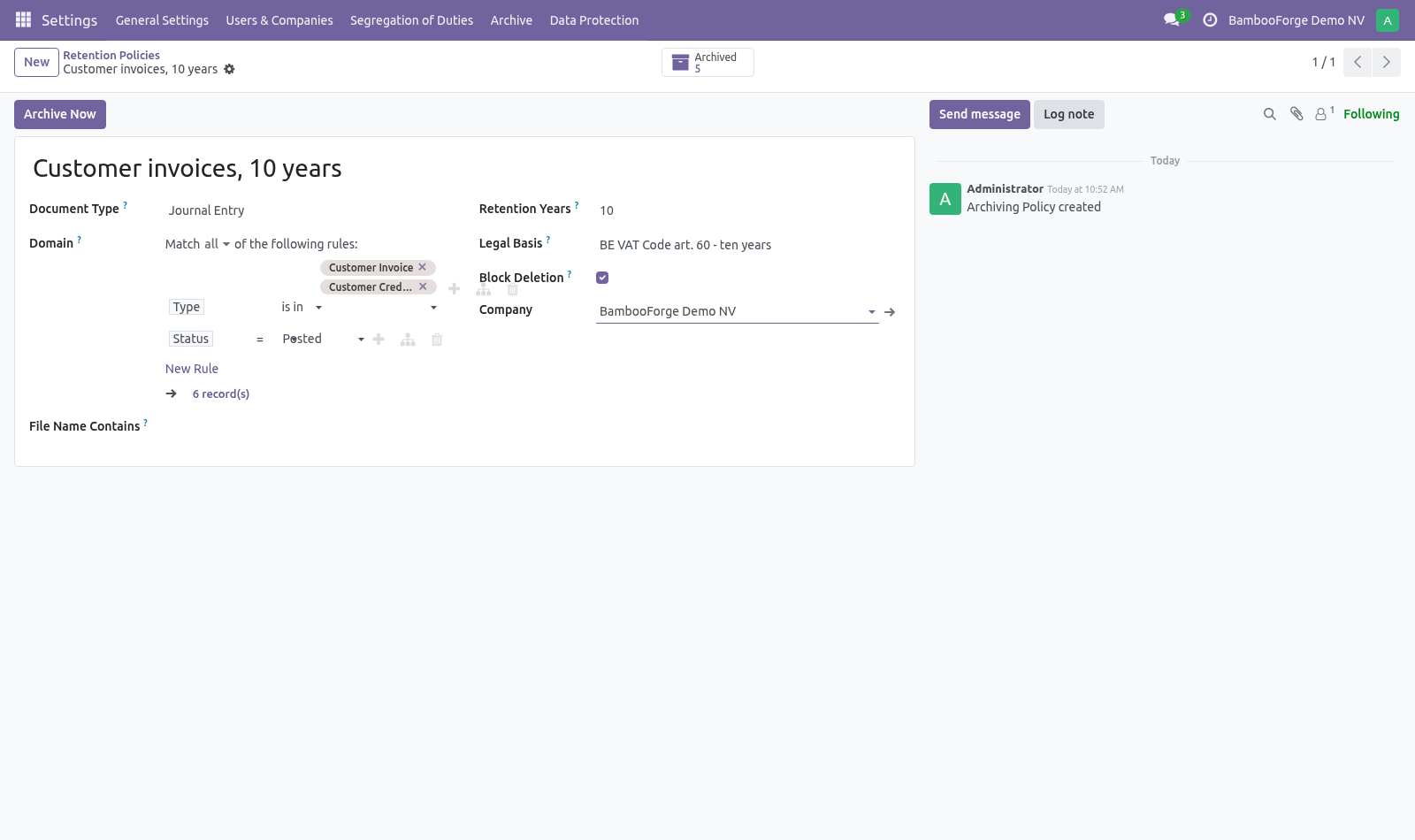
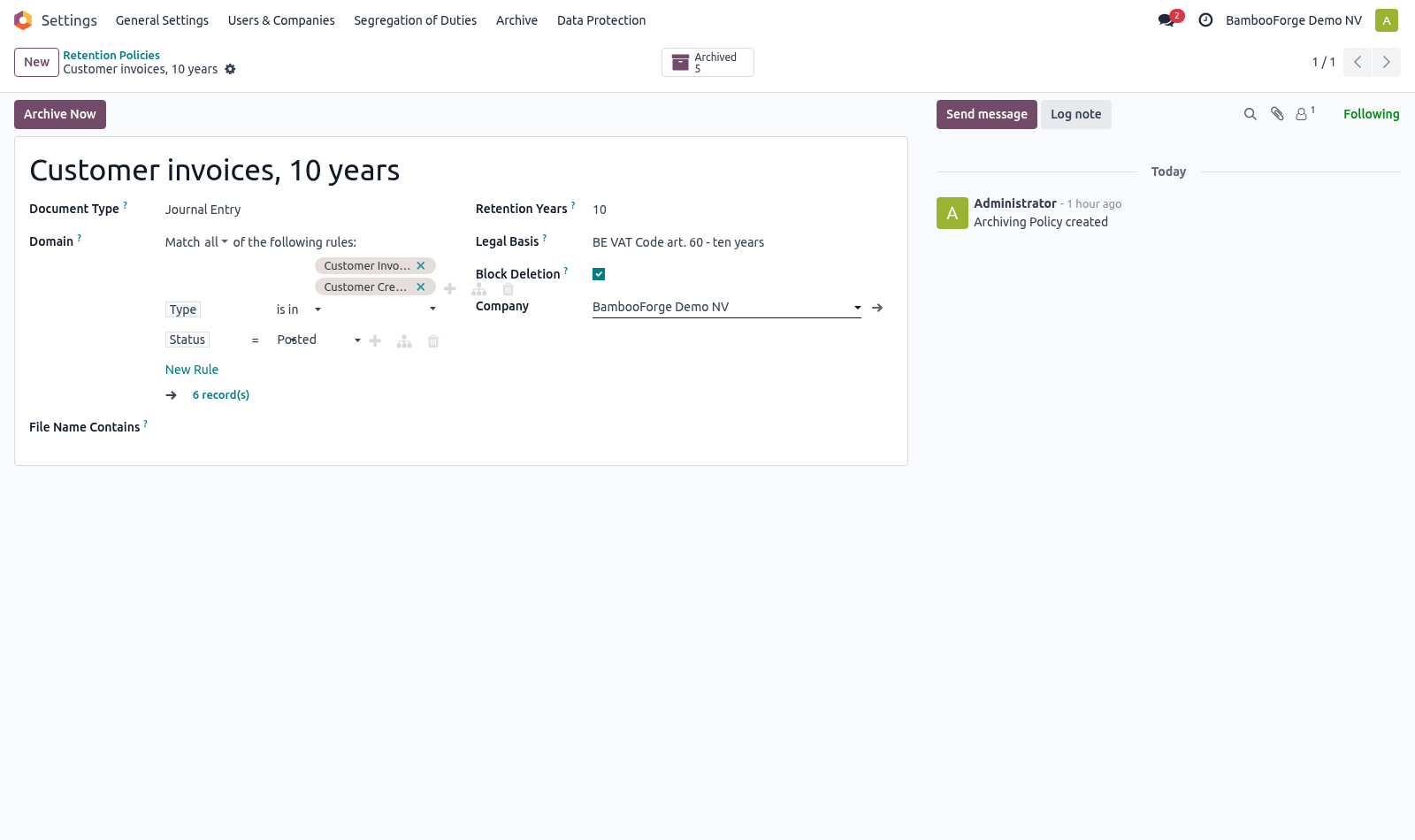
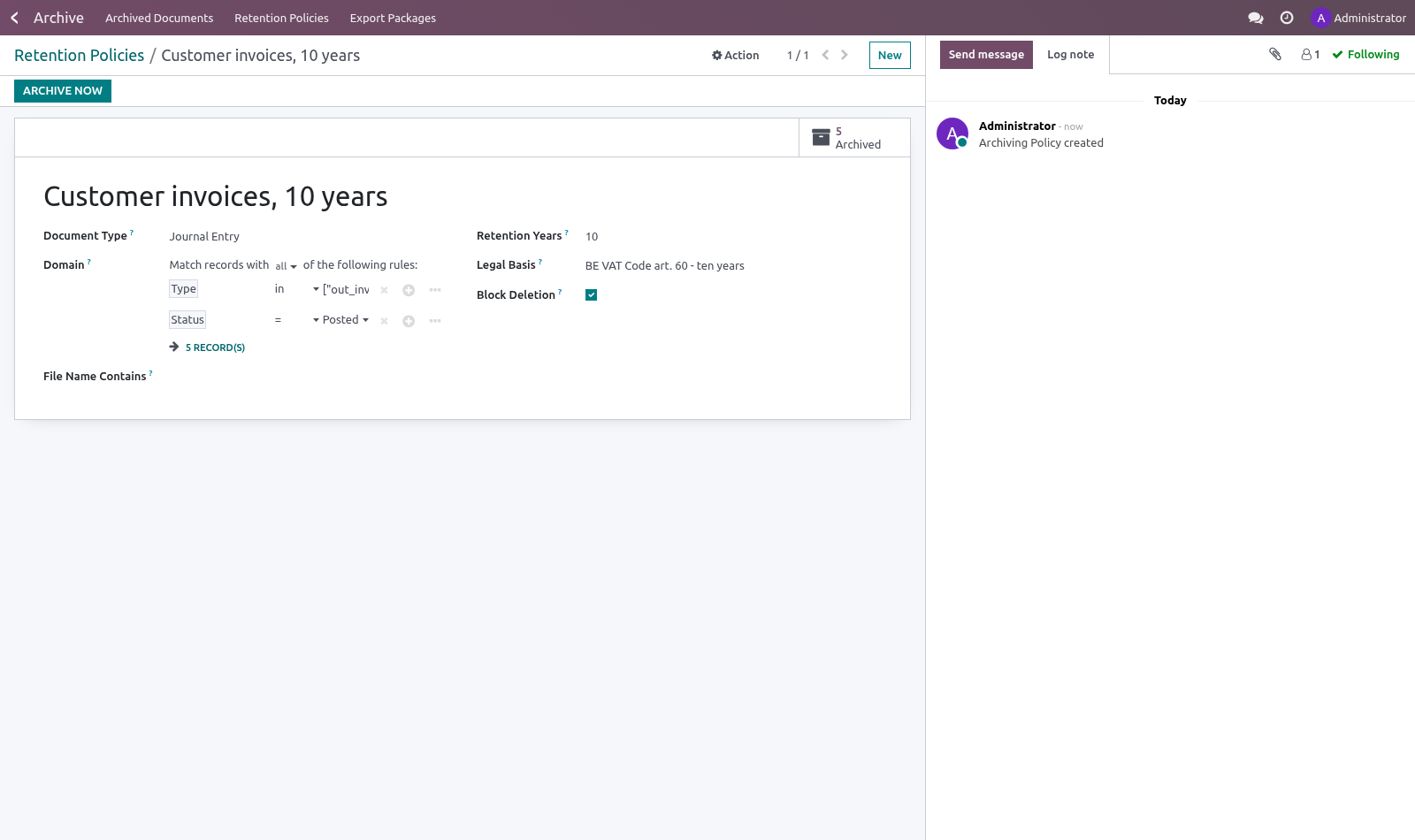
Policies. A policy says what is kept, for how long, and on what legal basis: the document type and an optional filter — posted invoices only, one journal; a file-name filter, for when only the issued PDF matters and the working files do not; the retention period in years; the legal basis you are relying on. An auditor asks for this before they ask for the documents. Retention runs from the document's own date, not from the day somebody got round to archiving it.
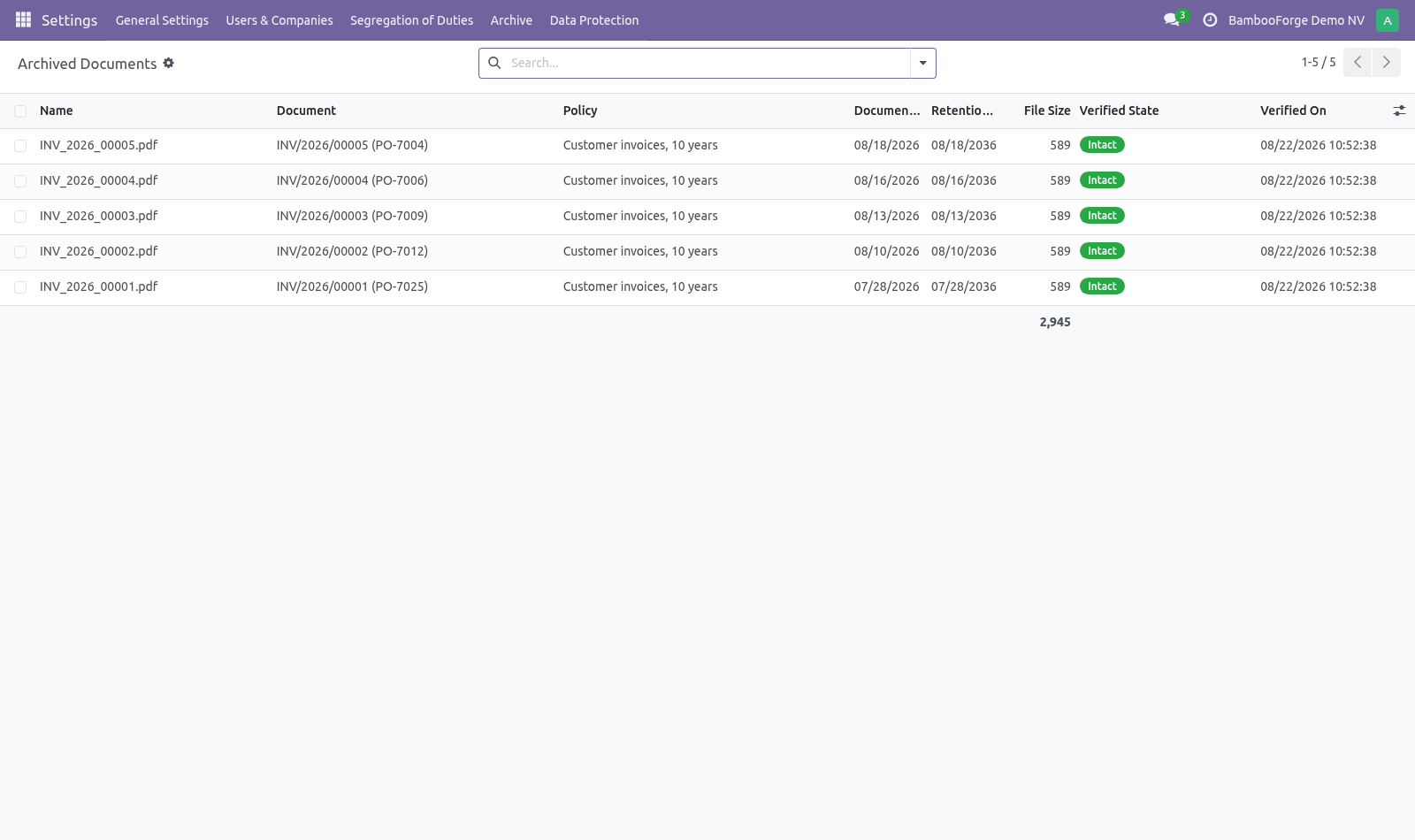
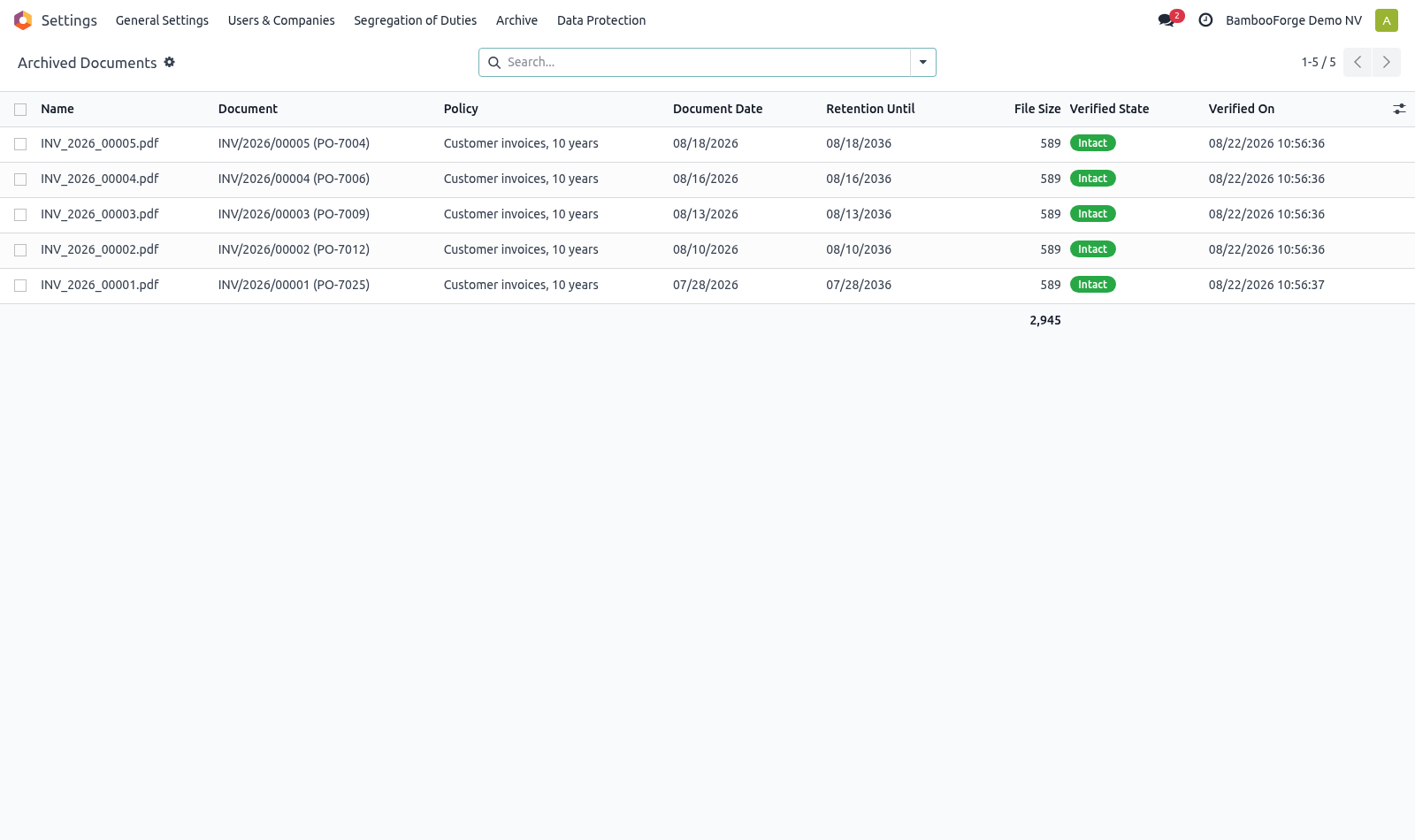
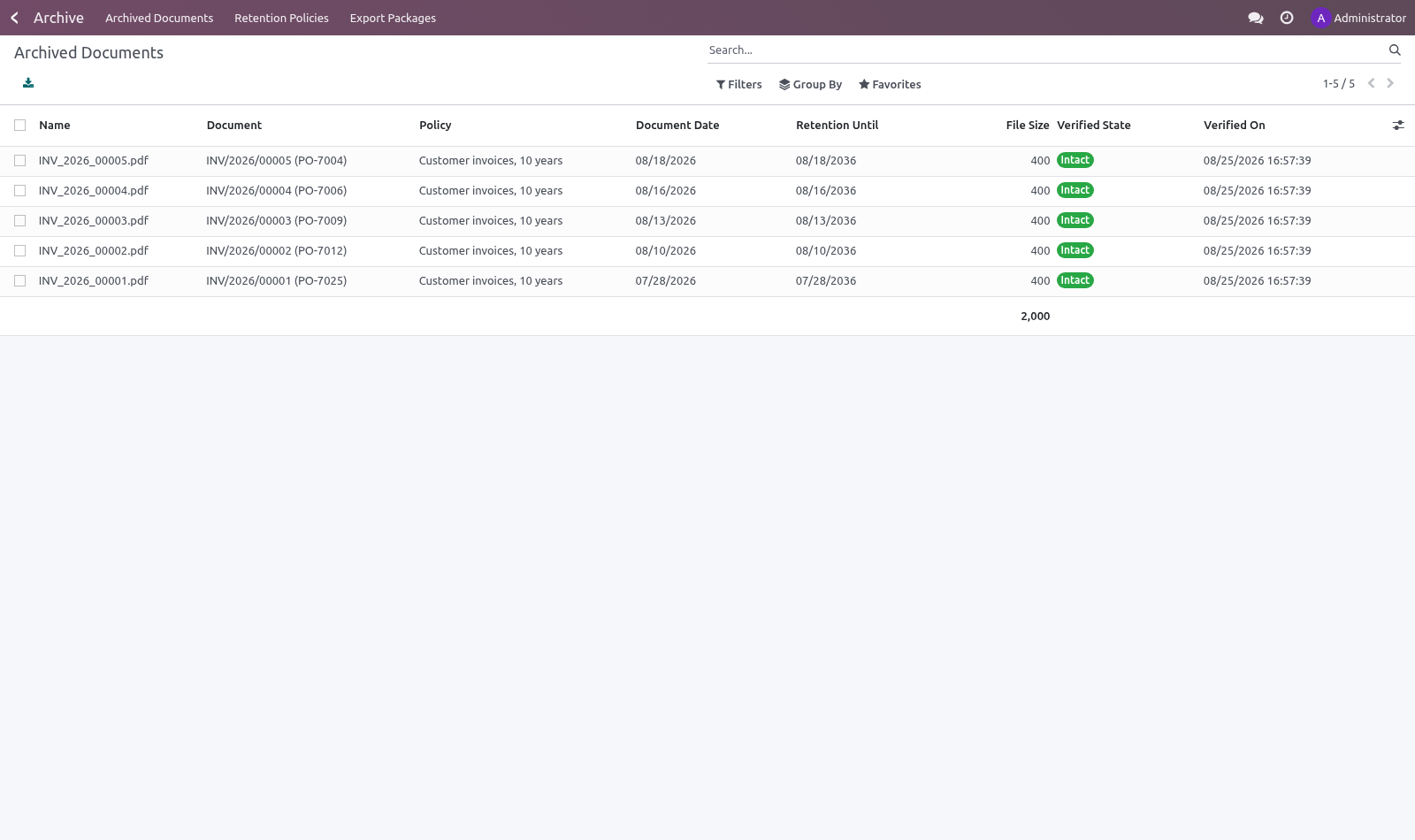
The chain. Every entry stores the SHA-256 of the file and commits to the entry before it. A stored hash proves a file has not changed; the chain proves something more useful — that no entry has been removed or reordered either. Altered — the file's content no longer matches.
Somebody edited it in place. File missing — the attachment row is there but the bytes are not. That is what a filestore restored from a bad backup looks like. Chain break — the entry's own hash does not recompute.
Something rewrote the archive table directly. Verification reports the two failures separately, because they mean different things: Deletion. While the retention period runs, neither the archive entry nor the underlying attachment can be deleted. Retention a user can undo with the bin icon is not retention.
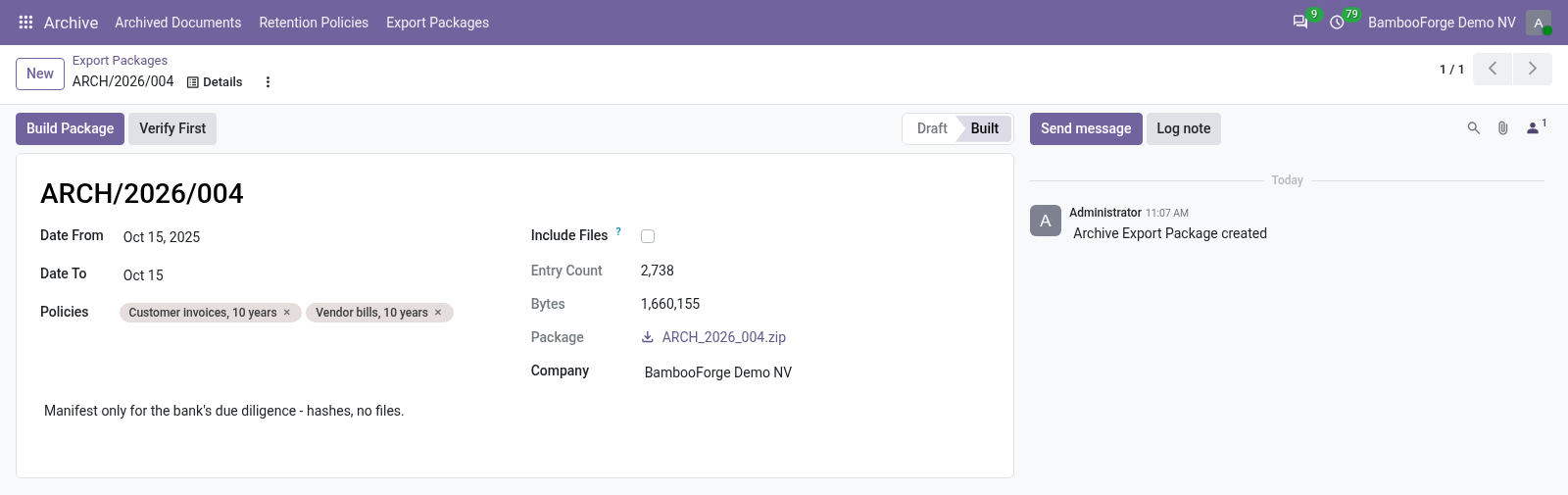
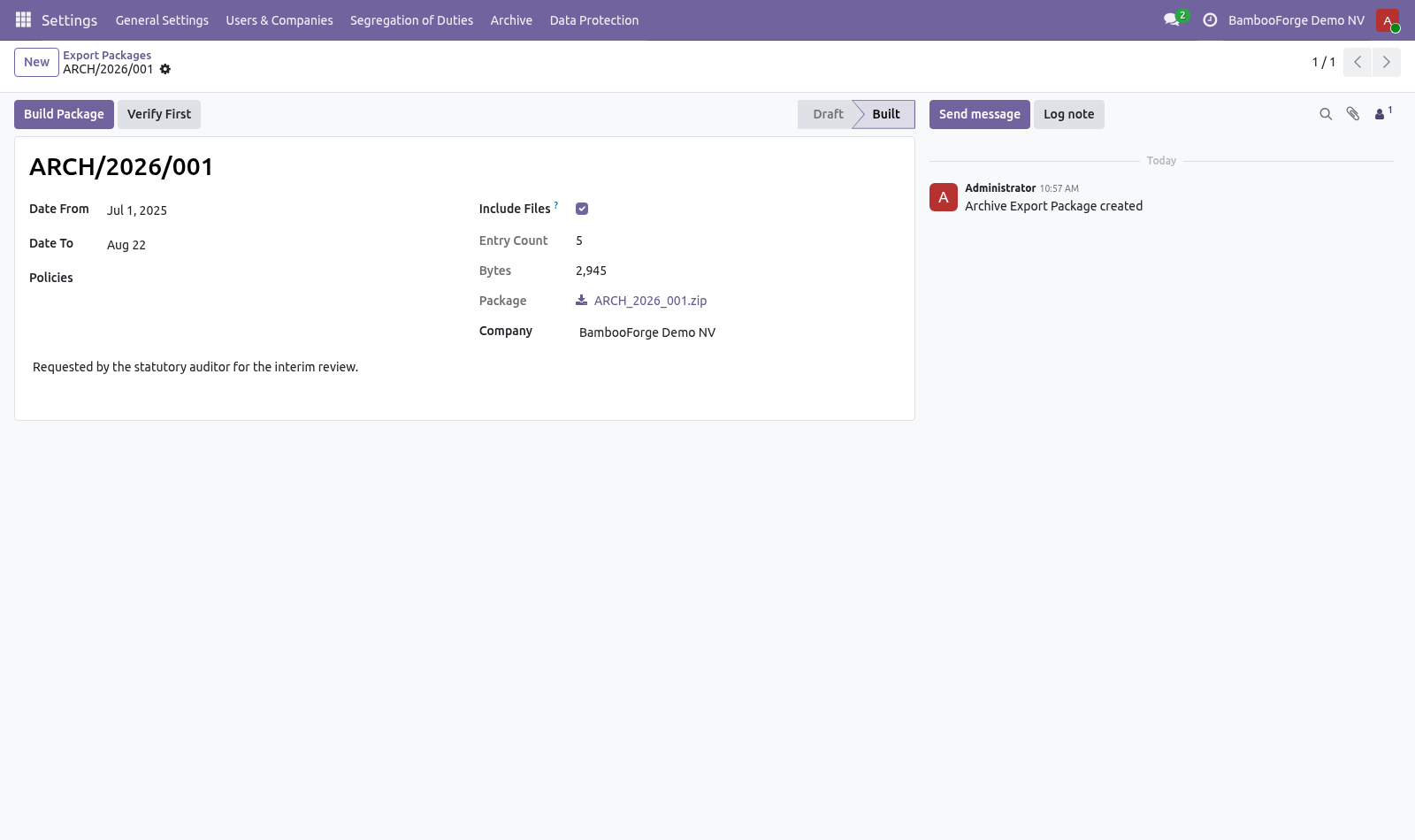
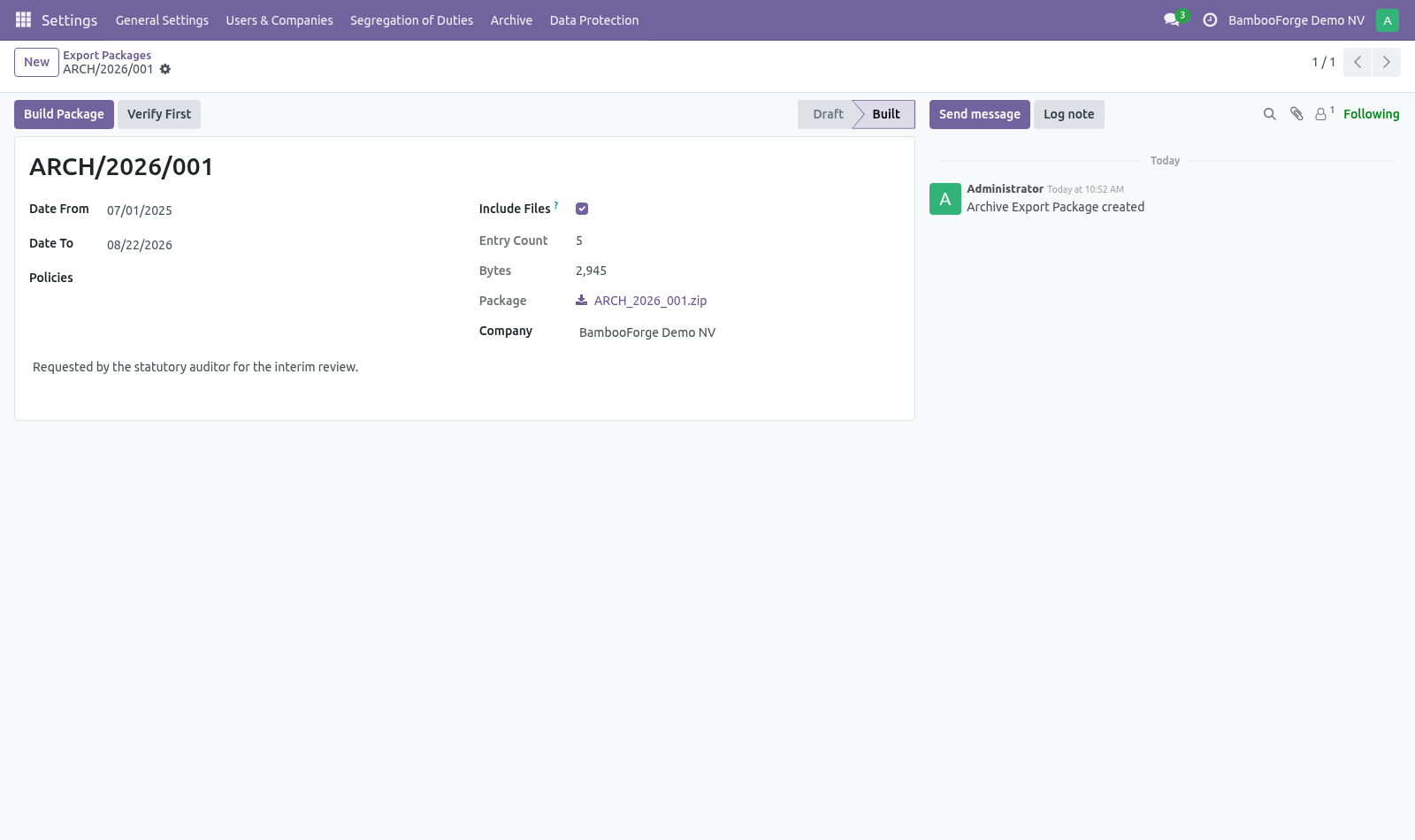
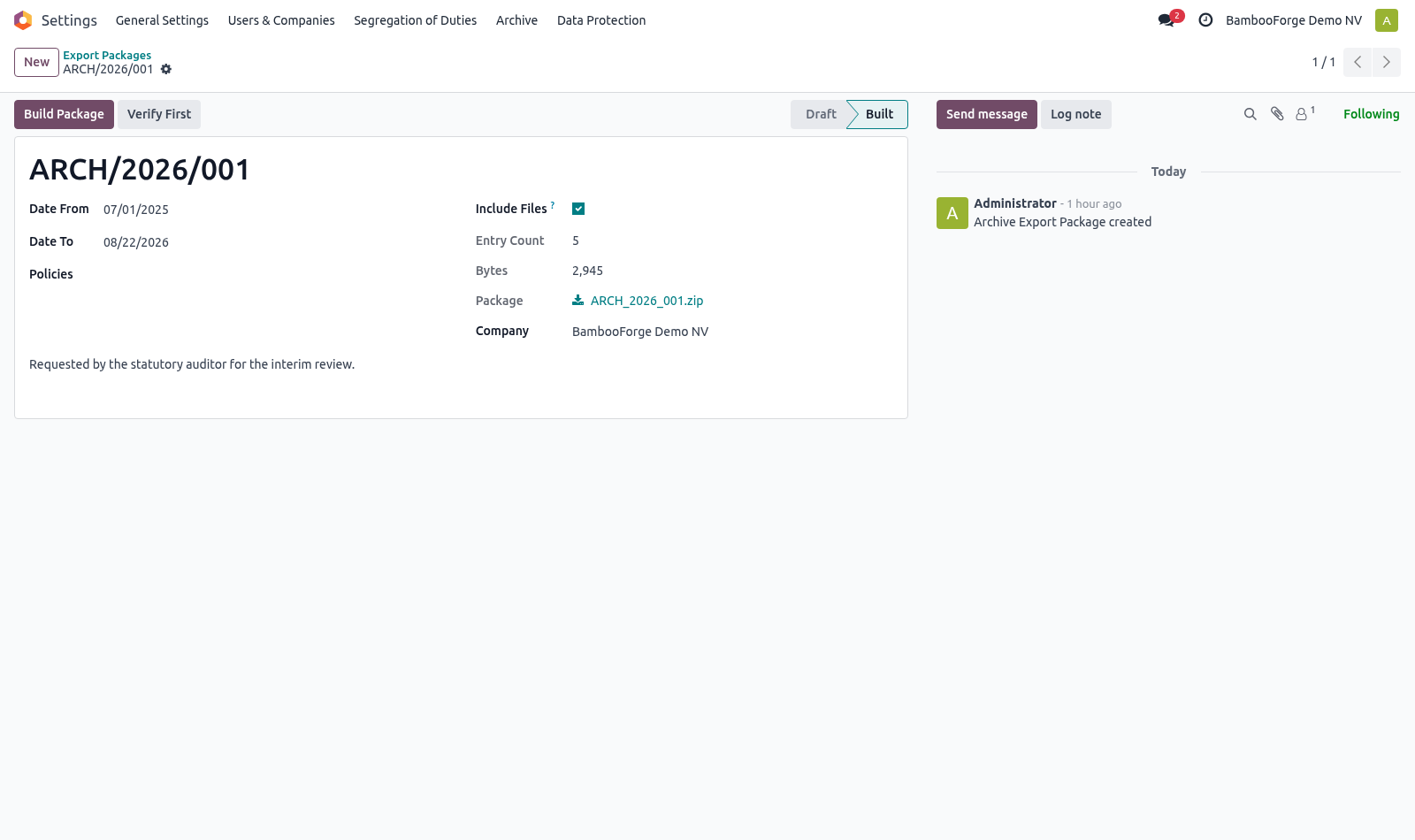
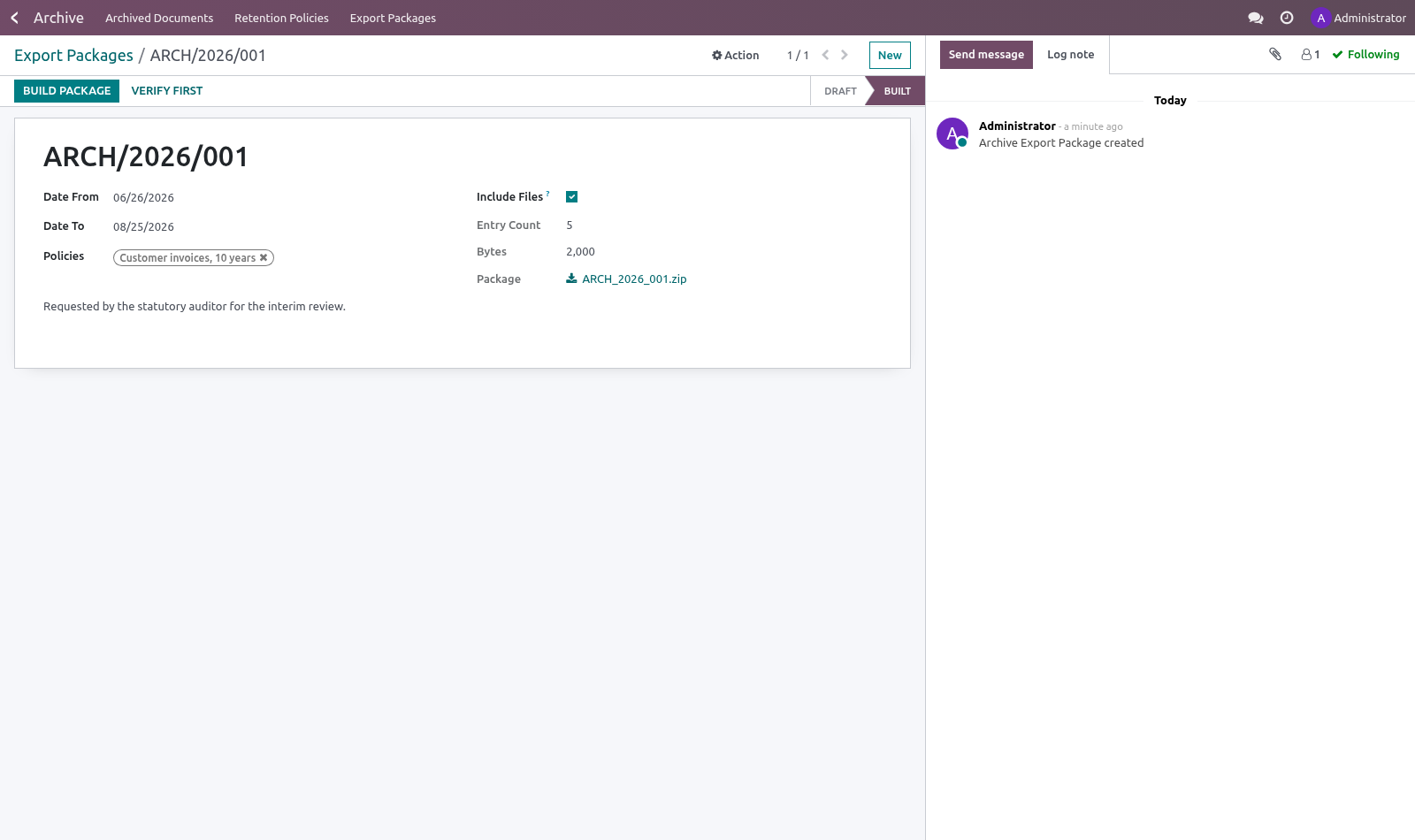
After the period, deletion is allowed — deliberately. Keeping personal data longer than the rule permits is its own breach. Handing it to an auditor. Archive ▸ Export Packages builds a zip holding the files, a manifest with every hash and chain value, and a README explaining how to redo the check with nothing but sha256sum.
An archive that can only prove itself inside the system holding it proves very little. For an archive too large to move, build the package with include files turned off: the manifest and the hashes still change hands. How we make sure it works. Before every release, 26 automated checks run against this app on Odoo 16, 17, 18, 19 and 20.
Among them: The same file is not archived twice. An archived attachment cannot be deleted. A plain employee does not see the menu. An employee reads the archive and touches nothing.
Zero years is not a policy. The complete list is in the source you receive. Questions people ask. Which Odoo versions does it run on?
Odoo 16.0, 17.0, 18.0, 19.0, 20.0, on the series you buy it for; each series is its own listing. Community or Enterprise? Both. It needs no Enterprise app.
Now the part most videos leave out: what this does not do. The chain is per company and per Odoo database. It proves internal consistency, not that a document existed on a given date — that needs a timestamping authority, which is a different product. Archiving works on attachments.
A document that was never attached to a record is not archived, because there is nothing to archive. Verifying re-reads every file. On a large filestore that is real I/O, which is why the scheduled check runs weekly rather than hourly. The complete manual is at docs dot bambooforge dot dev, the demo database is linked from the store page, and support answers within twenty-four hours.
Links are in the description.
Transcript of the walkthrough (Odoo 19)
Document Retention & Immutable Archive. Keep issued documents as long as the law requires and prove they were never touched: hash chain, retention dates, deletion blocked. Most EU jurisdictions require accounting documents to be produceable for ten years, unaltered. Odoo stores attachments; it does not prove anything about them, and anyone with delete rights can remove one.
Archive ▸ Retention Policies In the next few minutes: what this is for, then policies, then the chain, then deletion, then handing it to an auditor. Then what this app deliberately does not do, so you can tell before you buy whether it fits. Everything lives under Archive then Archived Documents then Retention Policies then Export Packages. What this is for.
Most EU jurisdictions require accounting documents to be produceable for ten years, unaltered. Odoo stores attachments; it does not prove anything about them, and anyone with delete rights can remove one. Policies. A policy says what is kept, for how long, and on what legal basis: the document type and an optional filter — posted invoices only, one journal; a file-name filter, for when only the issued PDF matters and the working files do not; the retention period in years; the legal basis you are relying on.
An auditor asks for this before they ask for the documents. Retention runs from the document's own date, not from the day somebody got round to archiving it. The chain. Every entry stores the SHA-256 of the file and commits to the entry before it.
A stored hash proves a file has not changed; the chain proves something more useful — that no entry has been removed or reordered either. Altered — the file's content no longer matches. Somebody edited it in place. File missing — the attachment row is there but the bytes are not.
That is what a filestore restored from a bad backup looks like. Chain break — the entry's own hash does not recompute. Something rewrote the archive table directly. Verification reports the two failures separately, because they mean different things: Deletion.
While the retention period runs, neither the archive entry nor the underlying attachment can be deleted. Retention a user can undo with the bin icon is not retention. After the period, deletion is allowed — deliberately. Keeping personal data longer than the rule permits is its own breach.
Handing it to an auditor. Archive ▸ Export Packages builds a zip holding the files, a manifest with every hash and chain value, and a README explaining how to redo the check with nothing but sha256sum. An archive that can only prove itself inside the system holding it proves very little. For an archive too large to move, build the package with include files turned off: the manifest and the hashes still change hands.
Now the part most videos leave out: what this does not do. The chain is per company and per Odoo database. It proves internal consistency, not that a document existed on a given date — that needs a timestamping authority, which is a different product. Archiving works on attachments.
A document that was never attached to a record is not archived, because there is nothing to archive. Verifying re-reads every file. On a large filestore that is real I/O, which is why the scheduled check runs weekly rather than hourly. The complete manual is at docs dot bambooforge dot dev, the demo database is linked from the store page, and support answers within twenty-four hours.
Links are in the description.
Transcript of the walkthrough (Odoo 18)
Document Retention & Immutable Archive. Keep issued documents as long as the law requires and prove they were never touched: hash chain, retention dates, deletion blocked. Most EU jurisdictions require accounting documents to be produceable for ten years, unaltered. Odoo stores attachments; it does not prove anything about them, and anyone with delete rights can remove one.
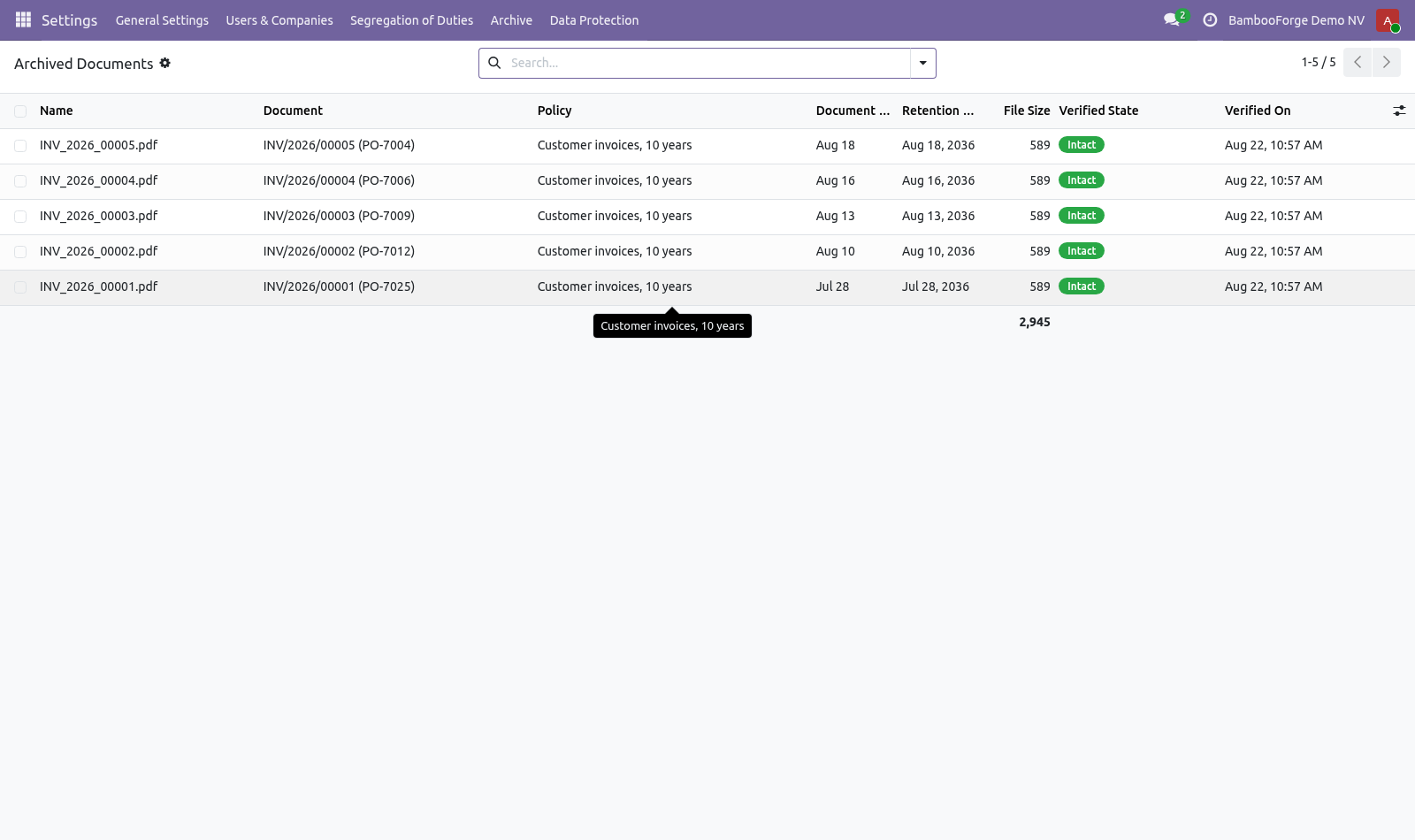
Archive ▸ Retention Policies In the next few minutes: what this is for, then policies, then the chain, then deletion, then handing it to an auditor. Then what this app deliberately does not do, so you can tell before you buy whether it fits. Everything lives under Archive then Archived Documents then Retention Policies then Export Packages. What this is for.
Most EU jurisdictions require accounting documents to be produceable for ten years, unaltered. Odoo stores attachments; it does not prove anything about them, and anyone with delete rights can remove one. Policies. A policy says what is kept, for how long, and on what legal basis: the document type and an optional filter — posted invoices only, one journal; a file-name filter, for when only the issued PDF matters and the working files do not; the retention period in years; the legal basis you are relying on.
An auditor asks for this before they ask for the documents. Retention runs from the document's own date, not from the day somebody got round to archiving it. The chain. Every entry stores the SHA-256 of the file and commits to the entry before it.
A stored hash proves a file has not changed; the chain proves something more useful — that no entry has been removed or reordered either. Altered — the file's content no longer matches. Somebody edited it in place. File missing — the attachment row is there but the bytes are not.
That is what a filestore restored from a bad backup looks like. Chain break — the entry's own hash does not recompute. Something rewrote the archive table directly. Verification reports the two failures separately, because they mean different things: Deletion.
While the retention period runs, neither the archive entry nor the underlying attachment can be deleted. Retention a user can undo with the bin icon is not retention. After the period, deletion is allowed — deliberately. Keeping personal data longer than the rule permits is its own breach.
Handing it to an auditor. Archive ▸ Export Packages builds a zip holding the files, a manifest with every hash and chain value, and a README explaining how to redo the check with nothing but sha256sum. An archive that can only prove itself inside the system holding it proves very little. For an archive too large to move, build the package with include files turned off: the manifest and the hashes still change hands.
Now the part most videos leave out: what this does not do. The chain is per company and per Odoo database. It proves internal consistency, not that a document existed on a given date — that needs a timestamping authority, which is a different product. Archiving works on attachments.
A document that was never attached to a record is not archived, because there is nothing to archive. Verifying re-reads every file. On a large filestore that is real I/O, which is why the scheduled check runs weekly rather than hourly. The complete manual is at docs dot bambooforge dot dev, the demo database is linked from the store page, and support answers within twenty-four hours.
Links are in the description.
Transcript of the walkthrough (Odoo 17)
Document Retention & Immutable Archive. Keep issued documents as long as the law requires and prove they were never touched: hash chain, retention dates, deletion blocked. Most EU jurisdictions require accounting documents to be produceable for ten years, unaltered. Odoo stores attachments; it does not prove anything about them, and anyone with delete rights can remove one.
Archive ▸ Retention Policies In the next few minutes: what this is for, then policies, then the chain, then deletion, then handing it to an auditor. Then what this app deliberately does not do, so you can tell before you buy whether it fits. Everything lives under Archive then Archived Documents then Retention Policies then Export Packages. What this is for.
Most EU jurisdictions require accounting documents to be produceable for ten years, unaltered. Odoo stores attachments; it does not prove anything about them, and anyone with delete rights can remove one. Policies. A policy says what is kept, for how long, and on what legal basis: the document type and an optional filter — posted invoices only, one journal; a file-name filter, for when only the issued PDF matters and the working files do not; the retention period in years; the legal basis you are relying on.
An auditor asks for this before they ask for the documents. Retention runs from the document's own date, not from the day somebody got round to archiving it. The chain. Every entry stores the SHA-256 of the file and commits to the entry before it.
A stored hash proves a file has not changed; the chain proves something more useful — that no entry has been removed or reordered either. Altered — the file's content no longer matches. Somebody edited it in place. File missing — the attachment row is there but the bytes are not.
That is what a filestore restored from a bad backup looks like. Chain break — the entry's own hash does not recompute. Something rewrote the archive table directly. Verification reports the two failures separately, because they mean different things: Deletion.
While the retention period runs, neither the archive entry nor the underlying attachment can be deleted. Retention a user can undo with the bin icon is not retention. After the period, deletion is allowed — deliberately. Keeping personal data longer than the rule permits is its own breach.
Handing it to an auditor. Archive ▸ Export Packages builds a zip holding the files, a manifest with every hash and chain value, and a README explaining how to redo the check with nothing but sha256sum. An archive that can only prove itself inside the system holding it proves very little. For an archive too large to move, build the package with include files turned off: the manifest and the hashes still change hands.
Now the part most videos leave out: what this does not do. The chain is per company and per Odoo database. It proves internal consistency, not that a document existed on a given date — that needs a timestamping authority, which is a different product. Archiving works on attachments.
A document that was never attached to a record is not archived, because there is nothing to archive. Verifying re-reads every file. On a large filestore that is real I/O, which is why the scheduled check runs weekly rather than hourly. The complete manual is at docs dot bambooforge dot dev, the demo database is linked from the store page, and support answers within twenty-four hours.
Links are in the description.
Transcript of the walkthrough (Odoo 16)
Document Retention & Immutable Archive. Keep issued documents as long as the law requires and prove they were never touched: hash chain, retention dates, deletion blocked. Most EU jurisdictions require accounting documents to be produceable for ten years, unaltered. Odoo stores attachments; it does not prove anything about them, and anyone with delete rights can remove one.
Archive ▸ Retention Policies In the next few minutes: what this is for, then policies, then the chain, then deletion, then handing it to an auditor. Then what this app deliberately does not do, so you can tell before you buy whether it fits. Everything lives under Archive then Archived Documents then Retention Policies then Export Packages. What this is for.
Most EU jurisdictions require accounting documents to be produceable for ten years, unaltered. Odoo stores attachments; it does not prove anything about them, and anyone with delete rights can remove one. Policies. A policy says what is kept, for how long, and on what legal basis: the document type and an optional filter — posted invoices only, one journal; a file-name filter, for when only the issued PDF matters and the working files do not; the retention period in years; the legal basis you are relying on.
An auditor asks for this before they ask for the documents. Retention runs from the document's own date, not from the day somebody got round to archiving it. The chain. Every entry stores the SHA-256 of the file and commits to the entry before it.
A stored hash proves a file has not changed; the chain proves something more useful — that no entry has been removed or reordered either. Altered — the file's content no longer matches. Somebody edited it in place. File missing — the attachment row is there but the bytes are not.
That is what a filestore restored from a bad backup looks like. Chain break — the entry's own hash does not recompute. Something rewrote the archive table directly. Verification reports the two failures separately, because they mean different things: Deletion.
While the retention period runs, neither the archive entry nor the underlying attachment can be deleted. Retention a user can undo with the bin icon is not retention. After the period, deletion is allowed — deliberately. Keeping personal data longer than the rule permits is its own breach.
Handing it to an auditor. Archive ▸ Export Packages builds a zip holding the files, a manifest with every hash and chain value, and a README explaining how to redo the check with nothing but sha256sum. An archive that can only prove itself inside the system holding it proves very little. For an archive too large to move, build the package with include files turned off: the manifest and the hashes still change hands.
Now the part most videos leave out: what this does not do. The chain is per company and per Odoo database. It proves internal consistency, not that a document existed on a given date — that needs a timestamping authority, which is a different product. Archiving works on attachments.
A document that was never attached to a record is not archived, because there is nothing to archive. Verifying re-reads every file. On a large filestore that is real I/O, which is why the scheduled check runs weekly rather than hourly. The complete manual is at docs dot bambooforge dot dev, the demo database is linked from the store page, and support answers within twenty-four hours.
Links are in the description.
Key facts
- What it is
- Keep issued documents as long as the law requires and prove they were never touched: hash chain, retention dates, deletion blocked.
- For
- Document Management
- Odoo versions
- 16.0, 17.0, 18.0, 19.0, 20.0 - Community and Enterprise
- Runs on
- Odoo.sh or Odoo you host yourself - not Odoo Online, which accepts no third-party apps
- Price
- 169 EUR, one-time, on the Odoo Apps Store
- Technical name
- bambooforge_archive
- Not for
- The chain is per company and per Odoo database. It proves internal consistency, not that a document existed on a given date — that needs a timestamping authority, which is a different product.; Archiving works on attachments. A document that was never attached to a record is not archived, because there is nothing to archive.; Verifying re-reads every file. On a large filestore that is real I/O, which is why the scheduled check runs weekly rather than hourly.
- Manual last updated
- 2026-09-25
Document Retention & Immutable Archive
What this is for
Most EU jurisdictions require accounting documents to be produceable for ten years, unaltered. Odoo stores attachments; it does not prove anything about them, and anyone with delete rights can remove one.
Policies
Archive ▸ Retention Policies
A policy says what is kept, for how long, and on what legal basis:
the document type and an optional filter — posted invoices only, one journal;
a file-name filter, for when only the issued PDF matters and the working files do not;
the retention period in years;
the legal basis you are relying on. An auditor asks for this before they ask for the documents.
Retention runs from the document's own date, not from the day somebody got round to archiving it.
The chain
Every entry stores the SHA-256 of the file and commits to the entry before it. A stored hash proves a file has not changed; the chain proves something more useful — that no entry has been removed or reordered either.
Verification reports the two failures separately, because they mean different things:
Altered — the file's content no longer matches. Somebody edited it in place.
File missing — the attachment row is there but the bytes are not. That is what a filestore restored from a bad backup looks like.
Chain break — the entry's own hash does not recompute. Something rewrote the archive table directly.
Verification runs weekly on its own. Silent corruption is otherwise found months late.
Deletion
While the retention period runs, neither the archive entry nor the underlying attachment can be deleted. Retention a user can undo with the bin icon is not retention.
After the period, deletion is allowed — deliberately. Keeping personal data longer than the rule permits is its own breach.
Handing it to an auditor
Archive ▸ Export Packages builds a zip holding the files, a manifest with every hash and chain value, and a README explaining how to redo the check with nothing but sha256sum. An archive that can only prove itself inside the system holding it proves very little.
For an archive too large to move, build the package with include files turned off: the manifest and the hashes still change hands.
Known limits
The chain is per company and per Odoo database. It proves internal consistency, not that a document existed on a given date — that needs a timestamping authority, which is a different product.
Archiving works on attachments. A document that was never attached to a record is not archived, because there is nothing to archive.
Verifying re-reads every file. On a large filestore that is real I/O, which is why the scheduled check runs weekly rather than hourly.
How we make sure it works
Before every release, 27 automated checks run against this app on Odoo 16, 17, 18, 19 and 20. Among them:
The same file is not archived twice.
An archived attachment cannot be deleted.
A plain employee does not see the menu.
An employee reads the archive and touches nothing.
Zero years is not a policy.
The complete list is in the source you receive.
Install
Copy bambooforge_archive into your addons path and update the app list, or install the ZIP from the Odoo Apps Store.
Install Document Retention & Immutable Archive.
Open Archive - its menus are Archived Documents, Retention Policies, Export Packages.
Questions people ask
- Which Odoo versions does it run on?
Odoo 16.0, 17.0, 18.0, 19.0, 20.0, on the series you buy it for; each series is its own listing.
- Community or Enterprise?
Both. It needs no Enterprise app.
- What does it need?
The standard Discuss, Settings apps. No extra Python package.
- Where does it show up?
Under the Archive menu (Archived Documents, Retention Policies, Export Packages).
- Does anything leave my server?
No. It makes no call outside your Odoo server: no telemetry, no licence check, no third-party service.
- What happens if I uninstall it?
Odoo drops the app's own tables and fields; the standard records it worked on (contacts, orders, products) stay as they are.